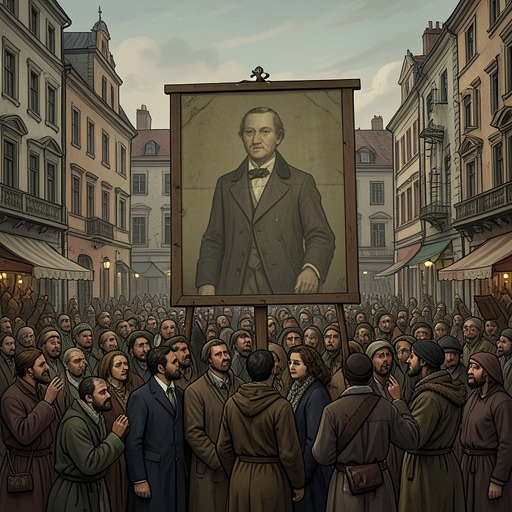
Political Conflict in Reconstruction-era Texas
News of the WorldPolitical Conflict in Reconstruction-era Texas is presented not as a distant contest among officeholders but as a force shaping local authority, public speech, and the safety of ordinary people. Through an empty county government, a newspaper reading that collapses into violence, and a printing business put at risk by legislation, the novel shows political power being contested in the spaces where people travel, gather, work, and exchange news.
Partisan Authority and the Institutional Vacuum
In Erath County, political allegiance becomes a test of who may enter and who may claim authority. One man declares that anyone who voted for Governor Davis will be kept out of the county. Asked whether this exclusion is an official decision, another explains that there is no local administration: the sheriff, justice of the peace, mayor, and commissioners have all been displaced. They had served in the Confederate Army or held public positions under the Confederacy; Governor Davis and the United States Army removed them, but no replacements have been sent. In the vacuum, local men have taken over the work of governing and insist that others answer to them. Their claim is not presented as a settled legal arrangement. It is power asserted in the absence of functioning civic institutions.
The scene makes political allegiance inseparable from the practical question of who controls the road and the county line. Exclusion from Erath County is framed as a response to a vote, while the removal of former officials is attributed to state and military authority. Neither action produces an orderly replacement government. Instead, authority fractures: an official structure has been dismantled, a new one has not arrived, and a self-appointed group fills the gap. The resulting tension is more than ideological disagreement; it determines who can move through the region and who is entitled to enforce a decision.
News, Print, and the Limits of Public Speech
Jefferson Kyle Kidd encounters the conflict through the systems that carry information. At Thurber’s News and Printing Establishment, the Chandler and Price press turns out announcements and advertising amid type cases and bindery equipment. The working print shop gives material form to the public circulation of words. Kidd also visits the Dallas Weekly Courier to receive news over the Associated Press wire, whose connection to Arkansas and points east is still operating. The telegraph is politically consequential: Comanche and Kiowa people know that United States Army orders travel over the wires, and they have learned to cut and reconnect them with horsehair so that a break will not be easy to locate. Communication infrastructure is therefore both a means of reporting news and a channel of military power, vulnerable to deliberate interruption.
Kidd’s own choices as a reader and presenter reveal the pressure exerted on public speech. In Durand, he selects comparatively soothing articles about floods along the Susquehanna and railroad bonds in Illinois, avoiding material on Hamilton, Governor Davis, Black suffrage in Texas, military occupation, and the Peace Policy. His restraint is practical: he hopes to earn money and leave town without being harmed. It does not mean that the political struggle has disappeared from the room. He is choosing what to read precisely because certain topics are dangerous. His newspaper readings offer distant reports and a shared occasion, but the local listeners bring their own conflicts to the gathering.
The Durand Mercantile Riot
The political fracture becomes physical at a reading in the Durand Mercantile. A United States Army soldier checks each man at the entrance for a handgun. Although carrying one is illegal, the sergeant allows those who have them to leave their weapons on a bench; by the time the room fills, seven or eight revolvers and a small two-shot pistol are there. Inside, people gather among imported goods, kerosene lamps, and glass cases, but they do not form a single audience. Kidd sees groups divided from one another, watching across the room with hostility. His opening remarks about road conditions briefly hold attention before political grievances intrude.
The argument turns to newspapers and party loyalty. One listener asks for the Houston Tri-Weekly Union; another objects that it is a paper supporting Governor Davis and accuses its supporters of being unreconstructed thieves. The response invokes Republican loyalty to the Union, and the dispute broadens into an argument about professional agitators. Soon a man warns that Governor Davis will close the Dallas Courier under the Printing Bill and divert two hundred thousand dollars in tax money to radical newspapers. Two men rise and confront one another over Hamilton and Governor Davis. Attempts to separate them draw more people into the altercation, while women leave the building and several retrieve their relatives’ handguns from the bench.
The United States Army sergeant hears the shouts about military rule, Austin corruption, and the Printing Bill but does not intervene. The quarrel then becomes a general fight: fists and chairs, a shattered glass case, a spilled coin can with money trampled underfoot, and a commemorative plate broken over a man’s head. The hotel owner and a schoolteacher fight their way into the street, followed by the others. The reading has not simply been interrupted by politics; the gathering itself has become an arena in which competing accounts of legitimacy, loyalty, and public spending are enacted through violence. The soldier’s presence controls weapons at the door but does not restore order once the crowd turns against itself.
Political Conflict and Private Consequences
For Kidd, the Printing Bill is not only a subject of debate. It threatens the work by which he earns a living. When he later speaks with the lawyer Branholme about adoption, the legal status of returned captives, and the bill, Branholme says that the measure might be rescinded in a few years, after Governor Davis is gone and the military no longer holds power. Only then might it be feasible to start the printing business again. The prediction offers a possibility, not a promise: Kidd’s livelihood depends on political changes whose timing he cannot control.
The same conversation places the status of returned captives beside the fate of the press. Branholme says that captives belong to their parents or guardians, even as Kidd’s questions about adoption and legal status signal that return does not end the difficulties surrounding them. The pairing exposes a broader consequence of political disorder: private responsibilities and relationships must be negotiated through institutions that have been displaced, contested, or made uncertain. Across Erath County, the telegraph lines, the Durand reading, and Kidd’s shuttered business, the novel depicts political conflict as a struggle over both authority and circulation—who may govern, whose account can be printed, and whether a message, a person, or a livelihood can pass safely through the state.