Postwar Economic Collapse and Shortages
News of the WorldPostwar Economic Collapse and Shortages are not merely background to the journey: they shape which roads can be traveled, what money can buy, how news moves, and who is left to provide protection. In the aftermath of the American Civil War, Jefferson Kyle Kidd has lost his deposits and business, food and clothing remain scarce, and damaged transport systems make travel uncertain. The novel presents hardship not as one isolated disaster but as a condition that presses upon private life, commerce, public authority, and the movement of people and information.
Lost Wealth and the Price of Survival
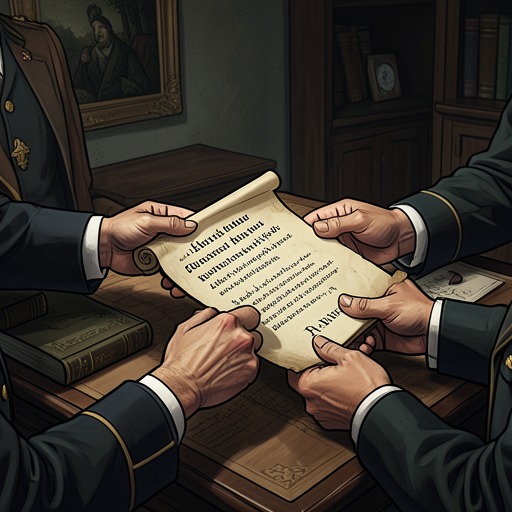
The collapse reaches Jefferson Kyle Kidd through specific losses. By 1866, his deposits and bank stocks are gone, and property taxes remain due. During the war, the San Antonio Commission for the Support of the Confederacy threatened him with jail unless he invested in Confederate bonds; the money went into those bonds, and he eventually sold his printing business to pay his debts. With his wife Maria Luisa dead the year before, he took to the road. At nearly seventy-two, his remaining assets are sharply reduced: a gold hunting watch, Pasha, and his reading voice. The contrast between his former business and his precarious life as a traveling reader gives the economic crisis a personal chronology, measured in lost savings, a closed shop, and work that must be carried from town to town.
Cash itself has become scarce. In North Texas, people count nickels and dimes and welcome hard money; both cash and news are difficult to obtain, especially near the Red River and the edge of Indian Territory. A Spanish eight-escudo coin, minted in twenty-two-karat gold and still retaining its milled edge, stands out as a substantial sum in this setting. It is the fifty-dollar payment sent by Johanna’s relatives through an agent to secure her return to Castroville. The coin’s material weight makes visible an economy in which ordinary money is hard to come by and a single payment must travel through intermediaries to accomplish an urgent task.
Damaged Routes and Material Shortages
The shortage of resources is joined to a damaged transportation network. Kidd imagines the difficulty his daughters and their family would face traveling back to Texas: many Southern bridges were blown up or burned during the war, railroads and rolling stock were shelled to pieces, and there was no public money to rebuild them. Food and clothing were still scarce. Travel would require Union Army passes, two wagons, and provisions purchased along roads where highwaymen might be waiting; even the Mississippi crossing at Vicksburg depended on whether a ferry was operating. The imagined journey makes clear that distance alone is not the obstacle. Travel depends on bridges, railcars, ferries, permission, money, and supplies, and the failure of any one link could strand a family.
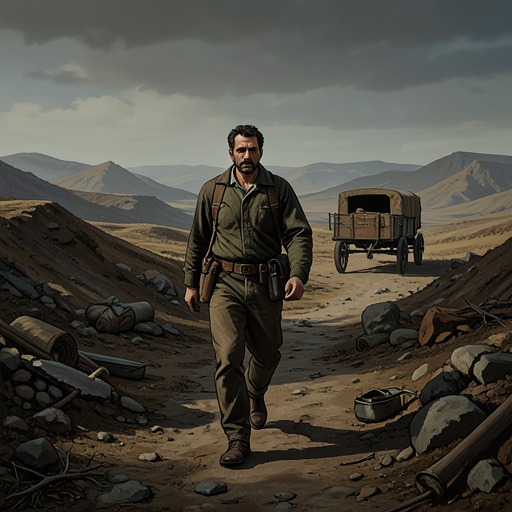
Kidd and Johanna encounter the same fragility on their own route. They cross the upper Little Wichita near its junction with the Red River at a run, and the flood briefly carries their wagon before the mare finds bottom. The crossing leaves the iron tire of a front wheel broken, a defect they cannot repair on the road. Later, at the Brazos ferry, they find no ferry at all. They must cross without it, releasing Pasha and driving the wagon and Fancy through the current. On the far bank, the crossing has also changed their route: they reach the Lampasas Road and will miss Meridian. These episodes show how travel is improvised around water, damaged equipment, and missing services rather than supported by dependable public infrastructure.
News, Printing, and Interrupted Connections
The same material uncertainty affects communication. In Dallas, Kidd finds a working hand-fed press at Thurber’s News and Printing Establishment, where announcements and advertising are being produced. He also pays to receive news from the Associated Press wire at the Dallas Weekly Courier offices. The wire from Arkansas and points east is still operating, but it is vulnerable: Comanche people and Kiowa have learned to cut it and reconnect it with horsehair so that it will no longer transmit without making the break easy to detect. Because Army orders travel by telegraph, this technical knowledge can interrupt both news and military communication. Printing and telegraphy offer ways to circulate information, but neither forms an invulnerable network; each depends on equipment, labor, and access that conflict or scarcity can disrupt.
Kidd’s own livelihood depends on these surviving channels. He gathers newspapers, translates articles from El Clarion, and prepares notices and handbills for public readings. In this way, the shortages that have weakened his former business also make his voice a portable means of earning money and distributing news. The town press and the road are linked: information must be gathered, printed or copied, carried, and presented to an audience before it can sustain him.
Exchange, Improvisation, and Local Power
Under these conditions, objects do not retain a single economic use. The gold coin pays for Johanna’s return, while the story of her transfer also records an exchange in which the Kiowa bring her to the agent and receive fifteen Hudson’s Bay blankets and silver dinnerware. The dinnerware is valued not only as tableware: it can be beaten into bracelets. The episode places the market exchange of goods beside a human life treated as something transferable, showing how material value and obligation can coexist uneasily.
Later, during the attack near the Brazos, Johanna holds out a shotgun shell loaded with dimes. Kidd recognizes that the coins and powder can make the shotgun function like a small cannon, giving them a chance to escape. Money has become ammunition: a sign of the region’s cash economy is repurposed as a tool of immediate survival. Johanna’s field expedience matters because the pair cannot rely on abundant supplies or external rescue; they must turn what they carry into what the situation requires.
Economic hardship also overlaps with the absence of stable local government. In Erath County, a man explains that there is no sheriff, justice of the peace, mayor, or county commission: officials associated with the Confederacy have been removed, and no replacements have arrived. A group claims authority in the resulting vacuum. The scene does not make economic scarcity the sole cause of political disorder, but it places both within a weakened public order in which residents cannot count on ordinary institutions to provide services or protection.
A Society in Flux
The novel’s account of hardship is uneven and unsettled rather than uniform. Britt Johnson describes free Black men in North and West Texas working as freighters and scouts, and serving after the war in the all-Black Tenth U.S. Cavalry. Yet the wider population has not settled its views about free Black people. His description of the situation as being in flux connects social uncertainty to a broader landscape where old arrangements have been broken and new ones remain contested.
Across the journey, economic collapse appears in practical tests: a family’s ability to travel, a reader’s ability to earn, a telegraph’s ability to transmit, a county’s ability to govern, and a traveler’s ability to cross a flooded river. The novel does not reduce these pressures to a single lack of money. Cash scarcity, shortages of food and clothing, broken transport, interrupted communication, and institutional gaps reinforce one another. Against them, characters rely on portable skills, improvised routes, valuable objects, and exchanges whose meaning changes with circumstance.