Reconstruction-era political disorder in Texas
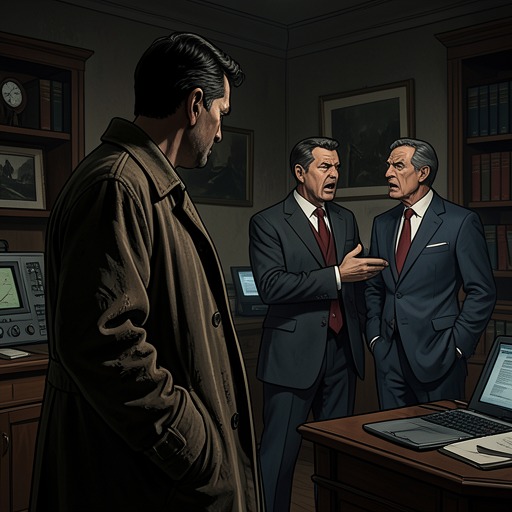
News of the WorldReconstruction-era political disorder in Texas is presented not as a single revolt but as a breakdown of dependable civil authority. Military rule, factional Republican politics, and vacant county offices leave people uncertain about who governs and who can protect them. Along the roads, that institutional confusion meets armed local power and the continuing danger of raids; the journey of Captain Kidd and Johanna makes the consequences tangible.
Military Rule and State Politics
At a newspaper reading in the Broadway, two United States Army soldiers stand at the front doors, as they do at public meetings, because Texas remains under military rule. The scene makes federal authority visible inside an ordinary gathering. The Captain considers that the arrangement might end if Washington seats the Texas delegation, but does not treat the prospect as a simple return to stable government.
The recent gubernatorial contest, as he describes it, is no longer a struggle between the old Southern Democrats and Union-loyal Republicans: the old Southern Democratic party is finished in Texas, and the contest is between two Republican factions. One, led by Governor Davis, presses for dictatorial powers; the faction led by Hamilton is less extreme. The Captain judges both factions to be robbing the state. His account links this political conflict to practical paralysis: anyone seeking help with land titles has little reason to appeal to a congressman, and resolving the Betancort land title could consume Elizabeth’s time for years.
The reading itself shows how that conflict intrudes on public life. The Captain brings news from abroad and elsewhere in the United States, including a storm in London, cattle-packing plants in Chicago, Irish arrivals in New York, and a Nebraska railroad. He deliberately offers subjects distant from Texas politics. When a listener challenges him for not reading Governor Davis’s state journal, he folds the newspapers and explains that political discussion could become a fistfight or a shooting. He points to the soldiers beyond the door, then closes his portfolio and asks the audience to argue on its own time. The soldiers are both a sign of imposed order and a reminder that ordinary debate has become perilous.
Vacant County Authority
The disorder takes a sharper local form near Durand, in Erath County. An armed group meets the Captain’s wagon; its riders are raggedly dressed but equipped with revolvers and new Spencer repeating carbines. The Captain wonders whether they have heard of the Great Brazos Ten-Cent Shoot-Out, but the encounter soon reveals a broader contest over power: the group claims that there is no functioning local administration.
The black-bearded rider says there is no sheriff, justice of the peace, mayor, or county commission. In his account, Governor Davis’s men removed the previous officeholders and the United States Army also expelled them; the displaced officials had served in the Confederate Army or as public servants under the Confederacy. No replacements have been sent. The riders say they have taken on the work themselves and hold the travelers accountable to them. Their claim is not presented as a lawful restoration of government: it exposes a vacuum in which an armed group can assert authority because established offices are absent. The Captain’s question about whether this is an official local decision underscores the gap between formal administration and the power exercised on the road.
Authority on the Roads
The political vacuum matters because travel crosses areas where different institutions and armed forces may appear, without a clear guarantee of protection. Earlier, Britt Johnson explains that Johanna’s parents and little sister were killed in a raid. Her relatives, Wilhelm and Anna Leonberger, have arranged for her return to Castroville, sending a fifty-dollar gold piece through an agent and a major from San Antonio. Britt has undertaken to bring her out of Indian Territory and across the Red River; the crossing has been difficult and the water has risen since the previous day. A family mission thus depends on intermediaries and a hazardous route rather than on any plainly effective public system.
On another stretch of road, a company of roughly ten United States Army mounted infantry appears. Captain Kidd checks his revolver, hides it beneath bacon, and remembers that its cartridges are concealed in a flour keg. He gets Johanna into the wagon bed, signals that he is her friend, and covers her with the wool blanket when she grows frightened at the sight of the soldiers. The passage establishes the soldiers’ presence but does not resolve what their appearance means for the pair; its force lies in the contrast between their organized arrival and the travelers’ immediate need to conceal themselves and prepare.
Raids and the Limits of Protection
The account of Comanche movement extends the geography of insecurity beyond the county dispute. Comanche people usually come from the north, down from the Red River and across the open, arid country around Lampasas. Dust makes their approach visible for miles, so they skirt towns and forts. Farther south, the hill country offers concealment, water, and isolated farms, while the narrative emphasizes the absence of soldiers there to stop them. In this setting, danger is tied to landscape as well as politics: distance from towns and forts can also mean distance from protection.
Captain Kidd responds by preparing to abandon the Curative Waters wagon if raiders appear. He rides Pasha, equips the packhorse with a blanket saddle pad, and keeps a butcher knife and revolver at hand. His plan is to cut the packhorse free, put Johanna on it, and flee, accepting that the wagon may be looted. From high points he stops for fifteen or twenty minutes to watch and listen for signs of riders, even reading the buzzards’ circling and sudden dives for indications of death or disturbance. These precautions do not restore public authority; they show how travelers must substitute vigilance and private means for reliable protection. Across the public meeting, the empty offices, and the exposed roads, political disorder is measured by what people can no longer safely assume: that debate will remain peaceful, that county government exists, or that help will be present when danger comes.