Texas
News of the WorldTexas is both the setting and an active pressure in Jefferson Kyle Kidd’s journey: a vast, unevenly governed state where roads connect distant communities but do not guarantee safety, and where the end of the Civil War has left political authority and social order in dispute. From Wichita Falls in the north to San Antonio in the south, the changing landscape determines who can travel, whom they must trust, and what it means to bring a child home.
A state in transition
The story opens in Wichita Falls in the winter of 1870. Jefferson Kyle Kidd, born in 1798, travels from town to town reading newspapers and journals. He had once been a printer, but the war took his press, and the Confederate economy had already collapsed before the surrender. Now he carries papers in a waterproof portfolio, turns up his coat collar against the weather, and makes a living by bringing distant news to North Texas. He arrives in Wichita Falls on February 26, hangs posters, and prepares to read through hard rain. Texas enters the narrative as a place where even public information depends on a precarious circuit of roads, weather, and a traveling reader.
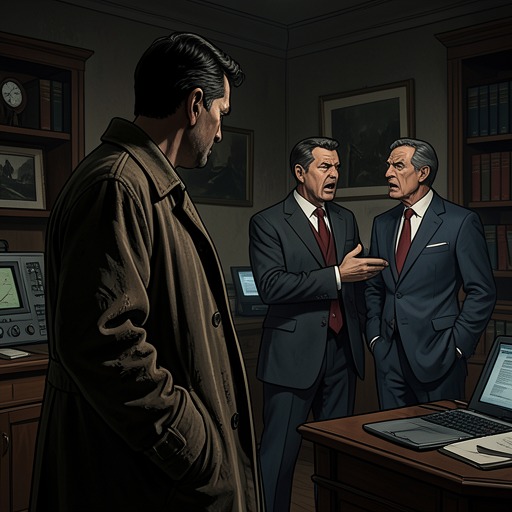
The journey also unfolds amid the political uncertainty of Reconstruction. At a reading in the Broadway, military men stand at the doors because Texas remains under military rule. The state’s recent gubernatorial contest has divided Republicans into rival factions: the faction led by Governor Davis seeks dictatorial powers, while the faction led by Hamilton is less extreme. Jefferson Kyle Kidd judges both to be robbing the state. The disorder reaches beyond elections. Disputed land titles cannot readily be resolved when officials are occupied with their own interests, leaving families to face years of work to reclaim their property.
Roads, rivers, and the return journey
Texas’s geography gives the escort its scale and its hazards. From Wichita Falls, Jefferson Kyle Kidd and Johanna Leonberger set out toward Spanish Fort, then south to Dallas and onward toward San Antonio, about four hundred miles farther down in the brush country. The route passes through the Cross Timbers and across the Red River, whose rising water has nearly drowned the travelers. Britt Johnson, who has undertaken to get Johanna out of Indian Territory and across the river, explains that her parents and little sister were killed in the raid in which she was taken. Her relatives, Wilhelm and Anna Leonberger, have sent a fifty-dollar gold piece to pay for her return to Castroville. The river crossing is therefore more than a geographic threshold: it brings Johanna out of one jurisdiction and sets her toward relatives she scarcely remembers.
The roads do not make the state secure. A mounted United States Army company appears on the road, and Jefferson Kyle Kidd hides Johanna beneath her wool blanket before speaking with the soldiers. He argues that he carries no handgun, while his shotgun and provisions remain under their scrutiny. The encounter exposes the limits of institutional protection: Britt says the Army no longer takes charge of captives. Later, in Erath County, Jefferson Kyle Kidd finds an even more direct vacuum of authority. A local faction tells him there is no sheriff, justice of the peace, mayor, or county commission; officials have been removed, and no replacements sent. The men who have taken on local power declare that travelers answer to them. In Texas, the question of who governs can change from one stretch of road to the next.
Frontier violence and vulnerable passage
Further south, the country changes again. The travelers leave the more open northern country for the Texas Hill Country, where valleys and ridges offer concealment, water, and isolated farms. Jefferson Kyle Kidd understands the danger: Comanche raiders come south from the Red River across the arid country around Lampasas, then favor the hill country for its cover, water, and opportunities to raid without soldiers nearby. He plans how to abandon the wagon if necessary, preparing a packhorse so Johanna can escape with him. From rises beside the road, he stops to watch and listen for signs of riders, reading the landscape for threats before they come into view.
The state’s dangers are not confined to raiding parties. At Carlyle Springs, Jefferson Kyle Kidd remains awake through the night while the Horrell brothers are reportedly drunk in town. The Merritt brothers keep watch in turns, guarding him and Johanna; he sits by a wagon wheel with his revolver in hand and leaves before daylight. Such episodes make travel a repeated negotiation with local violence, not a straight passage between named towns. Each stop can offer a little shelter, but neither a road nor a settlement ensures that authority will protect those passing through.
Towns, public life, and changing fortunes
The towns along the route offer contrasting forms of community. At the Broadway reading, Jefferson Kyle Kidd uses a lantern, a newspaper, and a patient audience to bring reports from abroad into a local gathering. The crowd listens to accounts of a census in India, a windstorm in London, cattle packing in Chicago, and Irish arrivals in New York. Men considering a cattle drive to Missouri attend closely to news that might matter to their own plans. In this setting, Texas is not isolated from the wider world; its residents encounter that world through a public performance shaped by the needs and interests of a local audience.
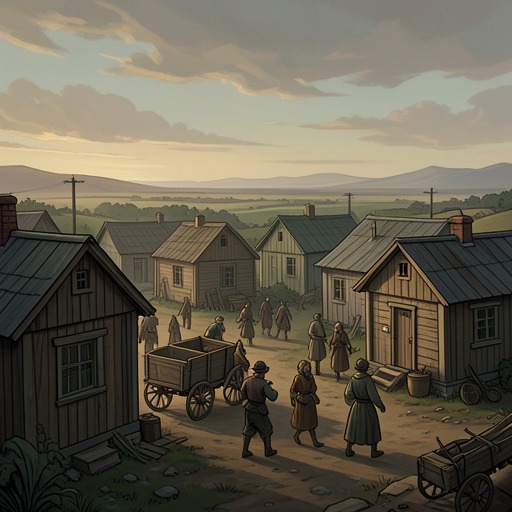
Castroville, at the end of the southbound journey, appears markedly different from the exposed roads. Its stone houses have steep roofs, galleries, and long windows; cactus and mesquite in the yards distinguish the town from the European villages its buildings recall. People live in the village and go out to work in their fields. An inn and gristmill stand by the Medina River among wild pecan trees, while a seminary and the large Huth Seed Company warehouse mark other features of town life. By the time the wagon reaches Castroville, the weather has warmed enough for Jefferson Kyle Kidd to shed his canvas coat, and the horses have survived the journey in good condition.
The state as a continuing journey
The return from San Antonio turns Texas back into a corridor of movement. Jefferson Kyle Kidd and Johanna travel north through San Antonio, Wichita Falls, Bowie, and Fort Belknap, sometimes with freight wagons or the Army. They continue to collect dimes for readings and to evade trouble while the state remains volatile. Their route crosses a Texas in which news, transport, and personal security depend on improvised arrangements rather than stable institutions.
The end of the road does not mean that Texas has stopped changing. After Colonel Ranald Mackenzie drives the last Comanche and Kiowa holdouts into Palo Duro Canyon, the Indian Wars come to an end. Meanwhile, San Antonio grows, and many of its old Spanish houses are torn down as people lose their lands. Jefferson Kyle Kidd eventually leaves the roads and settles there with Johanna, his daughter Elizabeth, and her family. The state that first appears as a sequence of uncertain crossings becomes the place where the travelers must face the consequences of arrival: Johanna remains inwardly Kiowa despite her return, while the city around them continues to alter. Texas thus binds together movement and dispossession, the promise of homecoming and the difficulty of belonging.