Texas Hill Country
News of the WorldThe Texas Hill Country gives the southbound journey of Jefferson Kyle Kidd and Johanna Leonberger a double character: it is a vivid spring landscape of granite, flowers, and running water, and a vulnerable frontier where the same terrain can shelter raiders and expose isolated families. Its beauty does not erase the violence embedded in its roads and abandoned homes; the country makes both visible at once.
Terrain and Exposure
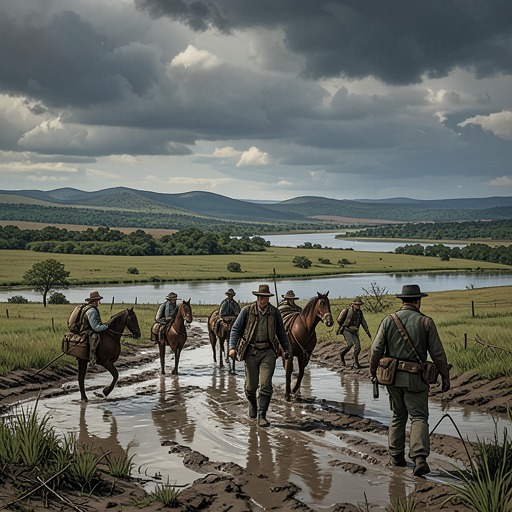
The travelers reach the hill country after crossing the open, arid country around Lampasas. Ahead lie deep canyons and high bluffs, with clear streams cutting through layers of limestone. The changes in elevation and cover alter the risks of travel. Ravines, water, and scattered farms offer places for raiding parties to approach unseen, unlike the more open country farther north. Jefferson Kyle Kidd recognizes that the landscape may conceal danger, but presses on, treating each new stretch as a risk to be met when it comes.
The Comanche people are associated with movement down from the north, from the Red River across the dry country around Lampasas. Dust raised in the open can be seen for miles, so raiders skirt towns and forts; farther south, the Hill Country’s water, cover, and isolated farms draw them in. The terrain thus shapes both military visibility and the possibilities of attack. Towns and forts do not form an unbroken protective boundary: beyond them, farms remain exposed in a landscape that can sustain a journey and conceal an assault.
The Southbound Route
As the travelers enter the region, the world seems to fall away beneath the wheels of the Curative Waters wagon: valleys and ridges recede toward a blue horizon. Jefferson Kyle Kidd repeatedly stops on rises, keeping the wagon from being silhouetted against the skyline while he looks and listens for signs of riders. He watches the trees below for movement and scans the circling buzzards for evidence of a carcass. Johanna Leonberger watches with him. The vigilance changes the pace of travel; distance is gained through pauses as well as forward motion.
The route passes through the red granite country north of Llano, where mountains of red and pink stone overlook valleys in bloom. Mexican hat flowers, gayfeather, and bluebonnets spread through the grass. The season offers fresh growth for horses and deer, and at night a ringtail cat approaches the campsite to take a kernel of spilled corn. Johanna whispers to it in Kiowa, her delight audible in the inflections of a language the surrounding English-speaking world does not share. The scene places living, intimate detail beside the journey’s constant awareness of danger without suggesting that the danger has passed.
Ruined Homes and Vulnerable Towns
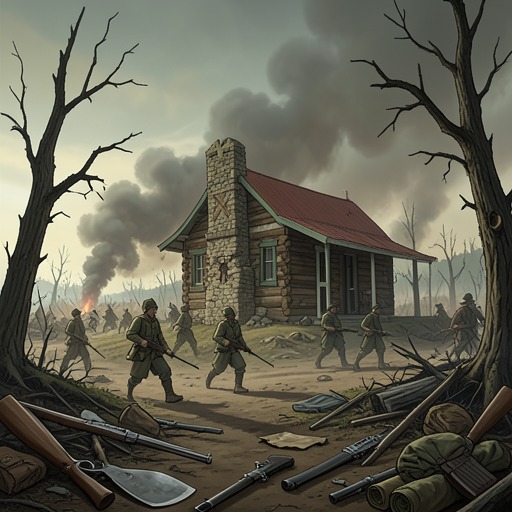
The route’s abandoned farms and cabins make the consequences of violence tangible. At one destroyed cabin, Jefferson Kyle Kidd finds broken cups, torn dress material caught on a nail, and a headless doll’s body. He removes a .50-caliber bullet from the wall with his knife and leaves it on the windowsill as a memento. The objects suggest ordinary domestic life interrupted, while the bullet gives the ruin a specific trace of violence. The cabin is not merely a shelter left behind; its remains direct attention to the people whose daily habits and attachments once made it a home.
Farther along, Fredericksburg appears as a small, predominantly German town, uneasy and poorly prepared to defend itself. Its broad main street could allow warriors to ride directly through the center and fire in both directions. When Jefferson Kyle Kidd and Johanna Leonberger arrive, townspeople gather around the green wagon after learning their names. They have heard that Johanna was redeemed with German coin silver, and their curiosity quickly becomes suspicion: they repeat beliefs that returned captives are strange, dislike white people, and must have taken some secret drug. The encounter shows how a place’s exposure to violence can coexist with the community’s inability to understand the people who survive it.
A Landscape of Political and Human Rupture
The instability surrounding the journey is not only geographical. In Erath County, a self-appointed group explains that there is no local administration: Davis’s men removed the sheriff and other officials, and no replacements were sent. The group has taken up the work of governing and claims authority over those who pass through. This episode belongs to the broader unsettled corridor of the journey rather than establishing that every part of the Hill Country is governed in the same way. It nevertheless sharpens the region’s defining condition: formal protection is discontinuous, while armed groups and local claimants can impose their own rules.
The Hill Country’s recurring contrasts give it significance beyond scenery. Water and concealment sustain both travelers and raiders; spring growth surrounds the evidence of burned homes; the beauty of the granite valleys coexists with the vulnerability of isolated farms and the suspicion directed at returned captives. For Jefferson Kyle Kidd and Johanna Leonberger, the region is a passage south toward Castroville, but the journey through it also exposes what that passage cannot repair: the physical destruction of households and the social distance that remains after a captive has been brought home.