Texas Rangers
News of the WorldThe Texas Rangers are presented as a daring and capable mounted force whose reputation emerges through two connected roles: their participation in the Mexican War and their work carrying military messages. In Jefferson Kyle Kidd’s recollections, they are both riders in the communications network of Zachary Taylor’s forces and young soldiers listening to an older man’s account of combat. The contrast makes them more than a passing military detail: their speed and confidence belong to the battlefield, while their attention to Kidd brings questions of experience, danger, and mutual responsibility into the scene.
Wartime Service and Reputation
During the Mexican War, Kidd was assigned to organize communications for Taylor’s forces. He wrote up the orders of the day on a small hand press, and Captain Walker of the Texas Rangers and his horsemen carried messages between Port Isabel on the Gulf and the Army encampment north of Matamoros, on the Rio Grande. The episode places the Rangers within a practical chain of military communication: orders had to be printed, conveyed, and carried across distance by riders.
The novel does not describe the Rangers’ internal organization or define their full institutional responsibilities. It does, however, make their mounted mobility concrete. Walker’s horsemen gallop with messages between separated military positions, connecting the printed work of Kidd’s press to the movement of Taylor’s forces. Their service is thus shown not only as fighting but as helping information travel where it was needed.
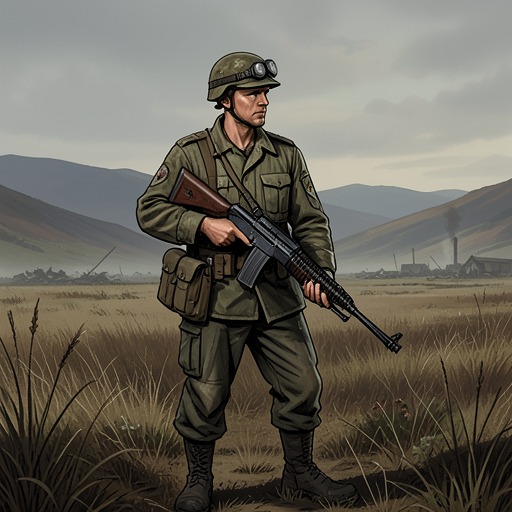
At the Battle of Buena Vista, the Rangers’ combat reputation is rendered through the reactions of their Mexican opponents. They are described as cool, young, reckless, and apparently fearless. The Mexicans hate them and call them rinches; at the same time, the narrative observes that the Mexicans would have fielded an independent cavalry wing as skilled and lethal if they could. The Rangers’ standing rests here on an adversary’s recognition of their effectiveness as well as on their own boldness.
The Rangers as Listeners
At Buena Vista, the Rangers lounge against the caissons and listen to Kidd. They are young men, but they attend to him out of courtesy as an older veteran. Their questions arise from comparison: they want to know about the Battle of Horseshoe Bend and to measure their own conduct against that of an earlier generation. They wonder whether what they endure is as difficult and whether their enemies are as cunning and brave. Their attention turns a battlefield pause into an exchange between lived experience and the standards by which soldiers judge themselves.
Kidd answers selectively, telling them about the Muscogee and Choctaw forces, the rifles his Georgia militia company brought, and the march toward Pensacola, where the wagons sank hub-deep in sand. He recounts that his captain was killed on the second day of the battle, and that he crawled out and dragged the man back under cover before he died. He also describes Andrew Jackson as fearless and almost maniacal in combat. The Rangers listen in the cold night beneath the stars, waiting through the pauses as Kidd gives them the account he is willing to tell.
Their interest makes the story of Kidd’s wound a question left hanging before it is spoken. He says he was shot in the hip without realizing it at the time; the wound missed the bone, and he thinks a spoon fired from a smoothbore may have struck him. The detail breaks any clean distinction between a soldier’s experience and the uncertainty of battle: even the person hit may not know what happened or when. The Rangers wait silently as he speaks, their youthful faces seeming strangely aged in the firelight.
Advice, Duty, and the Limits of the Portrait
The Rangers want wisdom, and Kidd’s answer is practical rather than grand. A person can be hit without knowing it, he tells them, and the man beside him can be hit too; they should take care of one another. The counsel grows directly out of his remembered wound and his effort to rescue his dying captain. In the scene, military courage is not separated from attention to another person’s vulnerability. The Rangers’ silence and nods show them receiving that lesson, though the novel does not report what any one of them later does with it.
The novel’s portrayal remains concentrated in these particular episodes. It identifies the Rangers as messengers in Taylor’s wartime communications and as audacious cavalrymen at Buena Vista, but supplies no account of their formal structure or later development. Nor should they be confused with every armed group encountered elsewhere in Kidd’s travels: the mounted infantry he later sees on the road are United States Army troops, while Almay’s companions are Caddo people. Within the evidence the novel provides, the Rangers’ distinctive significance lies in the pairing of mobility and nerve with a scene of listening. They carry orders across distance, then sit still long enough to hear what an older soldier has learned about surviving alongside others.