The Institutional Vacuum in Reconstruction-era Texas
News of the WorldThe Institutional Vacuum in Reconstruction-era Texas is the condition in which military rule and contested state power coexist with absent or displaced local government. In the novel, authority has not simply vanished: soldiers enforce requirements, political factions struggle over the state, and armed men claim jurisdiction for themselves. The result is a landscape where a traveler may face official scrutiny on one road and an improvised local regime on the next, with neither setting offering a dependable civilian system of law.
Military Authority and Uneven Law
At one point, Jefferson Kyle Kidd encounters a United States Army patrol while transporting Johanna Leonberger. The soldiers question him about certified proof of a loyalty oath, explaining that someone who voluntarily aided the Confederate Army would need to produce it while conducting official business. Kidd denies having aided the Confederacy. The exchange shows a government able to demand documentation and investigate a traveler, even as the ordinary protections and procedures of local administration are uncertain.
The patrol also examines the wagon’s contents. When asked whether he carries a rifle or handgun, Kidd answers that he does not, making a sardonic remark about the danger of encountering Comanches. His evasive humor sits against a serious political circumstance: the narrative describes a law against carrying handguns as mindless, especially on the frontier, and characterizes the Reconstruction government in Texas as corrupt. The law is present, but its perceived legitimacy and practical fit are in question. Johanna listens as Kidd’s voice sharpens; she recognizes that he is insulting the soldiers, and her eyes brighten. Political tension is not merely background to the inspection but something the two travelers experience together.
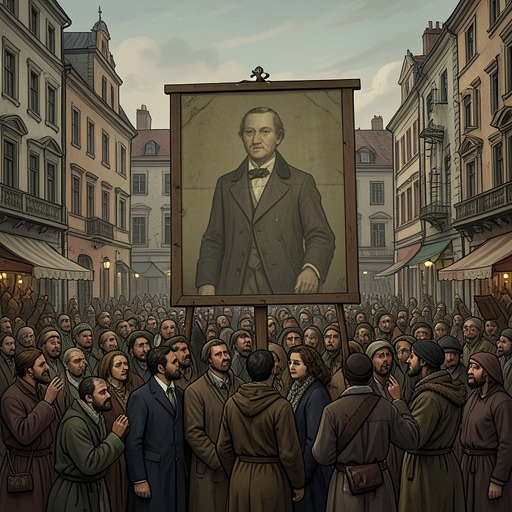
The Army’s presence is also visible in public life. At a newspaper reading in the Broadway, two Army men stand at the front doors, as they do at public meetings, because Texas remains under military rule. The soldiers’ presence marks the gathering as an event taking place under occupation and constraint, even while the crowd assembles for a customary reading and contributes coins at the entrance.
Political Conflict and Public Speech
Military rule is tied to an unresolved struggle over who will govern Texas. The narrator suggests that it might end within months if Washington seats the Texas delegation, but the recent gubernatorial contest has not been a straightforward contest between the old Southern Democratic Party and Union-loyal Republicans. The old Democratic party is described as finished in Texas; the fight is between factions within the Republican Party. One faction, led by Governor Davis, demands dictatorial powers more aggressively than the faction led by Hamilton. Both are accused of robbing the state, and the political disorder obstructs ordinary work such as clearing land titles. The Betancort title, for example, is expected to consume Elizabeth’s time for years.
This conflict enters Jefferson Kyle Kidd’s newspaper reading when a member of the audience challenges him for not reading Governor Davis’s state journal. Kidd folds his newspapers rather than treating the challenge as a request for ordinary coverage. He explains that a discussion of Texas politics could quickly turn into a fistfight or shooting: people, in his judgment, have lost the ability to debate political events reasonably, and force has displaced argument. He points to the soldiers beyond the door as evidence of the conditions surrounding the meeting. Then he distinguishes his work from partisan advocacy: he gathers news from distant places, while listeners can consult the Austin paper and the Herald for themselves. His boundary is practical as well as professional. He refuses to let local political antagonism take over the reading, and the audience responds with approving calls.
The selection of distant news gives that refusal a concrete form. Kidd reads about a British census and a rebellion against its enumeration, a windstorm in London, Chicago packing plants seeking cattle, Irish arrivals in New York, a railroad entering Nebraska, and an eruption of Popocatépetl near Mexico City. The range of subjects transports the listeners beyond Texas for a time. Against a state where local political talk threatens violence, the reading offers a shared public occasion organized around events elsewhere.
Local Government Replaced by Armed Claimants
The vacuum becomes explicit on the road into Durand. A group of well-armed men rides toward Kidd’s wagon. They wear ragged clothes and shabby hats, but have spent their money on revolvers and new repeating carbines. Kidd wonders whether they have heard of the Great Brazos River Ten-Cent Shoot-Out, and considers the broader condition anarchy: in Texas in 1870, every man does what seems right in his own eyes.
One rider approaches the wagon and studies Kidd, his cut, the blood on his shirt, and the mud on the wheels. Johanna has sunk behind the dashboard, where her face and fingers remain visible. The rider notices the gold lettering on the wagon, which identifies it as the Curative Waters wagon, before the group’s political purpose becomes clear. Another man declares that anyone who voted for Davis will not be allowed into Erath County. Kidd asks whether this is an official decision by the local administration. The black-bearded rider answers that there is no local administration, sheriff, justice of the peace, mayor, or county commissioner. Davis’s men have removed the previous officials; Davis and the Army have thrown them out. Yet no replacements have been sent. The armed men say they have taken on the job and that Kidd is accountable to them.
Their claim is not simply a rejection of government. They invoke the absence of a recognized local administration to justify an alternative authority, then enforce a political test based on support for Davis. In the same encounter, institutional vacancy and coercive power reinforce one another: the lack of a sheriff or commissioners does not make the road neutral but leaves room for armed men to impose their own rules. Kidd asks what the cost will be, while Johanna listens intently. The scene makes the traveler’s exposure immediate: the right to pass through the county is being treated as something the riders can grant or deny.
A Dangerous Geography
The journey also crosses jurisdictions and landscapes in which different kinds of authority and danger overlap. Kidd has undertaken to get Johanna out of Indian Territory and across the Red River, after an Indian agent received a fifty-dollar gold piece from her relatives for her return to Castroville, Texas. The agent’s involvement and the family’s payment establish an official effort to arrange her transportation, but the crossing itself is dangerous: the water has risen, and the travelers have nearly drowned. Administrative responsibility exists alongside the physical uncertainty of moving a child through contested territory.
Farther south, the landscape offers neither reliable protection nor a stable state presence. The Comanches generally come from the north, down from the Red River and across the open country around Lampasas, where dust clouds can be seen for miles. They may skirt towns and forts, but in the hill country they find concealment, water, and isolated farms; the narrative emphasizes that there are no soldiers there to stop them. Kidd responds by preparing an escape plan: he rides Pasha, equips a packhorse with a blanket pad, carries a butcher knife and revolver, and considers abandoning the wagon if raiders appear. He watches from rises, listens for signs of riders, and studies the buzzards for evidence of a body or disturbance.
The institutional vacuum is therefore more than a dispute over offices. It shapes what a loyalty paper can mean at an Army checkpoint, whether political speech can proceed without threat, who claims the authority to control a county road, and how a traveler assesses danger beyond the reach of forts and soldiers. Across these scenes, authority remains forceful but fragmented: the Army can demand proof, state factions can displace officials, and local armed men can announce themselves as the replacement. The consequences fall on people moving through the state, for whom protection depends less on a consistent public order than on reading each encounter and preparing for what might follow.