Wichita Falls, Texas
News of the WorldWichita Falls, Texas, is the opening town of the novel’s winter 1870 journey: a place where Captain Kidd earns a living reading the news aloud, and where Britt Johnson brings him a problem that redirects his travels. On February 26, Kidd arrives with newspapers and journals, prepares for a reading during hard rain, and encounters a ten-year-old girl who has already tried to escape the wagon carrying her. The town’s public gathering place becomes the threshold between Kidd’s solitary routine and his undertaking to escort Johanna Leonberger south.
A Town on Kidd’s Reading Circuit
Kidd travels alone through North Texas, carrying his newspapers and journals in a waterproof portfolio and stopping in towns to read the day’s news to an audience. In Wichita Falls, he lays out the Boston Morning Journal and begins with an article about the Fifteenth Amendment. His work has a practical economy: listeners pay a dime, and the coins ring into a paint can. The arrangement makes the reading a public service and a livelihood, sustained by the assembled crowd and by the occasional intervention of someone who catches a listener trying not to pay.
The gathering takes place in a broad, open hall used for wool storage and community meetings. Its lantern light is harsh, and the air is dark; outside, rain makes enough noise to compete with the reading. The crowd is almost entirely men and almost entirely white. At the back stand Britt Johnson, Paint Crawford, and Dennis Cureton, free Black men who work together as a freighting party: Britt is a freighter, while Paint and Dennis are his driving crew. Their presence situates Kidd’s reading among the people and businesses moving through the town, even as the racial composition of the audience makes their position in the room conspicuous.
The Reading and Its Interruption
Kidd’s program ranges from political news to reports of distant events. A New-York Tribune item reports that the polar exploration ship Hansa has been crushed and sunk in pack ice off Greenland, without saying whether anyone survived. Kidd later finishes with an article from the Philadelphia Inquirer about the physicist James Maxwell’s theories of electromagnetic disturbances in the ether. He chooses the scientific item to bore and calm the audience, hoping people will leave quietly. The reading thus serves not only to transmit information but also to manage a room in which he has become impatient with trouble and with other people’s emotions.
After the reading, Kidd folds his papers, extinguishes the bull’s-eye lantern, and makes his way through listeners who shake his hand and ask after his grown children. He answers that they are tolerable, then returns to Britt, whose raised forefinger had caught his attention during the program. Kidd expects the request to concern the Fifteenth Amendment; instead, Britt asks him to come to the wagon because there is a problem there. The shift from public news to an immediate human predicament turns the town’s meeting into the story’s first decisive change of direction.
The Girl in the Wagon
Britt’s wagon is backed beneath the roof of the livery stable’s fairway, though the front half and driver’s seat remain exposed to the rain. Under shelter, a girl sits on a bale of Army shirts, wrapped in a thick blanket and dressed in a deerskin shift decorated with four rows of elk teeth. Her hair is maple-sugar colored; two down puffs and a golden-eagle wing-feather are bound into it, and she wears glass beads. Her blue eyes move to follow every gesture, while her head stays still. The people around her regard her as something strange, difficult to classify, and potentially dangerous; her composed posture and lack of expression intensify their sense of distance from her.
Britt explains that she has jumped from the wagon twice on the journey between Fort Sill and Wichita Falls. Agent Hammond’s information identifies her as Johanna Leonberger, captured at age six four years earlier near Castroville, close to San Antonio. Kidd recognizes the location. The identification gives the child in the wagon a history and a destination: she is not simply an unknown captive, but a girl taken from a family near the route south.
Departure and Narrative Significance
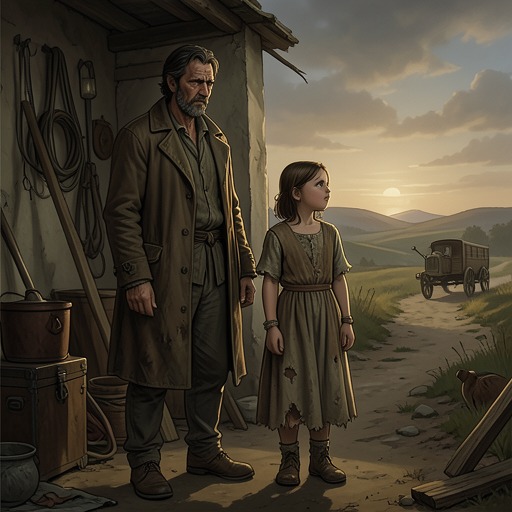
When Kidd and Johanna leave, people watching from doorways see an old man traveling with a ten-year-old girl whose new dress is splashed with Red River mud and whose hems are coated in iron-red mire. Some observers shake their heads; others watch with more covert interest and greed. Among them is the pale-haired man with a blue-patterned neckerchief, accompanied by two members of the Caddo people. The departure therefore does not leave the town’s dangers behind: the looks fixed on the pair suggest that their passage has been noticed by people whose intentions are not reassuring.
Britt and his two wagons head south along Childress Street toward the lower Little Wichita, while Kidd and Johanna set out east toward Spanish Fort. Their projected route continues through the Cross Timbers, then south by way of Dallas and onward toward the country around San Antonio, roughly four hundred miles farther on. Wichita Falls marks the point where Kidd’s familiar circuit of readings becomes a journey undertaken for another person. Its contrast between the orderly exchange of news for coins and the girl’s uncertain return gives the opening town its central narrative function: here, a report about a captive becomes a responsibility carried onto the road.