Wilhelm Leonberger
News of the WorldWilhelm Leonberger, Johanna Leonberger’s uncle, receives her when Jefferson Kyle Kidd brings her to the Leonberger farm after her ransom from captivity among the Kiowa. His response marks the homecoming as both a family reunion and a negotiation over documents, money, and property. While the family and neighbors anticipate a return to German speech and household customs, Johanna remains attached to the wagon and ways of life she has acquired in captivity; the gulf between those expectations becomes central to the failure of her return.
Identity and the Homecoming
Before reaching the farm, Jefferson Kyle Kidd gives a mounted messenger the news to carry ahead: Johanna, the daughter of Jan and Greta, has been missing for four years and is coming from captivity among the Kiowa. The messenger first stares at the Captain and then at Johanna, who looks back at him with hard blue eyes. His cry of praise establishes the news as a moment of overwhelming relief, though the scene does not identify the messenger as Wilhelm.
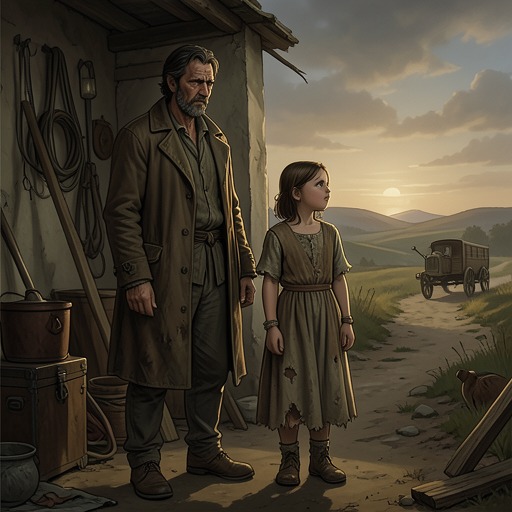
At the farm, the sound of German makes Johanna look again at the house and outbuildings. She recognizes her relatives as Tante and Onkle, terms for aunt and uncle, but the recognition does not make the place familiar in every other respect. Jefferson Kyle Kidd introduces himself and says he has returned Wilhelm’s niece. He explains that Indian Agent Samuel Hammond ransomed her at Fort Sill, Indian Territory. Wilhelm is still working through the papers as the Captain waits, exhausted from the journey and in pain. The formal handover therefore unfolds slowly: the girl has arrived, but the facts of her return are being established through documents as well as family recognition.
The Ransom and the Wagon
Wilhelm tells Jefferson Kyle Kidd that the family sent fifty dollars in gold. The Captain answers that he bought the wagon with it. Wilhelm looks at the wagon’s gold lettering, which reads Curative Waters, and at its bullet holes, then asks whether the harness came with it too. His questions keep the exchange grounded in tangible costs: the money was sent for Johanna’s return, and the Captain used it to acquire the vehicle that carried her.
The practical focus continues after the family gathers. Wilhelm pauses over the paperwork and asks whether the Captain has a receipt for purchasing the wagon. The Captain says he does not. The question does not establish that Wilhelm rejects Johanna or disputes her identity; the papers already concern her return, and Wilhelm has acknowledged the money sent. It does show that the material accounting of the journey remains unresolved even at the moment when the family’s larger emotional news might seem to eclipse it. The wagon is at once the means of bringing Johanna home and an object whose purchase Wilhelm wants documented.
A Homecoming on the Family’s Terms
Jefferson Kyle Kidd urges Wilhelm to give Johanna quiet, peace, and time to adjust. The Captain knows that she thinks of herself as Kiowa, has changed guardians three times, and needs reassurance rather than an abrupt demand to resume her former life. He also anticipates how quickly the news will draw people to the farm: they will arrive with a priest, songs, praise, food, and old likenesses of Johanna’s parents, asking whether she remembers. This forecast describes a community eager to welcome her, but also a welcome organized around prompting her to recover a prior identity.
Inside the house, Johanna sits in a corner with her hands clasped around her ankles, studying objects the white household takes for granted. Daguerreotypes seem to her like strange metal plates; the carpet’s vivid flowers, glass windows, ironstone dishes, side tables, and curtains belong to a domestic world whose uses she cannot readily understand. The Captain sits with coffee and seed cake while the girl withdraws into the corner. Wilhelm’s household is thus presented not simply as a refuge but as an environment Johanna experiences as strange. When Anna says Johanna is not too small to do her share, the Captain agrees. The brief exchange brings the question of adjustment down to household work, even as the larger mismatch in experience remains unresolved.
Failure of the Return
The next day, when visitors arrive, Johanna runs into the barn, climbs the ladder, and refuses to come down. With her skirt tucked into her belt, she hurls a sickle and a barking spud at people who climb partway up and speak to her in German. The scene gives physical form to the distance between the visitors’ effort to reach her through language and her refusal to be drawn into their gathering. She had also refused to leave the Curative Waters wagon bed the previous night, choosing to remain with her large red jorongo blanket rather than move into the house.
Later, Jefferson Kyle Kidd sees dark red stripes across Johanna’s forearms and hands, which the narration identifies as marks from a dog whip. He tells her to leave with him; she drops a bucket, vaults the fence, and runs to the road, crying that she will go with him. The evidence does not say that Wilhelm inflicted the wounds, and it does not identify him as the person who used the whip. It does show that Johanna’s stay with her relatives has not become the quiet, gradual adjustment the Captain urged. Wilhelm’s brief but telling attention to the wagon’s receipt sits beside this larger failure: the return can be accounted for in money and papers, but those formal arrangements cannot make Johanna feel at home. His role is defined by that unresolved contrast between receiving his niece and the limits of the household’s ability to receive the person she has become.