
Grief and the Limits of Letting Go
Nieuwe burenThis thread follows the couple’s different ways of mourning Lieve, showing how remembrance can sustain love while the demand to move on can deepen isolation.
increasing Bearing strength in each event
 decreasing
Bearing strength in each eventdecreasingThe Emergency Loss
The Future Interrupted
A sudden crisis
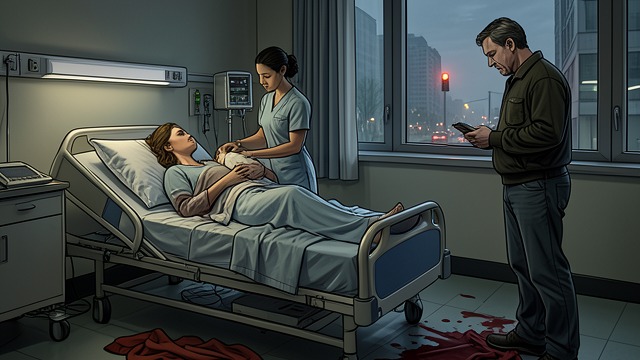
When Eva begins bleeding heavily, Peter drives her to the hospital through traffic while both struggle to comprehend what is happening. The medical team discovers that the placenta has detached and that Lieve’s heart has stopped; the imagined future of their family is ended in a matter of hours.
Meeting their daughter
During the emergency caesarean, Peter and Eva hear the sounds of the procedure without seeing what is happening behind the screen. Then Lieve is lifted into view and placed against Eva, who touches her daughter’s face and calls her perfect. The scene makes their loss tangible: this is not an abstract failed pregnancy but a child they can hold and know through her features.
They take Lieve home and bury her, preserving a place where Eva can return. Their grief begins with shared shock, but its later course will diverge: Eva remains bound to the daily acts of remembrance, while Peter avoids the grave because it embodies the failure he cannot bear to face.
Different Ways of Mourning
One Loss Two Rhythms
Eva’s daily vigil
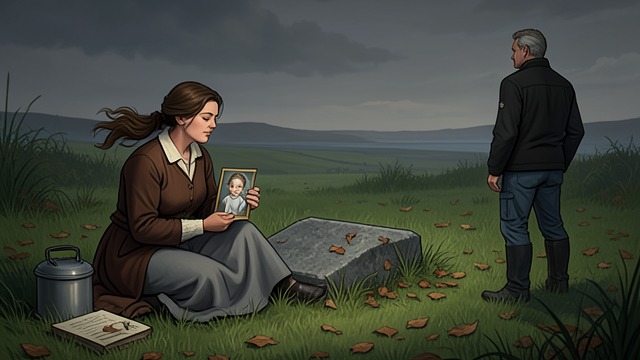
For a year, Eva visits Lieve’s grave every day, sometimes twice. She tends the flowers and keeps a photograph of her daughter close, treating remembrance not as a stage to complete but as proof that she remains Lieve’s mother.
Peter’s avoidance
Peter does not go to the grave after the funeral. He experiences it as a monument to his failure and struggles to feel the same uncomplicated parental bond that Eva describes. His absence does not mean the event has left him untouched; instead, grief appears as avoidance, guilt, and an inability to speak honestly about what he feels.
Their different responses create a painful asymmetry. Eva reads Peter’s distance as emotional abandonment, while Peter feels that the sorrow in their home leaves no safe space for his own version of loss.
A House Built Around Absence
The Empty Room
A future preserved in objects
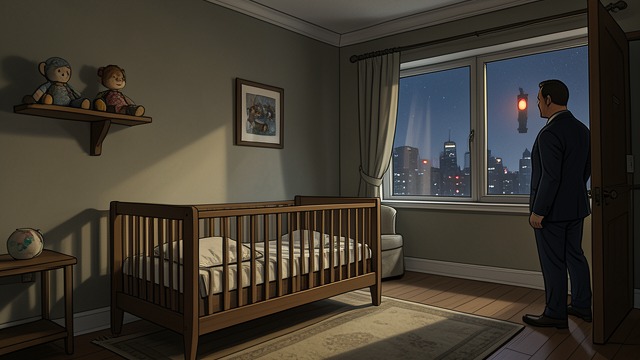
The couple’s new home was designed for a child: its location, practical features, and planned nursery all belonged to a future they expected to share with Lieve. After her death, Peter completes the house anyway, laying floors and painting walls according to Eva’s wishes as though careful work might still give her something.
Home as memorial
When Eva finally arrives, the rooms feel less like a fresh start than a place where their unrealized family has been carefully staged. The nursery has become Peter’s computer room, but its original purpose remains present in his memory. The house holds practical signs of care alongside the pain of every plan that will not happen.
The move shows how grief inhabits ordinary space. A finished floor or a kitchen appliance can be both evidence of devotion and a reminder that the imagined child will never use what the parents prepared for her.
The Anniversary Farewell
Saying Goodbye Without Erasure
A ritual at the grave
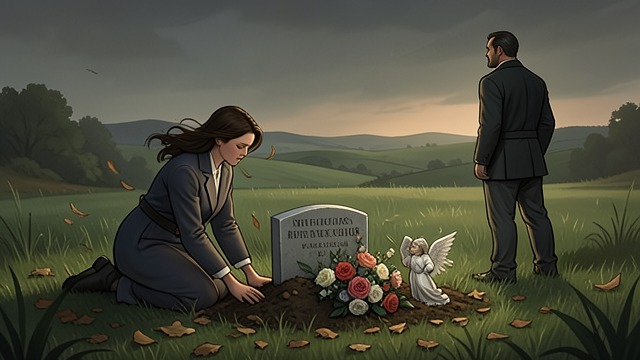
On the first anniversary of Lieve’s death, Eva tends the grave and speaks to her daughter as “Mama.” She tells Lieve that the parents must continue living, while insisting that this does not mean they are abandoning her or ceasing to love her.
Memory remains personal
Eva places a small angel among the flowers and accepts the image of Lieve as a spiritual presence watching over them. Peter cannot share that belief, but he stays beside Eva and participates in the visit. His gesture matters precisely because it does not require him to adopt her explanation of what happens after death.
They leave the cemetery without crying and walk toward the beach together. The departure is not a cure or a declaration that the past is finished; it is an attempt to carry their daughter’s memory while making room for a present beyond the grave.
The Child Who Remains
Grief Becomes a Moral Boundary
An old memory inside a new crisis
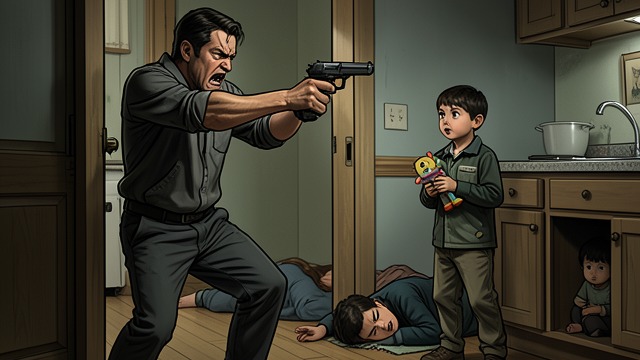
When Peter enters the cottage armed, the conflict over Eva’s pregnancy rapidly becomes a threat of murder. As he aims at Steef, the memory of Lieve’s lifeless body returns and interrupts the violence he is preparing to commit.
An unwelcome reason to live
The imagined death of another child stops Peter from shooting Steef, but it cannot restore control or repair his relationships. Gunfire follows, and Peter’s sense of what he has done arrives only after the killing has stopped. In the aftermath, Sem is still alive and hidden beneath the kitchen counter, holding his toy and crying.
The surviving child becomes an immediate moral responsibility rather than an abstract promise of fatherhood. Peter cannot undo the deaths or escape their consequences; the child’s frightened gaze makes him confront the fact that he is still alive and must answer for what he has done.
At thirty weeks of pregnancy
The first year after Lieve’s burial
During the move to Melkweg 1
One year after Lieve’s death
At the final confrontation in the cottage
