Bezitterige liefde
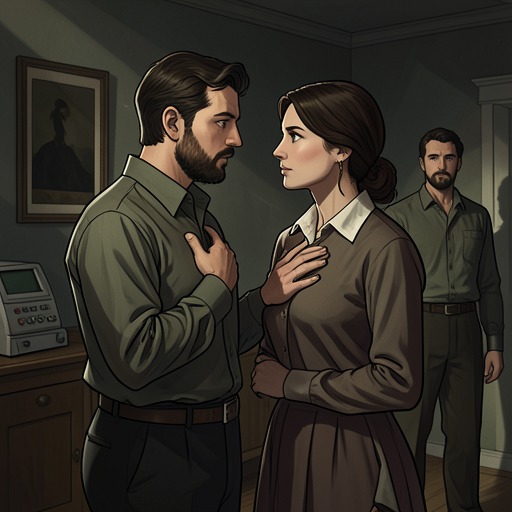
Nieuwe burenBezitterige liefde is the possessive form of love that governs Peter’s final pursuit of Eva: he treats marriage and devotion not as bonds between separate people, but as grounds to demand her presence, an explanation, and ultimately submission. Its decisive expression is the conversion of threatened self-destruction into violence against others. Peter calls his plan a way to end their suffering together, but the scene exposes the coercion beneath that language when he shoots Eva and turns next toward Steef.
Love as a Claim of Ownership
Peter’s account of the crisis begins from the conviction that Eva has left him for Steef. He takes her absence as confirmation of betrayal and insists inwardly that, as her husband, he is owed the truth. The marriage becomes a title he can invoke against her choice to leave, rather than a relationship whose terms she can determine for herself. His desire is not simply to return to her: he wants her, and he treats that distinction as a reason she must come back.
That claim is sharpened by Peter’s account of his own life. He says he has lived only for Eva and cannot imagine a future without her. He presents her departure as something that will destroy him, then makes her responsible for that destruction. In this logic, his dependence does not lead him to recognize Eva’s independence; it becomes evidence, to him, that she has done him an injury for which she must answer. The language of love thus carries an accusation and an entitlement at once.
Jealousy, Suspicion, and the Pursuit
As Peter searches for Eva, suspicion takes over the landscape. He runs through the dark, looks into houses, and interprets possible scenes of intimacy as signs of the life he believes Eva has chosen with Steef. A couple he glimpses on a couch is not Eva, but he immediately imagines that it could have been her. He pictures her with Steef in bed and invents a shared future for them, including a tent by the beach. These are not facts he has witnessed; they are jealous conjectures that intensify his certainty and anger.
The pursuit has a concrete, armed dimension. Peter has kept his pistol, although while driving over the Waalbrug at Zaltbommel he considered throwing it into the Waal; he missed the turnoff and continued toward Eva. He tells himself that he must find her, show the scale of his love, and obtain the truth if she rejects him. The weapon makes the contradiction in that purpose plain: the demand for an answer is already bound to a threat of death.
When Peter reaches the cottage by the pond, he sees Eva and Steef together. Eva is sitting opposite Steef with her face in her hands, her body shaking; she sinks to her knees and crawls toward him. Peter experiences the sight as unbearable and reads the scene through revulsion, not understanding. Her distress and Steef’s sternness are visible, but Peter’s possessive interpretation leaves little room for either of them to be more than figures in the betrayal he believes he has suffered.
Self-Destruction as Retaliation
Before entering the cottage, Peter imagines killing himself in front of Eva. He pictures his blood staining her sight and their love being permanently tainted by his death. In his fantasy, other people may say he chose to end his life, but Eva will know that she drove him to it; he imagines that she will never be happy again. Suicide is therefore not only an escape in his thinking. It is also a means of assigning blame and securing a lasting place in Eva’s future through punishment.
This imagined spectacle reveals the coercive structure of his attachment. Peter frames the act as proof of love, but the intended audience is Eva, and the intended consequence is her lifelong guilt. His imagined death is designed to control what she will feel and remember after he is gone. Even his appeal to truth is inseparable from the demand that Eva acknowledge his version of events and bear responsibility for his pain.
The Fatal Outcome
At the confrontation’s climax, Peter declares inwardly that he will not go alone and that he will take Eva with him. He recasts killing as a release for both of them, though the decision is his and Eva is not consenting to it. The possessive logic reaches its most explicit form here: because he cannot accept separation, he treats her life as something he can end along with his own.
Both Peter and Eva fire. Her shot strikes the ceiling; his hits her heart. Eva drops her weapon and collapses over Rebecca’s body. Peter reports feeling nothing, then turns toward Steef, who reaches for the weapon lying at his feet. Peter presents the next shot as a way to ensure that they do not escape him and says he will take them to hell. The movement from professed devotion to murder is not a separate interruption of his possessiveness; it is its culmination. Love, as Peter construes it, has become a claim so absolute that the other person’s refusal to remain is answered with lethal force.