Boundary-crossing intimacy among the four
Nieuwe burenThe boundary-crossing intimacy among the four begins as a night of music and drinking and becomes a charged encounter between Peter, Eva, Steef, and Rebecca. Its decisive turn is not simply that the couples touch and kiss: Peter’s excitement at reconnecting physically with Eva gives way to his shock when she turns toward Rebecca and accepts Steef’s touch. Eva’s later account supplies a different emotional frame, linking the night to her anger over Peter’s decision to stop therapy and insisting that, despite recognizing how far things went, she feels newly alive rather than regretful.
Background and Trigger
Peter’s account places the encounter amid a gathering with Steef and Rebecca. Before the dancing takes over, Eva remarks that a man being discussed looks a little like Steef. Peter is convinced she says it deliberately to put him in his place, an early sign that he experiences the evening through jealousy and alertness to comparison. The remark does not stop the party; instead, it helps establish the tension beneath its increasingly uninhibited surface.
Eva’s retrospective account identifies a more consequential source of her mood. Peter had told her that he had stopped therapy. She says that, without this disclosure, she might have drunk less and sent Steef and Rebecca home in time. She had been angry throughout the evening, and attributes her excessive drinking to that anger. Her account does not claim that the decision to stop therapy alone explains everything that follows, but it makes clear that the gathering’s turn toward intimacy occurs against an existing marital conflict rather than in an emotional vacuum.
Music and Disinhibition
The music becomes the scene’s immediate force. When Steef spills beer, Peter says that he does not care if the floor cracks; his body feels fluid as he spreads his arms, closes his eyes, and gives himself over to the guitar and Billy’s rough voice. The passage renders abandon physically: the sound seems to take possession of him, and he shouts. The lyric “It's a nice day to START AGAIN.” marks the moment with an image of renewal, though the night’s later consequences make any fresh beginning less straightforward than the refrain suggests.
The excitement spreads across the group in gesture rather than discussion. Steef shouts, all four yell like exuberant teenagers, and the women jump after kicking off their shoes. Steef gathers both women against him; as they nearly lose their balance and laugh, his hands appear to seize their breasts. Eva does not stop him. Peter then pulls Eva away from Steef, places his hands around her hips, and presses his erect body against her. His repeated insistence that he dares anything and is Billy registers a temporary surrender to the performance and the music, not a considered resolution of the couple’s problems.
Escalation and Uneven Participation
When the music slows to Billy Idol’s “Eyes without a Face,” Peter dislikes the song, while Eva puts her arms around his neck and dances close with him. He wants to preserve her arousal, fearing it will fade. Across the room, Steef and Rebecca have fallen onto a sofa; Peter sees Steef touch Rebecca’s breast and take her nipple into his mouth. The curtains are still open. Peter steers Eva toward another sofa, dismissing the prospect of a mess on its white upholstery because, in his thinking, tomorrow can deal with tomorrow.
Peter kisses Eva cautiously, and she kisses him back. They use their tongues, and he understands this as the first time in a long while that he has kissed his wife that way. They sink toward the sofa together, but Eva wriggles free, stands, closes the curtains, and straightens her skirt. Peter’s heart races as he reaches for her, wanting her close and wanting to prevent a pause in which either of them might reconsider. The curtains’ movement changes the scene’s exposure, but it does not restore the private reunion Peter is trying to hold on to.
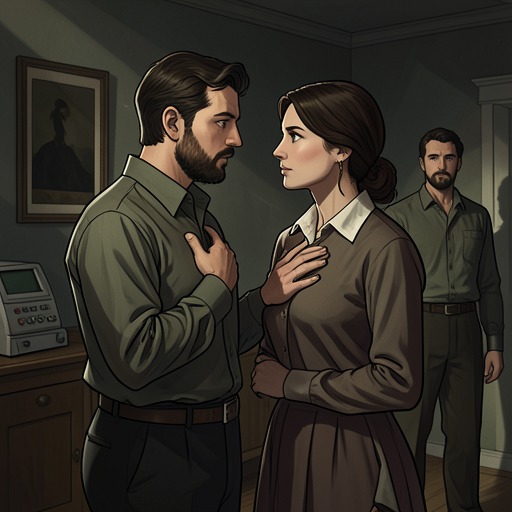
He hears Steef groan and looks despite wanting not to. Rebecca is sitting on Steef with her dress pushed above her hips, revealing salmon-pink lace underwear. She laughs at something he says, then takes Eva by the hand. Rebecca puts a hand into Eva’s neckline and strokes her breast; Steef strokes Eva’s calf and moves his hand upward. Eva does not push them away or respond with the outrage Peter anticipates. Instead, she bends to kiss Rebecca, closes her eyes, and gives herself over to Steef’s hand between her legs. Peter remains on the sofa, physically aroused but frozen. The encounter’s central reversal is therefore also a disparity of experience: what Peter had treated as a chance to reclaim closeness with Eva becomes a scene in which he cannot act and Eva directs her intimacy elsewhere.
Eva’s Retrospective and Significance
The narrative shifts from Peter’s immediate, first-person perception to Eva’s account of the same night. She acknowledges that things got out of hand, yet says that it does not feel that way to her. Her heart is still pounding and her arms and legs feel exhausted by the alcohol, but she describes the aftermath as a pleasant hangover, one that leaves her smiling through the day. She says she has no regrets, even though she believes she ought to have them. That contrast prevents Peter’s paralysis from serving as the only measure of what the encounter means.
The scene thus brings two responses to one boundary-crossing night into direct tension. Peter’s longing to keep Eva close turns into stunned observation; Eva’s account connects her conduct to anger and heavy drinking while also presenting the experience as a return to feeling alive. Her retrospective qualification does not erase the evening’s loss of control, but neither does it reduce her response to remorse. The encounter marks a shift from the couple’s troubled intimacy toward a more complicated arrangement among all four: what begins as shared exuberance ends with Peter isolated on the sofa, while Eva remembers the night as an experience she does not wish to disown.