Donor Conception and Genetic Fatherhood
Nieuwe burenDonor Conception and Genetic Fatherhood is the novel’s central conflict over what makes someone a father: genetic connection, pregnancy, intention, or the work of care. Peter and Eva’s struggle to conceive leads them through fertility treatment and the loss of Lieve, a daughter conceived with donor sperm; later, Eva and Rebecca arrange for Steef to father a child without his knowledge. The contrast makes biological paternity not an abstract question but a claim with consequences for the people who carry, raise, or never agreed to conceive the child.
Infertility and the Medical Route
After a year of trying to conceive, Peter and Eva ask their general practitioner for a referral to a gynecologist. He initially sees no reason for alarm, given their health and age, and recommends tracking Eva’s basal temperature. Each morning at half past six, Eva records it; a rise of 0.2 degrees Celsius signals a likely approaching ovulation. Sex becomes timed and instrumental: foreplay is cut short, and Peter is expected to ejaculate quickly so they can get to work.
The tracking does not resolve their difficulty. When the couple returns to the doctor, Peter resists entering the medical process. He wants a child with Eva, but wishes conception to arise from love rather than a procedure, and he misses the intimacy they had before trying for a baby. Eva, whose desire for a child overwhelms her, argues that they should at least learn whether a treatable problem is preventing pregnancy. Her body bears the tests and treatments, while Peter’s reluctance is bound both to their changing sex life and to the prospect of medicalizing conception.
At the gynecologist’s office, an internal examination and ultrasound reveal no apparent abnormalities in Eva; her temperature chart indicates monthly ovulation, and no blockage, cyst, or inflammation is found in her uterus or ovaries. Blood is drawn, and Peter undergoes two semen analyses, each after five days without ejaculation. Both tests find too few sperm and poor motility: the sperm present move forward only weakly. The assessment leaves medical intervention as the remaining route the couple can pursue.
Donor Conception and Peter’s Fatherhood
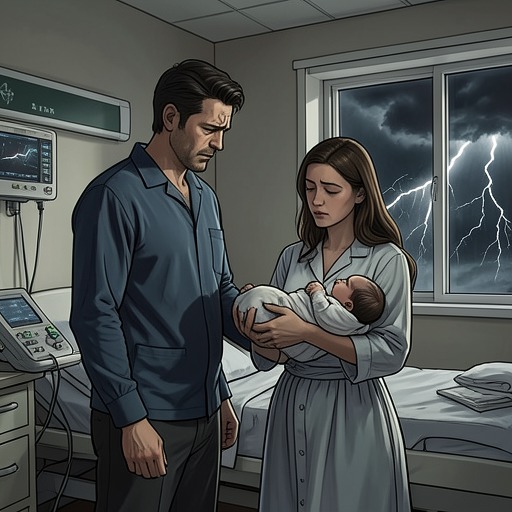
The couple’s treatment history eventually includes nine IVF attempts, four ICSI procedures, and five attempts at KID. Their daughter Lieve is conceived with sperm from an unknown donor, not Peter. Peter describes the donor with hatred, and at a later therapy session he explains that Lieve’s burial also marked the burial of their shared dream. He considers the repeated procedures and the loss too much to continue, especially when Eva’s healthy body has borne the physical cost of a problem identified in his sperm.
Peter’s relationship to Lieve is therefore shaped by a painful separation between genetic and lived fatherhood. He identifies her as his daughter while also naming that she was not biologically his. After her death, he says his emptiness comes partly from Eva drifting away; he did not carry or make the child. His account does not erase his grief, but shows how infertility and donor conception complicate his sense of place in the family. Genetic paternity becomes a wound he cannot ignore, even as his attachment to Lieve is real.
The Concealed Plan to Conceive with Steef
Later, Eva and Rebecca consider using partner-swapping as a way for Eva to become pregnant by Steef. Rebecca proposes what she calls soft coercion: Eva would calculate her next ovulation, arrange a meeting, and try again if conception did not occur. The plan depends on not consulting Peter and Steef about its reproductive purpose. When Eva raises the condom, Rebecca points out that it could leak, making the risk of pregnancy part of the scheme rather than an agreed possibility.
The proposed encounter takes place against a stated framework of discussion and boundaries. Steef asks whether the couples have talked about how far they want to go, and warns that even one exchange will permanently change Peter and Eva’s sex life. He and Rebecca describe different forms of swapping, including full swapping, and establish limits: Steef does not want bisexual activity; no one should be made to do anything against their will; a partner can stop the encounter with a shoulder tap. These safeguards concern sexual activity, but they do not disclose the concealed aim of conception. The gap between negotiated sexual boundaries and withheld reproductive intent is central to the scene’s ethical conflict.
During the encounter, Eva finds herself unable to relax into the sexual exchange. She feels detached, monitors her actions, and experiences the activity as mechanical rather than spontaneous. Rebecca takes the lead, while Eva remains conscious of the others and of her inexperience. Eva’s stated objective is not simply the pleasure of partner-swapping: she wants Steef’s sperm and fears wasting the opportunity. The scene thus places bodily participation and informed consent under pressure from a reproductive goal that the men have not been told about.
Genetic Claims and the Cost of Secrecy
After a condom mishap, Steef brings Eva a morning-after pill from a night pharmacy and apologizes. He says he wants no further children, describing Sem as having come into the world against his will, and doubts his own stability and fitness for fatherhood. He also distinguishes his intimacy with Eva from being in love, while describing their connection as more than a casual physical encounter. His words reveal that the possibility of an unintended pregnancy carries particular weight for him: he already experiences fatherhood as something he did not choose, even while trying to care for Sem.
The concealed plan is eventually exposed. Steef accuses Eva and Rebecca of stealing his sperm, emphasizing that Rebecca participated in the deception. He rejects their decision to determine his reproductive future for him and asserts that he has a right not to want the child. His anger turns the biological fact of paternity into a demand for agency: being the genetic father does not mean he consented to conception or accepts the role being arranged for him.
Significance
The novel sets medical procedures and sexual improvisation beside one another as different routes to parenthood, but neither makes the ethical questions disappear. Peter’s infertility places the burden of treatment unevenly on Eva and makes donor conception necessary to the birth of Lieve; the later plan redirects that same concern with genetic connection toward Steef, whose sperm is treated as a solution without his informed agreement. In both situations, the distinction between genetic and social fatherhood is charged with grief, attachment, and responsibility.
The resulting conflict resists a simple equation of biology with fatherhood. Peter’s bond with Lieve exists despite the absence of genetic paternity, while Steef’s biological connection to a possible child cannot substitute for consent. The story’s sharpest contrast is between Peter’s anguish at not having fathered Lieve genetically and Steef’s anger at being made a genetic father without choosing it. Together, their experiences show that reproductive agency cannot be settled by biology alone: conception also involves who knew, who agreed, whose body bore the consequences, and who is expected to care for the child.