Eva
Nieuwe burenEva’s identity as a mother is shaped by both a promise and a loss: she once promised Peter a family when he felt utterly alone, then became the grieving mother of Lieve, who was stillborn. Years later, when she is pregnant again, the possibility of a child does not heal the distance between them. At the holiday cottage, Peter sees Eva with Steef and understands the pregnancy as proof of betrayal; their confrontation ends with Peter shooting her.
Identity and the Promise of a Family
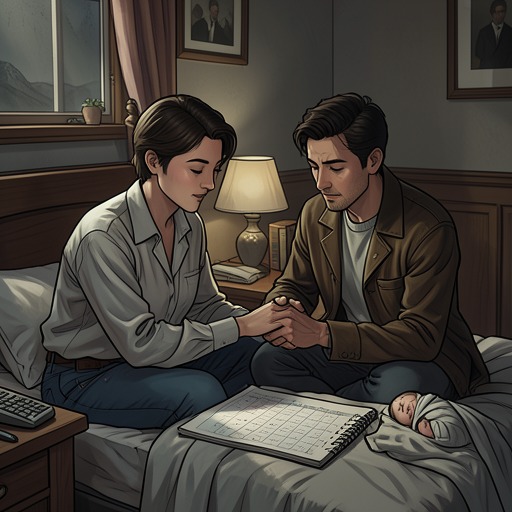
Eva’s wish to have children first takes shape after Peter’s mother’s funeral. His father had died six months earlier, and, crying together on their bed, Peter says he feels alone in the world. He longs for a sibling who had known and loved their parents and could share his memories. Eva tells him that, however hard she tries, she cannot be that person. Instead, she promises to give him a family and to bear as many children as he wants.
Eva argues that they are young enough to become energetic parents and that their children need not grow up as only children or lose their parents at a young age. Peter worries that his small salary as a beginning journalist makes the timing impractical. Eva dismisses the concern: she has a job as a kindergarten teacher and intends to keep working, while Peter may be promoted by the time she becomes pregnant. He agrees, though he later admits he did not know whether he truly wanted a child. What he did know was that he wanted to remain with Eva, and the thought of her carrying his child reassured him. Her promise thus begins as an act of care for Peter as much as a settled account of her own desire for motherhood.
Marriage, Silence, and the Loss of Lieve
The shared project of having a family becomes inseparable from grief. At a café on the Grote Markt, Eva thanks Peter for speaking about their loss and tells him that his words mattered: at times, his reserve has made it seem as though she alone is mourning Lieve. Peter struggles to meet her gaze, aware of the pain and reproach it holds. He says that he, too, cared and had wanted to become a father. Yet their conversation has narrowed until childlessness and their daughter’s death are nearly the only subjects they can discuss. Other topics feel forbidden and can provoke Eva’s anger; Peter expects to be accused of evasion and insensitivity.
Their silence has practical as well as emotional weight. Peter would rather return to their new house and finish the bedroom laminate flooring before the planned move, but he knows Eva wants to stop for coffee. They sit together without speaking, watching people shop. The scene echoes Peter’s image of his own parents, exhausted and out of things to say, and leaves him thinking that this is what their life has become.
Eva’s own account of bereavement shows how fiercely she guards her connection to Lieve. After realizing that she has gone several hours without thinking of her daughter, she is frightened that forgetting might mean letting go. She recalls Lieve’s small body, closed fists, and fine hair, and insists inwardly on her identity as a mother, even though Lieve died and Eva never truly got to know her. She lights a candle beside a framed photograph that others do not want to see. To Eva, it is not merely an image of a dead baby but a picture of the daughter she carried and remains proud of. She talks to Lieve there and holds on to Hetty’s consoling idea that the child was a wise, good soul whose purpose belonged to something higher: a star child, an angel watching over her. Therapy gives Eva an hour in which she can speak about her grief, even as she resists the advice to release her hold on her daughter’s memory.
Pregnancy, Infertility, and Adoption
Eva’s later conflict over how to have a child is expressed in bodily terms. She wants to feel a baby inside her, give birth herself, share her blood with the child, and have her breasts respond when it cries. Peter, by contrast, no longer wants to return to hospital treatment: no donor insemination, IVF, or ICSI. Adoption appears to him the fairest compromise because neither partner would have a blood connection to the child.
Eva challenges that idea by asking who would do most of the caring, and argues that adoption would not make the relationship emotionally equal. In her view, the birth mother retains a foundational bond with a child regardless of what she has done. Her position exposes a tension between Peter’s proposed fairness, which treats the absence of a genetic link as an even starting point, and Eva’s conviction that pregnancy and birth are distinct forms of attachment. The earlier promise that she would bear children for Peter has become a dispute over whose body, relationship, and understanding of parenthood will define their family.
The Pregnancy and Eva’s Death
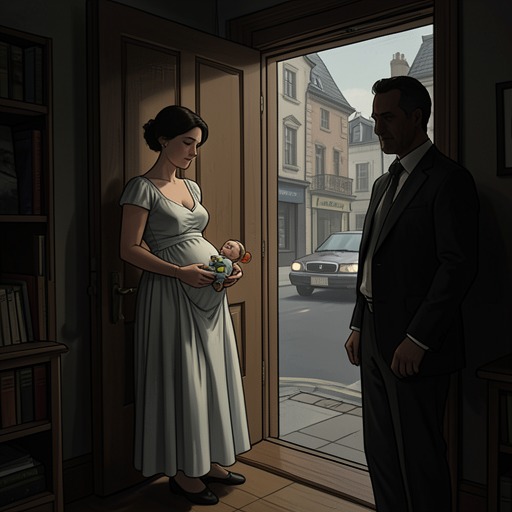
When Peter finds Eva at the cottage by the pond, she is facing Steef, shaking and then moving towards him as Peter watches from outside. Peter enters with a gun and confronts them. Eva tells him that they are having a child, then begins to say that the child is his as well. Peter looks from her to Steef and interprets the pregnancy differently: Eva is carrying Steef’s baby, and Peter believes they are trying to pass it off as his. The disclosure turns the long struggle over parenthood into an immediate crisis of paternity and possession.
Peter remains focused on the perceived betrayal and raises his weapon again. Eva and Peter both fire. Her shot strikes the ceiling; his hits her heart. She drops her weapon and collapses over Rebecca’s body. The woman who had once promised Peter a family, and who continued to claim motherhood through the death of Lieve, is killed at the moment a new pregnancy is revealed. The ending makes the child’s arrival inseparable from the couple’s collapse: Eva’s desire for a child has not ended, but the family she and Peter once imagined has become the scene of his violence.