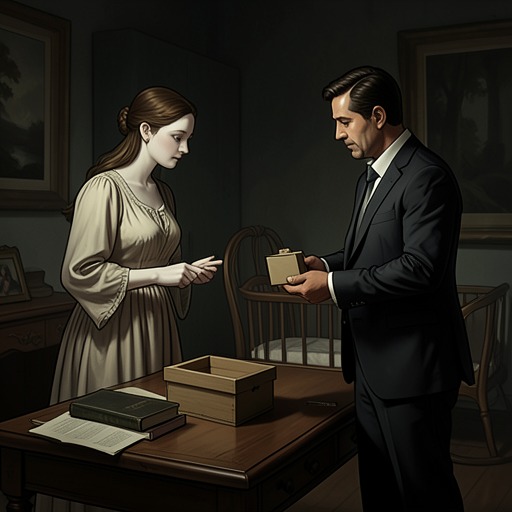
Eva and Lieve’s mother-daughter relationship
Nieuwe burenEva and Lieve’s mother-daughter relationship endures beyond Lieve’s stillbirth: Eva’s pregnancy, the brief encounter with her daughter’s body, and the life of mourning that follows all remain part of her identity as a mother. The bond is shaped by an abrupt physical separation, but Eva refuses to let that separation make Lieve merely a lost possibility. Her gestures at the hospital, at home, and at the grave preserve a relationship with a child she loved deeply but never had the chance to know alive.
Pregnancy and the Emergency
At thirty weeks, Eva’s pregnancy is interrupted by a sudden crisis. On 22 July, she wakes Peter in the early morning, bleeding heavily and frightened that they are losing the baby. She urges him to get her to hospital. Peter scrambles for the car keys, which he has left on the bathroom sink, while Eva’s bleeding soaks through the towel she is holding between her legs. Her pleas for Lieve to hold on make the baby’s place in the family immediate and intimate: she is already being addressed as their daughter, not as an abstract pregnancy.
The journey intensifies the emergency. Peter drives through red lights and along pavements and cycle paths to get around traffic, while Eva sits rigid with fear. At the hospital, she is made to wait in a wheelchair even as she says she can feel her child fighting for her life. Eva has read extensively about frightening pregnancy complications; before the gynaecologist, she understands that something is wrong with the placenta. The ultrasound confirms that it has detached and that Lieve’s heart has stopped. The discovery turns the couple’s urgent effort to save their daughter into the beginning of a loss neither can reverse.
Meeting Lieve
During the operation, Eva refuses sedation. Peter can only hold her cold hand as the medical staff prepare to deliver the baby. When Lieve is lifted above the green drape, she is small, purple, and silent. Eva agrees to have her placed against her chest. She strokes the baby’s contorted face with one finger and recognizes her as perfect and complete. The contact is brief, but it gives Eva a chance to meet and touch the daughter whose life she had been trying to protect.
The parents dress Lieve in an outfit they had bought together on a weekend in Maastricht. They wrap her in a quilt Eva’s mother had made from remnants of Eva’s own baby clothes, joining Lieve’s short life to the material history of her mother’s family. In a transparent cot beside Eva’s bed, they study the baby’s features, recognize familiar family traits, stroke her fingers and toes, kiss her, and try to remember her scent. These acts of care are directed toward a child who has died, but they also establish the concrete memories Eva will carry as her daughter’s mother.
Grief and the Work of Remembering
Eva and Peter choose to take Lieve home and bury her, giving her a grave that Eva can visit. For a year, Eva goes every day, sometimes twice a day. Her visits are not a simple observance: a caller once contacts Peter after seeing Eva lying at the grave and worries that she may be dead. Up close, the woman sees that Eva is crying, her fists clenched against her stomach. The episode shows how grief occupies Eva’s body as well as her thoughts, and how her daily connection to Lieve can appear alarming to someone who does not know what the grave means to her.
Eva tends the grave and keeps its flowers alive. At the child’s section of the cemetery, Lieve lies beneath a white stone among forget-me-nots, with children’s decorations and bright flowers nearby. On a later visit, Peter brings a white rose and confronts his own distance from the grave: since the funeral, he has avoided going there, unable to face what he calls a monument to his failure. Eva’s sustained attendance contrasts with his absence. He recognizes his jealousy of the intensity of her grief, even though the person at its centre is their dead baby. Their different ways of mourning expose a painful imbalance without diminishing Eva’s attachment to Lieve.
That attachment also resists the idea that recovery requires forgetting. Eva is frightened when she realizes she has gone several hours without thinking of Lieve. She recalls her daughter’s delicate body, closed fists, and fine hair, and insists inwardly on her continuing identity as a mother, even though the child was stillborn and never truly known to her. The memory is precious partly because it is limited: Eva has the birth, the body, and the photograph, but not a life shared with Lieve. A photograph beside a candle lets her address her daughter privately and keep visible the child others may see only as a dead baby.
The First Anniversary and Continuing Bond
At the grave on the first anniversary, Eva removes withered flowers while Peter waters the forget-me-nots. She avoids his gaze and holds her jaw tightly, afraid that speaking will release a scream. She kneels, places her hand on the stone, and speaks to Lieve as both parents’ child. The anniversary brings the birth crisis back to Peter with the clarity of a sudden recollection: Eva’s bloodied hands, the frantic drive, the detached placenta, and the moment they learned that Lieve’s heart had stopped. Eva’s continuing ritual and Peter’s involuntary return to the emergency show how the loss persists differently for each of them.
Eva tells Lieve that her parents must carry on, but not because they are leaving her behind. She promises that Lieve remains in their hearts, that she will still think of her every minute, and that she will remain her mother while Lieve remains their daughter. She places a small stone angel among the flowers to watch over Lieve when she is not there. Peter cannot share her belief that Lieve has become an angel who remains near them; their grief includes this difference in what they can believe, as well as what they can remember.
At the end of the visit, Eva says she is letting Lieve go. She kisses the stone, takes Peter’s hand, and leaves with him. They do not cry as they walk away, and Peter feels lighter. The departure marks a change in their ritual, not a denial of the relationship Eva has just affirmed: she will no longer visit every day, but she says she will continue thinking of Lieve and being her mother.
Motherhood After Loss
The relationship continues to shape Eva’s ordinary life. She keeps a photograph of Lieve beside her bed, showing the baby in a knitted sweater and the quilt Eva made. On mornings when she feels unable to get up, she touches the photograph and draws comfort from knowing that she can still visit her daughter. At work, she is surrounded by lively children, whose noise and energy she welcomes rather than resents. Their vitality sharpens her awareness of the child she lost, while also giving her a daily life to return to.
Later, the possibility of another pregnancy reawakens hope and fear together. Eva notices that her breasts feel more tense than usual and that the smell of coffee makes her nauseated; she avoids running, cycling, and bumpy roads despite knowing the chance of pregnancy is very small. She tells herself that, if she is pregnant, it would be a miracle and a second chance. This hope does not replace Lieve or erase Eva’s motherhood. The relationship remains present in the way she remembers, mourns, and imagines a future: Lieve is gone, but Eva continues to claim her as her daughter.