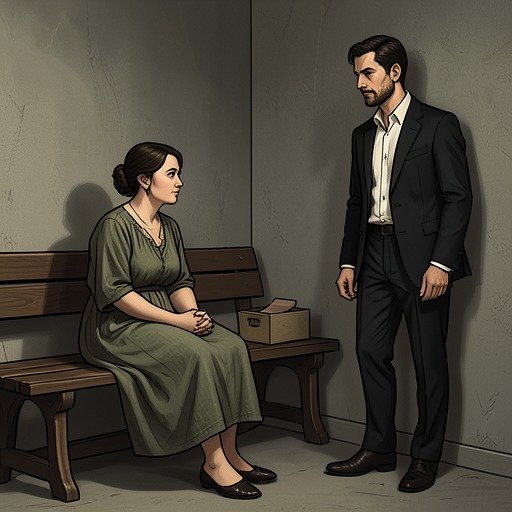
Eva and Steef’s Flirtation and Reproductive Plan
Nieuwe burenEva and Steef’s flirtation grows out of an already intimate social and sexual connection, but its decisive turn is reproductive: Eva and Rebecca plan to use partner-swapping to give Eva a chance to conceive with Steef without telling either man. Their shared language of fate and love conflicts with Steef’s unknowing participation and, when the plan is exposed, his insistence that biological fatherhood cannot be assigned to him without consent.
Infertility and the Pressure on Intimacy
Eva and Peter’s attempts to have a child shape the circumstances in which Eva’s relationship with Steef develops. After a year of trying, their family doctor advises them not to worry yet and suggests tracking Eva’s basal temperature. She takes it at half past six each morning; a rise of 0.2 degrees Celsius signals that ovulation may be near, and sex becomes scheduled around the possibility of conception. Their sex life narrows to a few days a month of intercourse organized around ovulation, while the rest of the month brings little intimacy. Peter misses their earlier closeness and resists medical treatment, saying that he wants a child conceived from love rather than in a laboratory. Eva, whose desire for a child has become consuming, argues that testing could identify a treatable problem.
The investigation changes the stakes. A gynecologist finds no apparent reproductive abnormality in Eva: her temperature pattern indicates monthly ovulation, and an ultrasound shows no blockages, cysts, or inflammation in her uterus or ovaries. Peter provides two semen samples after separate five-day periods without ejaculation. Both tests find too few sperm, and those present move poorly. The medical route now appears to be their remaining prospect for having a child, making the prospect of conception with another man more than a passing fantasy.
Attraction in the First Shared Encounter
The attraction becomes physical during a night with Peter and Rebecca. In a burst of dancing and exhilaration, Steef embraces the women; Eva lets him draw close before Peter pulls her away. Later, as the couples settle into separate encounters, Rebecca draws Eva toward her, touches her breast, and kisses her. Steef strokes Eva’s leg and moves his hand higher. Eva does not reject either of them: she kisses Rebecca and yields to Steef’s touch. Peter, watching from the sofa, lies frozen and unable to act. The scene therefore establishes an unevenness in the four-way intimacy: Eva and Steef’s physical proximity is real, but Peter experiences the encounter through jealousy and paralysis.
Eva’s own recollection of the night emphasizes both desire and uncertainty. Rebecca’s kiss surprises her, as does her pleasure in touching Rebecca’s breasts; she also remembers Steef’s hand moving up her leg and beneath her underwear. The memory unsettles her, and she tries to put it out of mind. Attraction is not presented as a simple declaration of love. It emerges through bodily contact that Eva later finds difficult to reconcile with her existing marriage and the emotional consequences of the encounter.
Rules, Consent, and the Limits of the Experiment
Before a later partner-swapping evening, Steef asks whether Eva and Peter have discussed how far they are willing to go. Eva calls it an experiment and says they do not yet know whether they will become regular swingers. Steef warns that even one evening will permanently change their sex life. His caution places the encounter within a framework of explicit boundaries rather than treating it as an uncomplicated extension of the first night.
Over dinner, Steef and Rebecca explain different forms of swapping, from sexual contact without intercourse to full partner-swapping. They describe their own experience as full swapping and explain that Steef is unwilling to take part in bisexual acts. For full swapping, they say, condoms are used; nobody has to do anything against their wishes, a hand can be pushed away, and either partner can end the activity with a signal. These rules make consent and stopping part of the arrangement. Yet Eva’s private objective is already different from a shared experiment: she wants Steef’s semen as soon as possible, while Steef directs the first part of the encounter toward Peter to help him feel at ease. Eva finds the resulting sexual choreography mechanical and cannot lose herself in it. Her attention remains divided between the acts she performs and the conception she hopes to achieve.
A Concealed Plan for Conception
After a condom mishap, Steef brings Eva a morning-after pill from a late-night pharmacy. He apologizes and says that their intimacy makes the situation different from sex with a stranger, while carefully distinguishing that bond from being in love. He also says he does not want another child: Sem was conceived against his will, and Steef describes himself as too unstable and too attached to his freedom to want further fatherhood. Eva tells him she is not pregnant. His words make clear that the possibility of a child is not neutral for him, even as Eva and Rebecca begin to consider it as a route out of their own fertility crisis.
Rebecca proposes that they not consult either Peter or Steef, since doing so would make matters too complicated. Instead, they will arrange another swapping encounter around Eva’s next ovulation and let events take their course. When Eva asks about the condom, Rebecca answers that it could leak. Eva recognizes the plan as a deception; Rebecca rejects that description and interprets the possibility of Steef becoming the father as something meant to happen. She frames the intended child as conceived and received in love, contrasting that image with conception in a laboratory. The argument gives the plan a language of destiny and tenderness, but it does not alter its concealed nature or Steef’s stated opposition to having another child.
Exposure and the Conflict over Fatherhood
The arrangement is eventually exposed. Steef says that Peter had come looking for Eva in a panic and that Steef then forced her to tell him what had happened. He responds by accusing Eva of stealing his semen with Rebecca’s consent and calls their actions criminal. His anger focuses not only on the deception but on the belief that the women have presumed to decide what his reproductive role will be. He says that he does not want the child and claims the right to refuse, invoking his experience with Sem as a reason he knows a child needs a father.
The conflict reveals the divide at the center of Eva and Steef’s reproductive plan. Eva and Rebecca imagine conception as an act of love that might give Eva the child she longs for; Steef understands the undisclosed plan as a violation of his choice and an imposed claim on his fatherhood. Their physical intimacy has crossed into a consequential dispute about who may decide whether a child is conceived, and what affection can—and cannot—make consensual.