Eva refuses the morning-after pill
Nieuwe burenEva refuses the morning-after pill after a condom accident with Steef, choosing to preserve the possibility of pregnancy despite his explicit wish to prevent it. The decision is decisive because it makes a private act of bodily autonomy inseparable from deception: Eva protects the chance to become a mother, while Steef and Peter have not agreed to the future she is trying to keep open.
Background: A pregnancy longed for and resisted
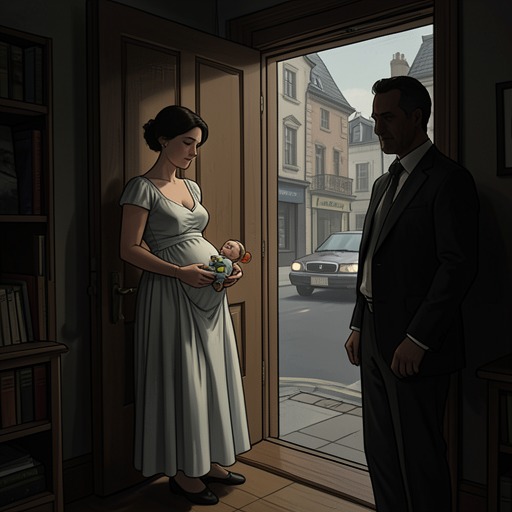
Eva’s choice comes after a long struggle to conceive with Peter. After a year of trying, their general practitioner initially saw no reason for alarm and advised them to chart Eva’s basal temperature. Each morning, she measured it and recorded the result; when it rose by two-tenths of a degree, they treated the likely approach of ovulation as a cue for intercourse. Sex became timed and purposeful, sometimes reduced to getting semen into Eva quickly enough for both of them to reach work. The routine narrowed intimacy to a few fertile days each month.
Six months into temperature tracking, Eva and Peter argued about whether to enter medical treatment. Peter wanted a child with her but objected to conception through a medical procedure, and he told her that he missed their former sex life. Eva, by contrast, felt that abandoning the effort would betray a desire that had come to occupy her entirely. The following morning they accepted a referral. A gynecologist found no obvious problem with Eva’s reproductive organs, but two semen analyses showed that Peter had too few sperm and that those present moved poorly. Their difficulty conceiving was therefore not a passing disappointment: treatment appeared to be the remaining medical route to a child.
That history helps explain why the possibility created by the condom accident carries such weight for Eva. The encounter does not establish that she is pregnant, and she tells Steef she is not. But in the wake of years of unsuccessful attempts, even an uncertain chance is something she wants to protect. The morning-after pill is not simply a medication to her; taking it would mean deliberately closing that chance.
Steef brings the pills
At dawn, Steef arrives at Eva and Peter’s home in the rain. Eva has been lying in bed, unwilling to face Peter, and hurries downstairs when she sees Steef at the door. Their customary greeting is a kiss, but this time they do not kiss. Steef asks for Peter and, told that he is out, follows Eva into the kitchen while she offers to make coffee.
Steef apologizes for his reaction to what he calls the condom accident. He has gone to a night pharmacy and brings a small white box, explaining that he obtained it without a prescription. He takes responsibility for what happened and says Eva had been kind to him, describing a bond between them that was intimate but not romantic. His apology therefore carries two distinct meanings: he acknowledges that the accident was his fault, yet he also treats the possibility of pregnancy as a danger that must be managed.
He explains that the box contains two pills, one to be taken immediately and the other twelve hours later. He warns that they may cause nausea and says they make it 95 percent certain that Eva will not become pregnant. Steef insists that he does not want another child. He says that Sem was conceived against his will and that, although he tries to be a good father, he considers himself too unstable and too attached to freedom to want another child. His appeal is not only practical; he asks Eva to recognize that no child should come from this situation.
Eva’s concealed decision
Eva does not openly refuse the medication at the kitchen table. Instead, she tells Steef that she will take the first pill after breakfast because she does not want to take it on an empty stomach. The delay lets her preserve the appearance of cooperation while concealing her actual choice. She knows what the box contains, accepts it, and does not tell Steef that she has decided against taking it.
While preparing breakfast, Eva lays out eggs, freshly squeezed orange juice, tea, white bread, and croissants. The bright, carefully arranged meal sharpens the contrast between the ordinary domestic morning and the decision she is making beneath its surface. She wonders why a settled, prearranged life is not enough and thinks of herself as someone who is deliberately risking the destruction of what she has. At the same time, she regards the risk as an attempt to fight for her own happiness. Her reasoning is bound to motherhood: she wants to keep Steef’s semen inside her and cherish the small possibility that it could lead to a child.
After Steef has gone to shower, Eva puts the morning-after pill in the grey rubbish bin, burying it beneath the other waste. The disposal is the action that makes her refusal real. Her promise about taking it after breakfast has been a cover, and the ordinary refuse conceals a decision with consequences neither man has consented to. Peter and Eva eat in silence, with the Sunday newspaper between them; the domestic scene continues, but Eva has made a consequential choice without disclosing it.
Conflict over parenthood and consent
The refusal places Eva’s longing for a child against Steef’s stated wish not to have one. It also exposes an imbalance in who would bear the immediate physical consequences: Steef can ask her to take the medication and describe what he fears, but Eva is the one who would swallow it, experience its possible side effects, or carry a pregnancy. Her private thought that no one else can decide what she puts into her body asserts that distinction. Yet her choice is not transparent agreement between the people involved. She hides it behind a promise, preserving her bodily decision through deception rather than open consent.
The surrounding events make that deception more than an isolated response to an accident. Before the encounter, Eva and Rebecca discuss swinging around Eva’s next ovulation and Rebecca proposes what she calls soft coercion: if one attempt does not result in pregnancy, they can try again. The possibility that a condom could leak is raised as part of that plan. Against this background, Steef’s later accusation that Eva and Rebecca stole his semen, with his wife’s consent, casts the incident as a dispute about reproductive deception and his claim to choose whether to become a father. The accusation does not erase Eva’s desire or her control over her body; it reveals the collision between that control and the other participants’ understanding of what they agreed to.
The episode thus joins the book’s infertility story to a sharper conflict about parenthood. Earlier, Eva and Peter’s attempts to conceive made sex a schedule governed by temperature readings and ovulation. Now an unintended opening appears in an encounter whose circumstances are themselves bound up with a plan to get Eva pregnant. The pill offers a 95 percent chance of closing that opening; Eva discards it instead. Whether her decision will produce a pregnancy remains unresolved here, but the secrecy has already changed the stakes: what Steef understands as an accident to be corrected becomes, for Eva, a possibility she refuses to surrender.