Farewell at Lieve’s Grave
Nieuwe burenThe Farewell at Lieve’s Grave is the anniversary visit in which Eva and Peter try to loosen grief’s hold without treating their dead daughter as forgotten. At Lieve’s grave, Eva promises that they must continue with their lives but will not abandon her; Peter remains unable to believe in the angelic afterlife that comforts Eva. Their departure together marks a change in how they carry the loss, not a cure for it.
The Anniversary and Unequal Grief
The visit takes place on Bevrijdingsdag, a year after Lieve died. When Eva asks how they should spend the holiday, she chooses the grave. The decision brings the couple back to a place that has become part of their separate ways of mourning: Eva has tended and visited it continually, while Peter admits that he had not returned since the funeral. His absence was not simple indifference. He had avoided the grave as a monument to his own failure, and even when grief had eased in daily life, therapy could still make the pain behind them newly present.
Eva’s relationship with the grave has been more constant and more physically consuming. For a year she went there every day, sometimes twice in one day. Once, a woman who saw her lying on the grave became so worried that she approached to check whether Eva was alive; she found her crying, fists clenched against her belly. The episode makes plain how the grave has served not only as a place of remembrance but as a setting where sorrow could overwhelm her body. By the anniversary, the flowers in the bed have withered, and Eva quietly removes them rather than beginning with words.
The couple’s grief is not synchronized. Peter has described himself as less occupied by sorrow than before: he has new friends, listens to music again, and rides his motorbike. Eva, meanwhile, remains fiercely attached to the daily acts by which she has maintained her bond with Lieve. Her insistence that she is still a mother, even though her child was stillborn and she never truly knew her, explains why the idea of letting go can sound to her like erasing both Lieve and her own motherhood. The anniversary makes those different experiences meet at the same small plot of ground.
The Ritual at the Grave
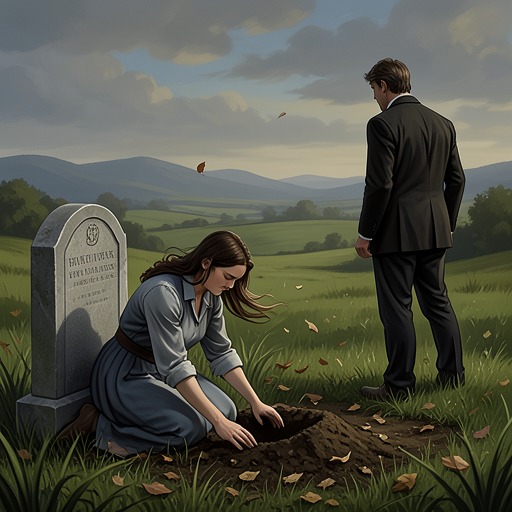
The grave stands in the children’s section, marked by a white stone and surrounded by blue forget-me-nots. Its inscription affirms that Lieve will remain in her parents’ hearts. Eva has kept the place carefully, adding fresh flowers and decorative figures; during this visit, she kneels and places her hand on the stone. Peter waters the flowers while she clears away the dead ones. Their gestures are practical and intimate, but they do not produce an easy shared feeling. He strokes her back and holds her hand, acutely aware of his jealousy toward the dead baby and of the intensity of Eva’s sorrow.
Eva speaks to Lieve as her daughter and addresses both parents as present. Peter manages a greeting, but inwardly experiences his participation as formal rather than heartfelt. He wants to feel love for a child who never lived outside the brief reality of her birth, yet what he can recognize in himself at the grave is guilt. The scene therefore refuses a neat reconciliation between parental love and bereavement: Eva’s bond is vivid and sustained, while Peter’s attempt to approach it is strained by his sense that he failed and by his inability to feel what he thinks he ought to feel.
Letting Go Without Abandonment
Eva’s farewell is carefully qualified. She tells Lieve that her parents have to move forward, but that they are not leaving her behind: Lieve remains in their hearts, Eva will think of her constantly even if she no longer visits every day, and she will always remain Lieve’s mother. The promise changes the meaning of absence. Leaving the grave is not presented as withdrawing love; it is a decision to alter the daily form that love has taken.
To give the promise a visible companion, Eva takes a small stone angel from her bag and sets it among the forget-me-nots. She says it will watch over Lieve when she is not there. The object gathers her belief that Lieve has become an angel, a belief shaped by the explanation that Lieve’s soul belonged to something higher. Peter finds Eva’s capacity to believe impressive, but cannot believe that Lieve is now an angel hovering around them. The figurine therefore does not resolve their difference. It gives Eva a concrete way to imagine continued care, while Peter can only stand beside her and look at it.
Eva then whispers that she is letting Lieve go. Peter strokes her curls, presses his nose to her neck, and kisses her earlobe. They leave hand in hand without crying. The combination of tenderness and restraint matters: the ritual does not make them perform a single, shared grief, but allows them to depart together despite the difference between what Eva believes and what Peter can feel. He describes himself as several kilos lighter as they walk away, an immediate easing that belongs to this moment rather than proof that sorrow has ended.
From the Cemetery to the Shore
Eva suggests that they go to the beach. They walk for what feels to Peter like miles beside the tide, through warm shallow water, with their shoes in their hands. At the quieter nudist beach, Eva undresses and settles into the sand, calling the experience freedom. The movement from graveyard to shore shifts the scene from the fixed place of loss toward open space and bodily presence. It does not cancel the farewell; it follows it, giving the couple a shared activity after the solemn act of remembrance.
The scene’s release is deliberately limited. In a later period of uncertainty about whether she could be pregnant, Eva becomes afraid of running, cycling, and even driving over bumpy roads, despite believing the chance to be very small. She turns to a photograph of Lieve, remembers the baby in a knitted sweater and the quilt she made, and draws strength from the thought that the worst pain cannot happen again. Her delight in the liveliness of the children she works with coexists with that memory. The grave visit thus marks a decision to stop going every day, not an end to Lieve’s presence in Eva’s life.
Significance
The farewell is a turning point in practice rather than a final stage of grief. Eva relinquishes the daily visit while reaffirming her identity as Lieve’s mother; Peter joins the ritual without adopting her spiritual explanation. Their handclasp and walk to the beach offer a modest form of shared continuation, not a declaration that the loss has been overcome. The event’s central distinction is between letting go of a repeated act and letting go of the child: Eva attempts the first while explicitly refusing the second, and Peter can accompany her even where belief remains beyond him.