Hey Joe
Nieuwe buren“Hey Joe” is the song Peter plays for Steef during their visit, and its performance becomes a small but decisive passage from self-consciousness to ease. The song’s repeated question about a gun and its account of a man who has caught his partner with another man supply a stark lyrical counterpoint to the warmth of the encounter: Peter and Steef meet the violence in the words with a smile, a laugh, and a hand placed gently at the back of Peter’s neck.
Place in the Visit
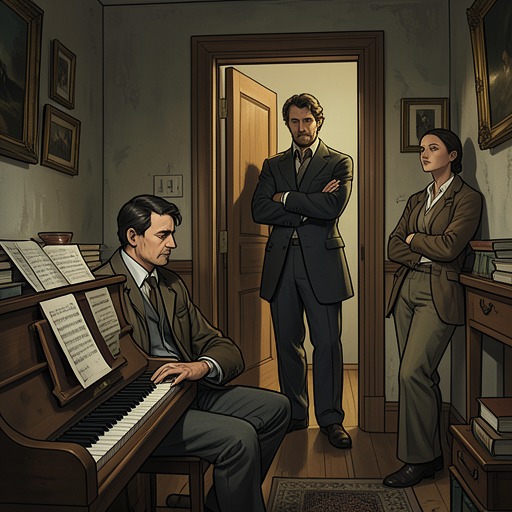
The song enters after Peter and Eva have shown Steef and Rebecca around their house. Steef and Peter remain upstairs beside Peter’s music collection, where Peter talks about his earlier life as a disc jockey and guitarist. At Steef’s invitation, Peter takes up his guitar but admits that he has not played for more than fifteen years and was never particularly good. Steef encourages him to play anyway, treating the request as an invitation to share something rather than as a test of skill.
That hesitation matters to the scene’s shape. Peter begins from an apologetic account of his own ability; Steef answers with uncomplicated enthusiasm. The music that follows is therefore not introduced as a polished performance or a return to professional musicianship. It is a tentative attempt made possible by Steef’s encouragement, with Peter discovering through the act of playing that the music remains in his fingers.
The Guitar Performance
As Peter plugs the guitar into his amplifier, Steef rolls a cigarette and looks through the CDs. Peter starts the recognizable guitar figure from Jimi Hendrix’s “Hey Joe.” He reflects that electric guitar can sound like something quickly, and the familiar loop gives him a way into the song without requiring him to prove the quality of his playing. What he thought he had lost returns through his hands as he continues.
Steef responds physically before the performance becomes a full exchange: he closes his eyes and sways his head to the music. Then he begins singing softly. The change is mutual but modest. Peter supplies the guitar; Steef joins with his voice, and the private collection upstairs becomes the setting for something they make together. Their attention shifts away from the house tour and its demonstrations of comfort toward the imperfect, shared act of playing.
Lyrics and Contrast
The lyrics make the song’s scenario explicit. Its opening question is repeated, with a slight variation in the second line: “Hey Joe, where you goin' with that gun in your hand” and “Hey Joe, I said where you goin'with that gun in your hand”. The answer gives the weapon a motive: “I'm goin'down to shoot my old lady now”, followed by the explanation, “You know I caught her messin' round with another man”. The song thus places a gun, jealousy, and suspected infidelity inside the music Peter and Steef share.
The scene does not turn those lyrics into a confrontation between the two men. After looking at one another, they smile; once the song reaches the lines about the shooting and the other man, they laugh together. The contrast is specific: the words describe an act of retaliatory violence, while the men’s immediate response is a release of tension and shared amusement. The song’s subject remains present, but the performance gives it a different effect in this moment.
The Encounter’s Effect
The narration describes their laughter as liberating. Steef then lays his large, warm hand at the back of Peter’s neck and tells him to relax and let his shoulders drop. He presses Peter’s shoulders down with both hands. The gesture extends the song’s effect beyond sound: Steef’s encouragement first gets Peter to play, and his touch follows the shared laughter with direct physical reassurance.
“Hey Joe” therefore matters here not simply as a song in Peter’s collection, but as the means by which the visit briefly changes register. Peter’s old musical identity becomes active again, Steef moves from listener to singer, and their response to the song’s violent story is laughter rather than hostility. The scene gives the performance a clear sequence—hesitation, playing, joining in, and release—without making Peter’s imperfect playing or the song’s dark narrative disappear.