Lieve
Nieuwe burenLieve is Eva and Peter’s daughter, conceived with donor sperm after years of fertility treatment and stillborn at thirty weeks. Her brief life becomes the center of the couple’s grief and a lasting dividing line in their marriage: they bury not only their child, but also the shared dream that had sustained their attempts to become parents. The memory of Lieve later interrupts Peter’s attempt to shoot Steef, making her presence consequential even in the novel’s final violence.
Identity and Conception
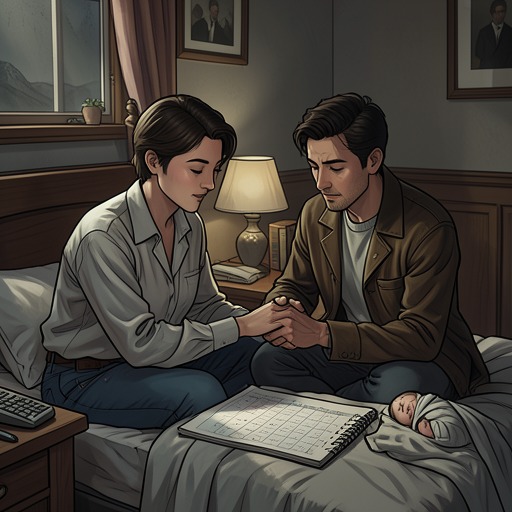
Lieve is Eva’s and Peter’s child, but not Peter’s biological daughter. After repeated difficulty conceiving, the couple underwent nine IVF attempts, four ICSI treatments, and five KID procedures. Their infertility had already reshaped their relationship: efforts to conceive turned sex into a timetable organized around ovulation, while the question of whether to continue medical treatment became a deep dispute. Peter objected to further procedures partly because he could not bear to see Eva’s healthy body endure the cost of his fertility problem. Their daughter’s conception through a donor made the wish for a child real, but also introduced a painful difference between biological and parental fatherhood. Peter describes the donor as an unknown man he hated, even as he recognizes Lieve as the child he and Eva had longed for.
Birth and Death
On 22 July, Eva woke Peter in a panic, bleeding heavily and convinced that they were losing the baby. He searched frantically for the car keys while Eva pleaded for Lieve to hold on. They drove to the hospital through red lights and around traffic; the blood soaked a towel and reached the car’s beige upholstery. At thirty weeks, Lieve was considered viable, and Eva insisted that every second mattered. The ultrasound confirmed that her placenta had detached and that Lieve’s heart was no longer beating. The emergency and the loss became inseparable in Peter’s memory: later, the sight of Eva’s distress brings the morning back to him with startling clarity, while the image of Lieve’s lifeless body in a hospital glass container remains an enduring source of pain.
Grief and the Grave
Eva and Peter chose to take Lieve home and bury her, giving Eva a place she could visit. For a year she went to the grave every day, sometimes twice. Her grief was so consuming that a passerby once worried she had collapsed there and called Peter at the newspaper. The visits show how Lieve’s absence occupied not just the couple’s thoughts but the daily shape of Eva’s life.
At the grave, Eva addresses Lieve as her daughter and promises that moving forward will not mean abandoning her. She kisses the gravestone and places a small stone angel among the forget-me-nots, saying it will watch over Lieve when she is not there. Peter admires Eva’s ability to believe that their daughter has become an angel and remains near them, but he cannot share that faith. The gesture therefore holds both parents’ grief while exposing a difference in how they make meaning of it: Eva sustains a bond through spiritual belief and ritual; Peter can acknowledge her devotion without finding comfort in its explanation.
Continuing Presence
Lieve remains part of the family through the objects her parents keep. In a photograph taken shortly before the burial, she wears a small sweater knitted by Eva’s mother and lies wrapped in a quilt Eva made. After Peter leaves, Eva packs the photograph, Lieve’s lock of hair, and the sweater alongside her clothes and documents. She cannot leave her daughter’s things behind as she departs from the marriage. The photograph is greasy from her pillow and tears, a physical trace of repeated mourning; when Eva touches Lieve’s face, the memory helps her get up and return to work with young children.
At school, the lively children are not a burden to Eva. Their shouting, play, laughter, and tears sharpen the contrast with the child she lost: having seen a dead child, she cannot complain about the noise of living ones. Lieve’s absence thus changes how Eva experiences other children, while the keepsakes and visits show that continuing with daily life does not dissolve her attachment.
Narrative Role and Legacy
For Peter, Lieve’s death marks the limit of what he can bear in the pursuit of parenthood. At a relationship-therapy session, Eva asks why he will not continue trying for a child. His answer is bound to the treatments, the physical and emotional suffering Eva endured, and the loss of Lieve, whom he had scarcely been able to mourn. In his understanding, burying their daughter also meant burying the dream they had pursued together. Lieve’s death therefore becomes more than the end of a pregnancy: it fixes a boundary between continued treatment and stopping, and intensifies the distance between Eva’s enduring desire for a child and Peter’s refusal to repeat the ordeal.
Late in the novel, Peter raises his gun at Steef. As he prepares to pull the trigger, he sees Lieve’s dead body in the hospital glass container and cannot fire: there is a child involved. The memory does not undo Peter’s rage or prevent the confrontation from becoming violent—Rebecca shoots him—but it interrupts his intention to kill Steef. Lieve’s lasting narrative force lies in that contradiction: she is both the devastating memory around which the family’s grief has gathered and the image that, at a decisive instant, stops Peter from taking another life.