Peter
Nieuwe burenPeter is the novel’s first-person narrator, a man who longs to remain with Eva even as infertility and years of strain have narrowed their life together. His story moves between efforts to restore closeness and moments when uncertainty becomes unbearable: a concert with Steef briefly gives him a sense of belonging, but Eva’s departure and his suicidal crisis expose how little control he feels he has over the future.
Identity and Inner Life
Peter’s perspective makes his emotional life immediate, but not always reliable as a guide to what others feel or intend. In a therapy session, he struggles to find words that might persuade Eva to give their marriage another chance. He knows that he loves her and does not want a divorce; even a simple, predictable life with her seems preferable to separation, despite the pain of a future without children. His difficulty speaking stands in contrast to the strength of his wish to stay.
Eva describes a recurring feature of their life together: Peter reacts badly to changes he did not anticipate or prepare for, and his stress leaves her feeling that she must be the strong one and carry the burden. Her account presents a relationship in which responsibility has become uneven. Peter’s own account in therapy confirms his attachment to Eva, but it also shows how hard it is for him to turn that attachment into words or a convincing plan for the two of them.
Infertility and the Marriage
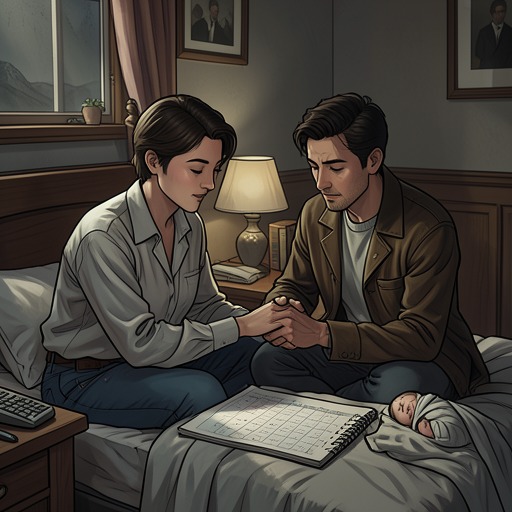
The couple’s desire for a child becomes a prolonged medical and emotional ordeal. After Peter resists finding out whether something is wrong, Eva becomes angry and feels betrayed. She explains that her longing for a child has taken over her life, while also hoping that their sex life, reduced to ovulation and ejaculation, can return to normal once she is pregnant. She argues that a treatable problem might be found, making refusal to investigate seem senseless to her.
They receive a referral the next morning and see a gynecologist five weeks later. Eva’s examination shows no apparent abnormality; her temperature chart indicates monthly ovulation, and an ultrasound reveals no blockage, cysts, or inflammation in her uterus or ovaries. Peter provides semen samples after periods of abstinence, in circumstances that leave him embarrassed. Both tests reach the same conclusion: his sperm count is low, and the sperm present move very little. The couple’s hope of having a child therefore depends on medical intervention, rather than on a problem identified in Eva.
Peter later describes five years of trying as a life organized around sperm, eggs, temperature, hormones, hope, sorrow, and pain. Their shared isolation has grown so constricting that they risk suffocating one another. The image captures more than the practical demands of treatment: the pursuit of parenthood has become the atmosphere of the marriage, crowding out other forms of intimacy. Peter still wants Eva, but wanting her does not undo the damage accumulated during those years.
New Space and Shifting Attachments
At a later point, Peter tells a therapist that he and Eva have grown closer, though he privately recognizes that this is not true: they are farther apart than ever. What has changed is that there is now room to escape the pressure that once filled their shared life. Peter has Steef; Eva has Rebecca. Peter has bought another motorbike and often goes out with Steef on Sundays, while Eva has begun going out again. A U2 concert is approaching, a child sometimes comes into their lives when they babysit, and Peter and Eva have resumed sex, though infrequently. He values even a small fragment of renewed closeness with Eva.
The contrast between that outward description and Peter’s private assessment matters. New routines have made the marriage more bearable, but he does not mistake them for a true recovery. His return to motorcycling and his friendship with Steef offer forms of life beyond fertility treatment, while Eva’s connection with Rebecca gives her a separate source of companionship. The couple’s renewed sex is a limited sign of contact, not proof that the distance between them has closed.
At the U2 concert, Peter’s sense of separation briefly gives way to exhilaration and collective belonging. After going to the toilet, where his trainers become soaked with urine, he returns to the field convinced that the music, the crowd, and the force of the moment have brought him into the shared movement around him. He lifts his hands, runs, and feels the bass in his body. His earlier bodily discomfort does not matter to him; being there, among people singing together, becomes an experience of inclusion.
That exhilaration also sharpens his feelings about Steef. Peter sees him in the crowd and interprets their connection as an almost fated bond: they live opposite one another, belong together, and lift each other up. He says to himself that Steef is the only man with whom he could have sex, and that he loves him. Peter’s attention moves between the crowd’s physical closeness, Steef’s flirtatious interaction with a woman on his shoulders, and another woman beside him. The scene joins affection and erotic possibility to the concert’s temporary freedom, without resolving what Peter’s attachment to Steef will mean beyond that moment.
Eva’s Departure and Peter’s Crisis
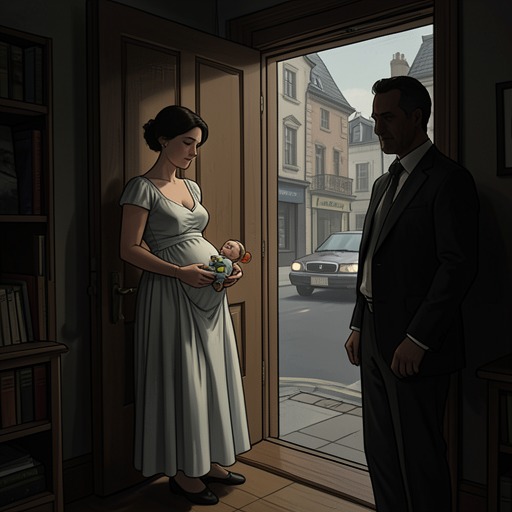
The possibility of starting over becomes concrete for Peter only after Eva has left. When he puts his key in the front-door lock, her keys are lying on the mat. He splashes cold water on his face and searches the house, calling her name. He tries to imagine ordinary explanations, such as shopping or a school meeting, and checks his phone for a message. The absence of a call, together with the keys left behind, defeats those explanations. He finds that her underwear, bras, and socks are gone. Her departure overturns his belief that the preparations he has made will allow them to begin again somewhere else.
Peter then imagines death as a way to spare Eva a divorce and the division of their belongings, while making her live with the consequences of his death. He pictures her finding his body and believes that others would support her and welcome a future partner who could make her happy. The thought turns self-destruction into an imagined message: his death would place responsibility on her, even as he tells himself that nobody would grieve for him. His reasoning exposes both despair and a continuing preoccupation with Eva’s response.
With a loaded pistol in his hand, Peter presses the cold barrel to his right temple. His hand trembles, and he doubts that he has the strength to kill himself; he fears that he would miss and injure only his eye or ear. When the telephone rings, he is so startled that he drops the gun. He is certain Eva is calling and imagines that she regrets leaving and wants him to collect her. Yet the voice only sounds like Eva. The scene ends without confirming who has called or whether Peter’s imagined reconciliation is real. His survival in this moment is not a resolution: the belief that Eva may be on the line briefly interrupts a crisis shaped by abandonment, hopelessness, and the urge to make her answer for his suffering.
Narrative Significance
Peter’s arc is built around the distance between attachment and security. He loves Eva and repeatedly wants a shared future, but the tests, routines, and disappointments of trying for a child have helped make their marriage feel confining. Elsewhere, a concert can give him the sensation of being part of a larger human movement, and friendship with Steef can open a space outside the marriage. Neither experience guarantees stability. When Eva leaves, Peter’s plans for a new beginning collapse, and his thoughts turn from preserving the relationship to making his absence consequential.
Because the novel presents these pressures largely through Peter’s own perspective, readers encounter his longing and fear from close range while also seeing the gap between his interpretations and confirmed facts. He reads a ringing telephone as evidence that Eva has changed her mind, but the voice is only identified as sounding like hers. That uncertainty leaves his future unresolved at the point of crisis, just as his desire to remain connected has not yet produced a secure way forward.