Peter Practices at a Shooting Range and Buys an Illegal Handgun
Nieuwe burenPeter Practices at a Shooting Range and Buys an Illegal Handgun marks the shift from Peter’s private suspicion of Steef to a concrete attempt to arm himself. A visit framed as friendship and self-protection gives Peter access to a pistol and its handling; later, as his fear hardens into certainty that Steef is dangerous, he seeks an unregistered weapon and arrives at Steef and Rebecca’s house armed. The sequence turns imagined danger into a material threat, even as Peter’s accuracy at the range offers little evidence that he is prepared to use a gun effectively.
The shooting-range outing
Peter accompanies Steef to a shooting range after the two have been intimate, riding behind him on Steef’s motorcycle. The outing has an outwardly companionable rhythm: Eva waves them off, and Steef is to teach Peter how to protect them. But Peter reads the trip through jealousy and suspicion. He has noticed the looks exchanged by Eva and Steef and describes their connection as a magnetic field. He is glad that Eva is unsettled by his departure, interpreting her concern as a sign that she is finally questioning him. In Peter’s mind, the afternoon is a chance to keep Steef close while learning how to defend himself.
Peter’s posture on the motorcycle makes that mixture of dependence and control visible. He does not put his arms around Steef’s waist; instead, he grips the seat and follows the bike’s turns. He imagines that he could throw them off balance and cause them both to crash. The thought marks how far he has moved from seeing himself as a passive, agreeable man who lets others take things from him. He now believes that he has understood Eva and Steef, is ahead of them, and can make or break their situation. The protective lesson is already bound up with a wish to gain leverage over the people he fears.
Learning to handle a pistol
At the range, Steef opens his locker and takes out three cases, handing Peter one of them. The pistol inside is Steef’s Sig-Sauer P-226, which he presents as light, easy to handle, and comfortable in the hand. The setting makes the weapon seem at once ordinary and consequential: men quietly maintain their firearms in a room lined with lockers, greeting the newcomers with gruff sounds. Peter is not simply hearing about guns; Steef puts one directly into his hands.
Peter’s eagerness soon draws a warning from another man at the range, who tells him not to hold or wave the weapon that way and reminds Steef to keep an eye on his companion. The correction exposes Peter’s impatience before he has learned the rules. Steef buys two boxes of ammunition, loads the magazines in silence, and hands Peter the Sig. He explains that it is only half-loaded and must still be handled with the barrel pointed in a safe direction. Peter receives safety glasses and hearing protection, then follows Steef into a narrow booth facing a large target. Steef demonstrates the stance and sequence: feet apart, body braced, shoulders relaxed, sights on the target, a breath taken before the trigger is pulled.
The gun’s physical force interrupts Peter’s inner turmoil, but it does not make him a skilled marksman. He says that the grinding in his head has stopped and the music has disappeared; for the moment, he feels in control. Yet when Steef describes the target as an enemy to be shot between the eyes, Peter sees only a dot and cannot identify the enemy he is supposed to imagine. His first shot jerks his hand upward and sends the bullet well above the mark. Out of twelve attempts, he gets close to the target only twice. Steef, by contrast, empties his own pistol without missing. Peter skips the next round, saying that he is exhausted. The lesson supplies him with the sensation of concentrated force, but its results show the gap between that sensation and actual competence.
From suspicion to an illegal purchase
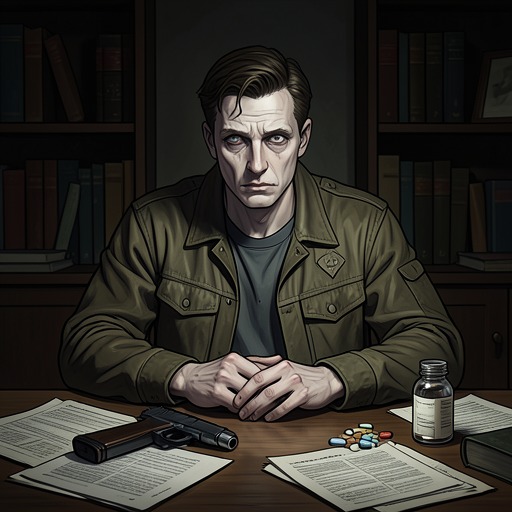
After the visit, Peter’s fears become more explicit. Alone at home, he concludes that Steef has deceived him, is capable of murder, and has Eva and Rebecca under his control. He distinguishes himself from them by insisting that Steef does not have power over him, then makes owning a weapon the necessary next step in protecting himself. With a triple espresso and Pink Floyd’s The Dark Side of the Moon playing, Peter repeatedly listens to the music’s opening, trying to make sense of what he hears. He presses his fingers to his temples and reduces his thoughts to a series of assertions: Steef is armed, Steef is mad, and Peter needs a gun.
Peter searches online for a pistol and finds Snuffelsnel, where someone is seeking a weapon without paperwork or bureaucratic complications. The wording matches Peter’s own urgent desire. He sees a response from a person calling himself Don D., who has provided a Hotmail address but no mobile number. Peter posts his own mobile number and email address. Almost immediately, he recognizes the danger of what he has done and worries that Don D. might be a police officer. The hesitation does not stop the search; it shows that Peter can still glimpse the recklessness of his plan while continuing to carry it out.
The weapon enters the domestic scene
Peter eventually buys a pistol from a junkie for three hundred euros. He describes it as a Croatian blaffer, and the gun sits heavily in the inside pocket of his jacket, against his thigh. When he explains his purpose as protection, the seller smiles contemptuously and pockets the money. Peter nevertheless feels protected as he stands outside the place he has cast as the enemy’s door. The contrast is stark: at the range, Steef had given him a supervised introduction to a Sig-Sauer and safety procedures; now Peter has acquired a weapon through an illicit transaction, without the same instruction or oversight.
He rings the bell, and Rebecca opens the door in a white tracksuit. She asks why he has not come around the back and whether he is cold or something is wrong. Peter answers that perhaps she knows. Inside, Steef is lying on the couch, and Peter smells marijuana. In the kitchen, Rebecca and Steef’s young child, Sem, sits in a high chair with red sauce on his face, feeding himself spaghetti by hand. Peter has come armed to confront people he regards as threats, but the first domestic detail he encounters is a child learning to do something for himself. The gun’s arrival at this household brings Peter’s private campaign of protection into direct proximity with the family life he believes others are conspiring to take from him.