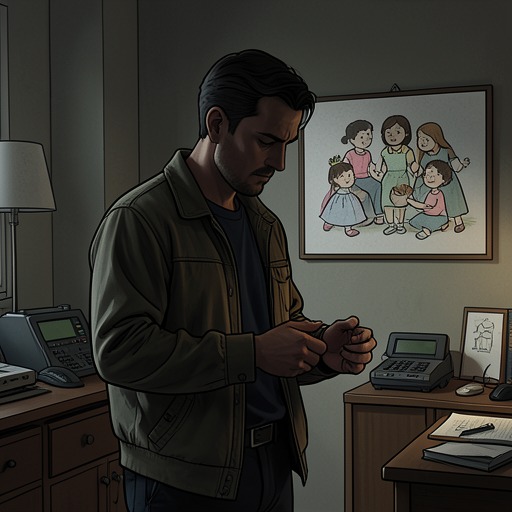
Peter and Eva Decide to Consider Adoption
Nieuwe burenPeter and Eva’s decision to consider adoption is a hard-won attempt to turn infertility and bereavement into a shared future, but it never settles their disagreement about what becoming parents means. Peter embraces adoption as a distinct and more honest path after rejecting further medical treatment; Eva voices acceptance while continuing to yearn for a child carried in her own body. That gap between their public decision and private desires becomes consequential when Rebecca proposes arranging a pregnancy without the men’s informed agreement.
Infertility and the limits of treatment
After a year of trying to conceive, Peter and Eva first ask their general practitioner for a referral to a gynecologist. He considers their age and health reassuring, says that half of couples who have tried for a year are still not pregnant, and recommends temperature tracking rather than immediate investigation. Eva takes her temperature each morning at half past six and records the results; a rise of 0.2 degrees Celsius signals a likely ovulation, turning sex into something timed around work and the cycle rather than mutual desire.
The pressure soon becomes a marital conflict. Peter wants a child with Eva, but resists entering the medical process because he wants their child to be conceived through love, not in a tube. He also misses their former intimacy: sex has become concentrated into a few days each month and absent for the rest. Eva, by contrast, cannot bear to give up the chance of having a child. She argues that testing might reveal a simple, treatable problem, and that refusing to find out would be foolish.
They eventually accept a referral. Eva’s examination, ultrasound, and temperature records show no apparent reproductive abnormality, but two semen analyses reveal that Peter has too few sperm and that those present move poorly. The results leave assisted reproduction as their remaining medical route to a child. That discovery sharpens the conflict: treatment offers a possibility, but pursuing it asks Peter to cross a boundary he has already named, while the desire for a baby is consuming Eva’s attention.
Grief and a change of direction
The choice to consider adoption follows not only infertility but also the death of Lieve. Peter later recognizes that he has avoided visiting her grave, treating it as a monument to his failure; when he finally kneels there with a white rose, he feels guilt rather than the love he believes he ought to feel. The child’s grave, marked by a white stone and surrounded by forget-me-nots, makes the loss concrete without making it easier to approach.
In therapy, Hetty challenges Peter’s account that he and Eva have found a new equilibrium. He says that grief no longer occupies every hour, and that new friends, music, and riding his motorcycle have helped life resume. Yet each therapy session returns him to the suffering he has tried to leave behind. Hetty names two losses: Lieve and the hope of another child. Peter’s later insight does not erase either loss. Instead, he sees that he and Eva had become overwhelmed by the options opened up after they abandoned their original decision not to enter medical treatment.
Driving away from the session, Peter reframes adoption as a new joint purpose, not a consolation prize. He reasons that neither parent would share a blood tie with an adopted child, and calls this fairer to all three of them. His formulation turns the absence of biological connection from an obstacle into the basis of a shared choice. The moment is also linked to Lieve: hearing Guns N’ Roses brings her back to him, and he visits the grave he had avoided. The future he imagines does not replace his dead daughter; it begins beside the memory of her.
A shared decision, and an uneven acceptance
At a gathering with Rebecca, Steef, and their baby Sem, Peter says that he and Eva will apply to adopt. Holding Sem no longer hurts him as it once did, and the evening lets the couple imagine a child in their lives without immediately retreating from the thought. Rebecca tells Eva that she hopes Eva can know the same happiness. Peter’s reassurance that they will pursue adoption presents the plan as a decision they can make together, although Eva does not disclose her continuing dream of carrying and giving birth to a child herself.
Later, Eva speaks in the language of acceptance: she says that she has made room for Lieve’s death, accepted that she and Peter may never have a child together biologically, and become open to adoption. She also acknowledges that her longing for a baby had dominated their lives and that she had pressured Peter during fertility treatment. She describes a period when she wanted to die and had seriously considered suicide. Her account shows how much adoption can mean as relief from a consuming struggle, but Peter’s perspective remains wary: he sees Eva as eager to perform recovery and to excel even at grieving. Their agreement is therefore real but not equally experienced. For Peter, adoption follows a conscious rejection of medical treatment; for Eva, it coexists with a desire she has not managed to relinquish.
That contradiction becomes explicit when Eva tells Rebecca that she wants to feel a child growing inside her, to give birth, and to experience the child as sharing her blood. She explains that Peter will not return to the hospital for donor insemination, IVF, or ICSI, and that adoption seems the fairest compromise because neither of them would have a biological bond. Rebecca disputes the idea that adoption resolves the problem, arguing that Eva would likely do most of the caring and that the birth mother’s bond would remain distinct. Their exchange exposes the competing meanings concealed by the word fair: shared absence of a blood tie for Peter, against Eva’s wish for pregnancy and a bodily connection.
The decision’s limits and consequences
Rather than accept adoption as the only path, Rebecca proposes what she calls soft coercion: she and Eva will arrange to swing, calculate Eva’s ovulation, and repeat the encounter if necessary. She raises the possibility that a condom could leak. The plan converts Eva’s unspoken wish into an attempt at conception while deliberately bypassing discussion with Peter and Steef. Its existence makes clear that the couple’s decision to consider adoption has not resolved Eva’s longing; it has made that longing harder to voice within the marriage.
After a condom accident, Steef brings Eva a box of morning-after pills. He says he does not want to take any risk of having another child, explaining that Sem was conceived against his will and that he is trying to be a good father despite feeling unstable and attached to his freedom. His response gives the reproductive choices at stake another dimension: what Eva experiences as a chance at motherhood is, for Steef, a risk of unwanted fatherhood. The adoption decision had offered Peter and Eva a route that appeared to avoid precisely this conflict, but the concealed plan places another man’s reproductive wishes in its path.
When the deception is later confronted, Steef accuses Rebecca of stealing his sperm with his wife’s consent and calls what they did criminal. His anger confirms that the proposed pregnancy was not simply an alternative route to the couple’s agreed goal: it involved a violation of the men’s ability to choose whether to become fathers. The adoption decision thus remains an important but incomplete turning point. It gives Peter and Eva a shared direction and a language of fairness, yet it cannot by itself reconcile their different desires or guarantee that their choices will remain mutual.