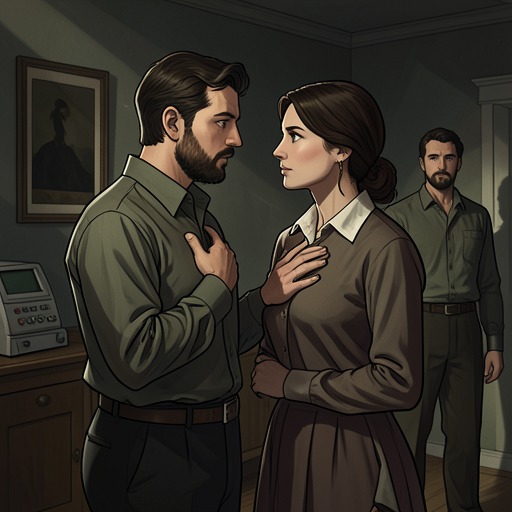
Peter and Eva's separation
Nieuwe burenPeter and Eva's separation is a state of unresolved absence that Peter tries to overturn by imagining a new life together. The possibility that Eva has left him becomes acute when he sees Steef's car where he expects to find her: to Peter, the sight confirms his fear, though his escalating suspicions and fantasies blur the line between what he knows and what he imagines.
Separation and the Future Peter Proposes
Peter is dissatisfied with the life he has built in De Zonnepolder. He describes his well-paid job as a practical necessity: at his age, he needs an income to support his family and pay the mortgage, not because the work gives him purpose. Even smoking a joint fails to quiet him; it makes him hear the music more intensely, while his thoughts return to the life he feels he is merely maintaining.
In Eva's absence, Peter rehearses a proposal for what they might do if she comes back. They could leave De Zonnepolder, he could resign, and they could perhaps move abroad and start something together. He recalls their old dream of running a beach café and imagines that they could still pursue it if they had a new shared goal. His comparison of their relationship to ABBA, Guns N' Roses, Pink Floyd, and The Beatles casts them as a team that should not be broken up. The plan is emotionally vivid but remains a proposal Peter has yet to make; its hopeful future stands against the separation he is experiencing.
The Car in the Parking Lot
Driving into the parking lot, Peter sees Eva's car among the Audis and Peugeots, then notices Steef's Ford in his rear-view mirror. The sight freezes him. Steef, whom Peter had mentally excluded from the situation, is physically present, and Peter immediately reads this as evidence that Eva has left him for Steef. He tells himself that he is not paranoid and that the truth has been confirmed, but the passage presents his certainty through his own agitated interpretation rather than establishing the full circumstances of Eva's departure.
Peter gets out, slams the car door, and walks in circles as the realization lands. He does not want merely to return to being with Eva; he wants her specifically. Anger overtakes him, and he starts running, convinced that leaving would mean losing her for good. He frames his pursuit as a demand for the truth and as proof of the scale of his love, invoking his position as her husband to claim that he is owed an explanation. His language makes attachment and entitlement difficult to separate: the desire to recover the relationship becomes a determination not to accept its possible end.
The Search and Its Consequences
Peter ducks under a barrier and takes an unplanned road in search of lighted houses, reasoning that Eva might be where the lights are on. He prowls among bushes and peers through glass doors. After a dog barks, he runs away; then he glimpses a couple having sex on a sofa. It is not Eva, but he immediately treats the scene as a possible image of what she may be doing with Steef. He imagines them together in bed and builds a story in which their sexual relationship has lasted for months and explains why Eva did not want him.
The search therefore yields no confirmed account of Eva's actions, only a more elaborate version of Peter's fear. He imagines himself as a temporary waiting place in Eva's life and Steef as the strong, fertile man she supposedly wanted all along. Even the beach-café dream returns inside this imagined rival relationship: Peter pictures Eva and Steef sharing the future he had planned for himself and Eva. The separation's decisive turn is not a reunion or an explanation, but Peter's movement from hope toward jealous certainty, with his private fantasies supplying the answers he cannot obtain.