Peter and Eva’s Marriage
Nieuwe burenPeter and Eva’s marriage is sustained by a powerful desire to remain together, yet repeatedly tested by bereavement and infertility. Their shared hope for a child begins as a promise of family and belonging; after medical treatment and the loss of Lieve, that hope becomes a source of pain and disagreement. The marriage does not resolve into either uncomplicated reconciliation or simple separation: affection persists alongside anger, distance, and conflicting ideas about what a future together should mean.
Identity and Background
At the time their relationship enters therapy, Eva describes Peter as someone who copes badly with unexpected change. When events arrive without warning or preparation, he becomes overwhelmed, leaving her to feel that she must be the stronger one and keep their life moving. Her account frames a familiar imbalance: Peter’s distress affects them both, while Eva experiences herself as responsible for carrying the relationship.
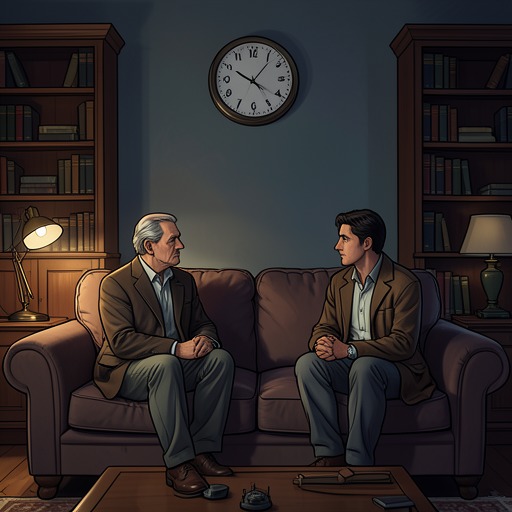
Peter initially resists therapy. He does not want to talk or accept help from Hetty Vos, whom he views with hostility, and resents that Eva arranged the appointment without consulting him. She has made the choice stark: attend therapy or face the possibility of divorce. In the session, he sits forward when asked to look at Eva as he speaks. He still loves her, does not want their marriage to end, and hopes to persuade her to give them another chance, though he cannot find the words he needs. His attendance is therefore both an act of resistance and an attempt to preserve the relationship.
Bereavement and the Hope for a Family
The wish for children becomes bound to grief and the need for family. After Peter’s father has died, his mother’s funeral leaves him feeling alone in the world. He tells Eva that he wishes he had a sibling with whom to share memories of their parents and the weight of the loss. Eva acknowledges that she cannot replace such a person, but promises that she wants to give him a family. She flushes her contraceptive pill after the funeral, and Peter agrees to try for a baby. He later recognizes that he did not know whether he truly wanted a child; what he knew was that he wanted to stay with Eva, and her willingness to carry his child reassured him.
Their attempt to conceive turns intimacy into a medical and scheduled effort. Eva becomes angry when Peter considers stopping, explaining that her longing for a child is consuming and that she hopes pregnancy will bring an end to sex organized around ovulation and ejaculation. The initial examinations find no obvious reproductive problem in Eva: her temperature chart indicates monthly ovulation, and an ultrasound shows no blockages, cysts, or inflammation in her uterus or ovaries. Peter’s semen is found to contain too few sperm, with those present moving poorly. The results place the medical problem in his body, while much of the physical treatment falls on Eva.
The couple proceed through nine IVF attempts, four ICSI treatments, and five donor-insemination attempts. Lieve, their daughter, was conceived with a donor and was not biologically Peter’s. After her death, Peter concludes that he cannot watch Eva’s healthy body continue to bear the cost of his infertility. He believes they have reached a limit, and that burying Lieve also meant burying the dream they had pursued together. Eva experiences his decision to stop as abandonment of that shared hope; for Peter, continuing has become inseparable from the danger of subjecting her to further pain after a loss they barely survived.
Renewed Intimacy and Persistent Distance
The marriage briefly opens into a wider social life. While visiting Rebecca and Steef, Peter and Eva share a meal of leftover pasta and take turns caring for Sem. Holding the child does not hurt Peter as he expected it might. Eva cries when Rebecca says she wishes the same happiness for her, and Peter proposes that they apply to adopt. Eva agrees that adoption is the fairest course, but keeps private her continuing wish for a child conceived in her own body and born from her own womb. Their agreement is real, but it does not mean that their grief or their desires have become identical.
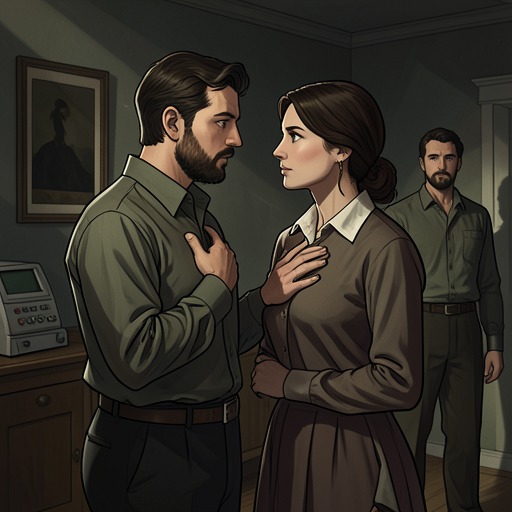
After Peter and Steef reconcile, Eva initiates intimacy with Peter. He is still angry with her and asks what she sees in him and why she wants to remain with him. Her tender kisses meet his own rough response, which carries an impulse to hurt her even as the encounter draws them back together. The scene makes the marriage’s contradiction physical: desire and resentment occupy the same moment. Their resumed sex is limited, but Peter values even a small amount of closeness as evidence that their shared life has not entirely disappeared.
Conflict and Uncertain Future
Later, Eva questions whether they belong together or want the same things. She reflects that they may have postponed living in the present by fastening themselves to the promise that life would become complete once they had a child. Peter rejects her framing as if it spoke for both of them, insists that he still loves her, and protests that she has raised these doubts during what he sees as their first day at the beach in years. Eva folds her arms, rests her forehead on her knees, and answers that the matter is not simple.
That exchange leaves the central conflict unresolved. Peter measures their marriage through his continuing love and his wish to stay; Eva is asking whether love and a shared history are enough if their aims have diverged. Their earlier efforts to conceive, their loss of Lieve, the possibility of adoption, and their renewed intimacy have not erased that question. The marriage’s significance lies in this uneasy persistence: commitment repeatedly brings Peter and Eva back into contact, but it cannot by itself make their grief, choices, or visions of the future the same.