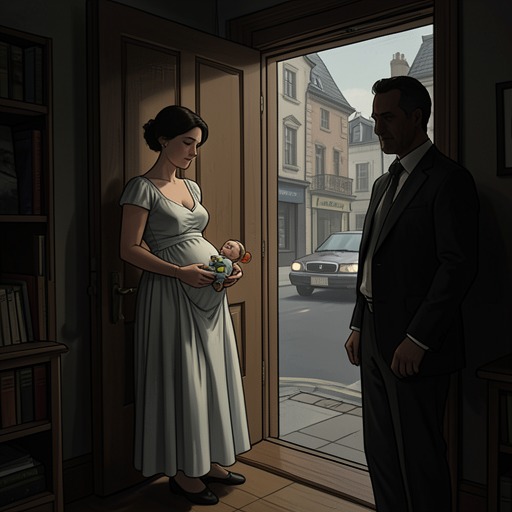
Peter and Eva’s fertility difficulties
Nieuwe burenPeter and Eva’s fertility difficulties transform their wish for a child into a prolonged struggle shaped by clinical uncertainty, sexual pressure, and competing claims over parenthood. Peter’s low sperm count and poor sperm motility narrow their options, but the problem does not end with diagnosis: it strains their marriage and ultimately becomes entangled with a plan to conceive through Steef without his informed agreement.
The search for an explanation
At first, Peter and Eva treat conception as a fresh beginning. They have sex frequently and imagine that each encounter may have made a baby; Eva sometimes feels nauseated or reads signs of pregnancy in her body. Repeated Predictor tests and subsequent bleeding interrupt that hope. After a year of trying, their general practitioner declines to refer them to a specialist, reasoning that many couples have not conceived by that point and recommending temperature tracking instead.
The advice makes sex increasingly procedural. Eva takes her temperature at half past six each morning and records it on a basal-temperature chart. A rise of 0.2 degrees Celsius is treated as a possible sign of ovulation, and intercourse becomes timed around it. Peter describes the routine as hurried and mechanical: Eva cuts foreplay short, while he is expected to ejaculate quickly enough for them both to get to work. The effort to make a child begins to displace the intimacy they had hoped parenthood would grow from.
Six months later, after a serious argument about entering medical treatment, the couple return to the doctor. Peter wants a child with Eva but resists the prospect of conception through medical intervention, which he associates with a child made in a tube rather than through love. He also admits that the scheduled sex has changed their relationship: intercourse occurs on only a few days each month, and he misses the closeness they had before trying for a baby. Eva feels betrayed by his hesitation. Her desire for a child is so consuming that she cannot accept giving up without first discovering whether a treatable medical problem is preventing conception. The next morning they receive a referral.
Diagnosis and its consequences
At the first specialist appointment, Eva is examined. The available checks show monthly ovulation, and an ultrasound reveals no blockage, cysts, or inflammation in her uterus or ovaries. Peter, meanwhile, provides two semen samples for analysis, each after five days without ejaculation. Both tests produce the same result: his sperm are too few and move too sluggishly. The account identifies a male-factor difficulty, not proof that conception is impossible; nevertheless, the couple are told that medical assistance is now their remaining route to having a child.
The diagnosis changes the meaning of Peter’s resistance. He had wanted their child to come from an expression of love, yet the medical findings make unaided conception appear increasingly unlikely. Eva’s desire is not abstract: she remembers wanting a child while teaching young children, envying the mothers whose children wrapped their arms around them. She imagines pregnancy and motherhood as a physical bond, a baby made from her own flesh and blood and connected to her for life. Peter’s willingness to give her the child she longs for had helped make him an easy person to choose; infertility places that promise under pressure.
The couple do enter the medical process, and Eva later refers to having had eggs aspirated from her body. The evidence presents treatment as an intimate bodily burden as well as a clinical intervention, while leaving the precise procedures and outcomes unspecified. Peter’s sperm results remain a recurring fact in their lives, invoked first as an obstacle and later as the basis for decisions that affect other people.
From fertility treatment to sexual strategy
The diagnosis reappears during the couple’s encounter with Rebecca and Steef. Rebecca proposes that Eva and Steef have sex around Eva’s next ovulation, with the possibility that the encounter will be repeated if conception does not occur. She frames the approach as soft coercion and suggests that Peter’s sperm might still fertilize an egg despite the test results. A condom is part of the discussion, but Rebecca raises the possibility that it could leak. The plan therefore takes the couple’s fertility problem beyond treatment: it makes a possible pregnancy depend on Steef’s participation while withholding the full purpose from him.
Peter and Eva’s agreement to take part does not erase the difference between their stakes. On the morning of the encounter, Peter watches Eva closely and recognizes that she is frightened but determined. He considers asking whether they should stop, yet believes she would be angry if he raised the question at that late moment. Their affectionate exchange—Eva’s red-painted nails, Peter kissing her fingers, and their expressions of love—sits beside his awareness that she is about to have sex with another man. The scene holds tenderness and unease together rather than presenting the arrangement as uncomplicated consent or mutual freedom.
Afterward, Steef brings Eva a morning-after pill obtained from a night pharmacy. He apologizes for his reaction to the condom accident and says that the encounter involved a kind of intimacy, though not being in love. He also says he does not want another child: Sem was conceived against his will, and Steef regards himself as too unstable and too attached to freedom to be a proper father. Eva says she will take the pill after breakfast, but privately wants to preserve the small chance of pregnancy and feels that she is always the one expected to make sacrifices. The conflict is no longer simply whether the couple can conceive; it is also about who may decide whether a pregnancy continues to be possible.
Paternity, blame, and the meaning of infertility
When Eva later suspects that she is pregnant, she recalls both her earlier longing for motherhood and the physical signs she associates with her pregnancy with Lieve. She is nearly certain, though the evidence here does not establish a test result. Against that uncertainty, Peter’s sperm diagnosis now carries a destabilizing implication: the possible child may not have been conceived with his sperm. Steef eventually confronts Eva and Rebecca, accusing them of stealing his semen with Rebecca’s consent and insisting that he has a right not to have another child. His anger exposes the ethical cost of treating a condom failure and another person’s reproductive wishes as instruments of the couple’s struggle.
Peter, meanwhile, turns the diagnosis into a spiritual explanation. He interprets his sluggish sperm as a sign that he is not meant to reproduce and that the couple had tried to bend the truth by making him a father. This conviction gives apparent purpose to a painful medical fact, but it also recasts infertility as destiny rather than uncertainty or bodily limitation. Across the story, the diagnosis changes meaning according to who invokes it: for Eva it is an obstacle to motherhood, for Peter a challenge to his identity and eventually a supposed cosmic warning, and for Steef a reason his reproductive wishes and consent have been violated. Their fertility difficulties thus become a dispute not only about the possibility of a child, but about whose body, choice, and claim to parenthood count.