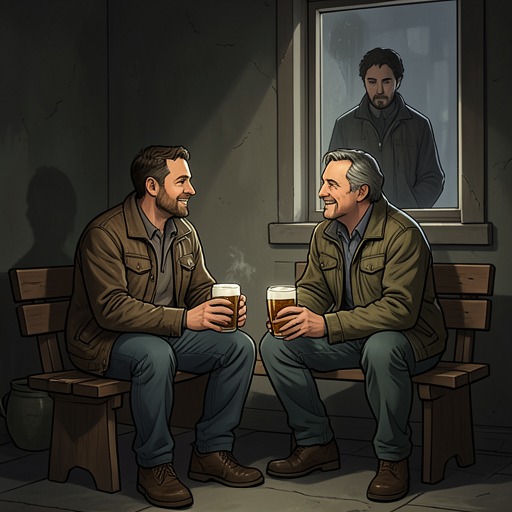
Peter and Steef’s Friendship
Nieuwe burenPeter and Steef’s Friendship becomes a rare source of companionship for Peter: it gives him a place to be understood without having to explain himself, and gradually opens a new social and emotional world around him. Built first through beer, motorcycles, and an unspoken code of discretion, the bond later deepens through disclosures of pain, music, and the intimacy of being welcomed into Steef and Rebecca’s family life.
Introduction and Shared Interests
Steef enters Peter’s life through an ordinary neighborly gathering. Rebecca brings cold beer and introduces the strikingly tall, blond man, whose firm handshake and blue eyes make an immediate impression. Steef’s first comment is about Peter’s immaculate lawn. The exchange soon turns into a relaxed evening: while Eva talks gardening with a neighbor, Steef keeps drawing beers from his BeerTender, and he and Peter discover a shared enthusiasm for motorcycling.
Steef has a Kawasaki chopper in his shed; Peter sold his Yamaha Cruiser the previous year. Steef regrets the sale and speaks of riding as freedom, with the wind in one’s hair. Peter agrees, but keeps to himself that, for him and Eva, something had mattered more than riding: one last fertility-treatment attempt in Belgium, which resulted in Lieve. The contrast establishes a quiet difference in what each man’s memories of freedom contain. Their first connection does not require Peter to reveal it.
Steef takes Peter to see the chopper. With beers in hand, they circle the polished motorcycle, and Peter runs a hand over its soft black seat and chrome mirrors. Steef invites him on a Sunday ride with colleagues; Peter gladly accepts. Their friendship is given a practical rhythm almost at once: a shared interest, a machine to look at, and a plan to spend time together outside the house.
Trust Without Confession
The bond becomes more explicit when Peter and Steef speak about therapy. Peter says he has stopped because talking about his feelings is not for him. He privately worries that Eva may have told Steef about his infertility and fears being seen as a man unable to make his wife pregnant. He also suspects Rebecca’s looks express pity rather than desire. Steef does not confirm or exploit those fears. Instead, he says he too has quit therapy.
Steef explains that an incident at work in Utrecht led the police chief to urge him into treatment. He tried, but felt terrible there; he blames the system rather than himself. He has left narcotics work and now rides a motorcycle while issuing traffic tickets. Peter does not ask what the incident was, and Steef shows no interest in why Peter attended therapy. The narrator identifies this non-interrogation as the moment their friendship is sealed: the men connect through silent understanding, not an exchange of private histories. Their closeness is not founded on full disclosure, but on the confidence that disclosure is not being demanded.
Steef then recommends a visit to the shooting range, saying that firing a few rounds at a target works better than therapy for relaxation. The suggestion brings their friendship into contact with a more troubling form of coping: the two men share an appetite for direct, physical release, while Steef presents shooting as an alternative to treatment. Peter is invited not merely to talk but to join him in an activity.
Music, Trauma, and Mutual Recognition
Steef’s guardedness does not mean that he has no need to be heard. In a later gathering, Rebecca explains that he served in Srebrenica and has never recovered from what happened there. Steef describes a shell exploding nearby, his own apparently unthinking rush through gunfire, and the delayed realization that he had survived while thousands of Muslim men had not. He urges Peter and the others to fight death and take what they can from life, gripping their wrists hard enough to hurt as he tells them to break out of their self-made prisons.
The force of that appeal leads straight into music. Steef calls music his salvation and points Peter toward U2 rather than therapy. Peter has the band’s albums arranged alphabetically; Steef asks for All That You Can’t Leave Behind and singles out A Beautiful Day as the song that carried him through crisis. He tells Rebecca he would want it played at his funeral. As it begins, Steef raises his clenched fists, Peter turns up the volume, and the moment becomes a shared act rather than another account of suffering. Peter watches the men dance with their eyes closed while Rebecca looks on serenely.
For Peter, this welcome changes what closeness seems capable of holding. He believes he could love more than one person at a time, and values that Rebecca does not make him minimize his grief or withdraw from him. The friendship with Steef is part of a larger trust between the two couples, but its male intimacy has its own form: shared music, physical gestures, and space to remain silent. When Peter holds Sem, Steef’s baby, and can stroke his soft head without pain, the evening also places Peter’s loss beside the possibility of affection that does not erase it.
A New Space in Peter’s Life
Peter later tells Eva that they have grown closer, though he knows this is far from the truth. Their five years of fertility struggle have revolved around sperm, eggs, temperature, hormones, hope, grief, and pain, until their shared world seemed to shrink around them. Now, however, each has found room elsewhere: Peter has Steef and has bought another motorcycle; he rides with Steef almost every Sunday and is planning to attend a U2 concert with him. Eva goes out again, and the couple sometimes look after Sem. Peter and Eva have resumed sex, though he describes it as infrequent and modest, and is grateful for even a small remnant of connection.
The friendship therefore has a double significance. It offers Peter genuine comfort and a way back into ordinary pleasures, but it also makes visible how far he and Eva have drifted apart: Peter’s growing closeness with Steef coexists with, rather than repairs, the distance in his marriage. Their bond begins in the freedom of a motorcycle ride and develops into something more sustaining—a relationship in which pain can be acknowledged, music can answer what conversation cannot, and companionship does not depend on pretending that everything is well.