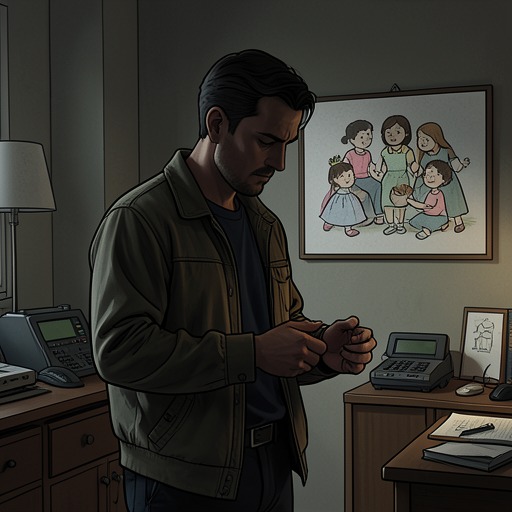
Peter decides to pursue adoption
Nieuwe burenPeter decides to pursue adoption after a sudden return of energy leads him to reconsider the choices that have shaped his and Eva’s life. The decision offers them a new shared direction after infertility and loss, but it does not erase their grief or resolve the difference between Peter’s acceptance of adoption and Eva’s continuing wish for a child who grows in her body.
Background and Change of Direction
At a therapy session, Peter tells Hetty that he would rather continue with his life than keep examining whether he is entitled to exist. He acknowledges that grief has become less constant: he and Eva have new friends, he listens to music again, and he rides his motorcycle. Yet therapy itself brings the suffering back into view. After leaving, he feels a renewed appetite for ordinary life and imagines inviting Steef for a beer at the beach, taking a holiday, cycling across the heath, going out with Eva, finding a new job, and attending a concert.
Driving past green fields and newly built neighborhoods, Peter sees the couple’s difficulty not as a lack of options but as a loss of confidence in their decisions. They had chosen marriage and then chosen to have a child with conviction. When conception did not come easily, they abandoned their intention to avoid medical treatment and entered a succession of fertility decisions that, in his view, left them overwhelmed and estranged from themselves. He concludes that they need not rely on Hetty to find a way forward: they must stop doubting and choose a new shared goal.
Adoption as a Chosen Future
Peter names that goal as adoption. He regards it not as a lesser substitute for a biological child but as another affirmative choice: the child would have no blood tie to either parent, which he considers fairer to all three. The distinction matters to his decision. Adoption is not framed as a second-best outcome after failed treatment, but as a different route into parenthood that Peter believes he and Eva can choose together.
His resolve takes shape as he drives, with the music turned up and his heart pounding. The guitar solo of Guns N' Roses’s Sweet Child O’ Mine brings Lieve to mind; the song had once carried promises for their daughter, and its title turns the new hope toward the child they lost. The forward movement of Peter’s decision therefore begins not by leaving Lieve behind, but by passing through a reminder of her.
Lieve’s Grave and Unfinished Grief
Peter turns away from the route home and goes to Lieve’s grave, a place he has not visited since the funeral and has avoided to Eva’s frustration. Her grave is on the children’s section of the cemetery, marked by a white fieldstone bearing the words For always in our hearts and surrounded by forget-me-nots. Nearby playgrounds and sports fields make the sound of living children part of the setting; Eva has kept the grave tidy, adding pink flowers beside two cheerful plastic Disney dwarfs.
Peter lays a white rose against the stone and kneels. He wants to feel love for the child he says was not his and with whom he never formed a bond, but what he feels is guilt. The visit complicates any reading of adoption as simple recovery: he can envision a future child while still struggling to recognize his connection to the child who died. His earlier account of feeling better likewise coexists with the pain of being reminded of what happened.
A Shared Plan, Not Yet a Shared Longing
In a later domestic scene with Rebecca and Steef, Peter holds their baby, Sem, and tells Eva that they will sign up for adoption. Eva responds positively to the fairness of adoption, but privately withholds her dream of a child conceived in her body and born from her. Her words and silence expose a difference that Peter’s sudden certainty does not settle: he has made adoption his chosen path, while Eva’s desire for a biological child remains alive.
That tension persists in Eva’s later account of bodily unease and the possibility that she might be pregnant. She avoids running, cycling, and bumpy roads, while telling herself that pregnancy would be a miracle and a second chance. The adoption decision is therefore a genuine turn toward a common future, but not proof that the couple’s hopes have become identical. Its significance lies in Peter’s attempt to replace the exhausting proliferation of medical choices with a deliberate commitment, even as grief and differing desires continue to shape what that commitment means.