Peter's electric guitar
Nieuwe burenPeter's electric guitar is both the remnant of an early ambition and the instrument through which Peter briefly recovers it. After more than fifteen years without playing, he plugs it in at home and performs a passage from Hey Joe for Steef. The guitar makes an old, frustrated dream audible again, while the shared performance shifts music from solitary aspiration into a moment of ease and physical closeness.
Early ambitions and abandonment
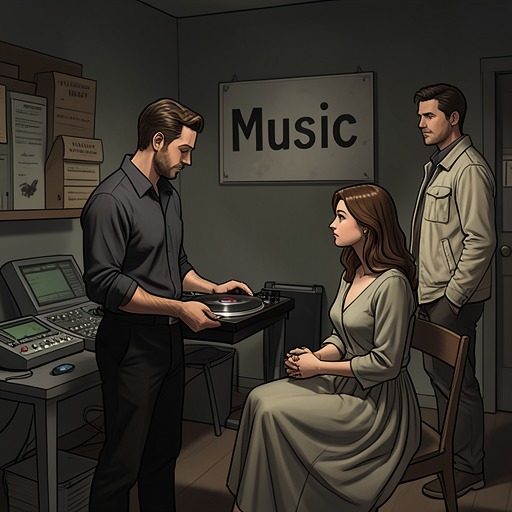
As a teenager, Peter imagined making music for a living. He invested his money in equipment for DJ work, but saw that work chiefly as a way to pay for guitar lessons: what he really wanted was to become a guitarist in a rock band. At parties he played records for a hundred guilders an evening, while at home he practiced until his fingers were sore. The guitar thus belonged to a larger hoped-for life, one Peter tried to finance and prepare for rather than merely admire from a distance.
His ideal was the commanding rock soloist. Peter admired guitarists whose eyes were closed and whose attention seemed given wholly to the sound of the strings. In his youthful picture of a band, the other musicians were needed mainly to keep rhythm; the guitarist shaped the music and stirred the audience. Posters of Led Zeppelin, Jimi Hendrix, Keith Richards, and Ritchie Blackmore surrounded him as he practiced. The instrument carried an imagined identity as much as a musical skill: playing meant becoming self-possessed, powerful, and impossible to ignore.
That aspiration met a decisive setback at an audition for On the Road, a locally popular band. Peter was so nervous that he vomited and then could not produce a note. The band said he lacked stage presence and advised him to do something about his fear of failure, advice he never followed. Looking back, he recognizes a contradiction in that history: fear of failing repeatedly brought failure, while he suspects that success may have frightened him even more. The guitar therefore recalls not only ambition but also a performance he could not make happen.
The guitar returns at home
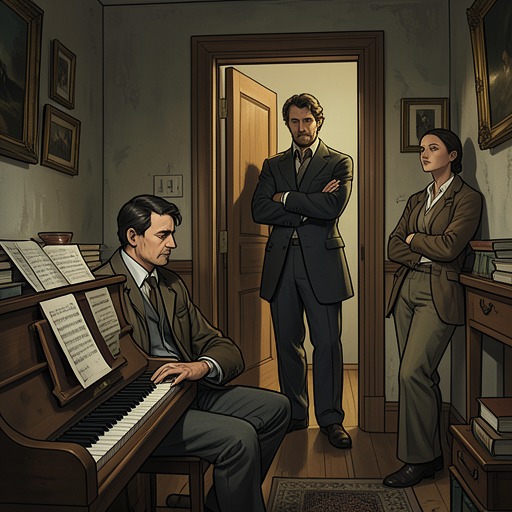
Years later, during a tour of Peter and Eva's house with Rebecca and Steef, Peter and Steef linger upstairs by Peter's music collection. Peter talks about his former life as a DJ and guitarist, then qualifies the story: he has not played for more than fifteen years and was never very good. Steef asks to hear him anyway, treating the gap and Peter's self-deprecation as no reason not to play. The request brings the neglected instrument out of memory and into the room.
Peter plugs the guitar into an amplifier and runs his fingers over the strings. He notes that an electric guitar quickly sounds like something, and begins the Hey Joe passage associated with Jimi Hendrix. What follows surprises him: the playing is still in his fingers. The instrument is not presented as proof that Peter became the guitarist he once imagined. Instead, its immediate, recognizable sound gives him a way back into playing without requiring him first to overcome the old audition or demonstrate mastery.
A shared performance
Steef searches through Peter's CDs and rolls a cigarette while Peter plays. He closes his eyes and moves his head with the music, then begins singing softly. Their performance is no longer organized around Peter's adolescent ideal of the isolated soloist. Peter supplies the guitar part, but Steef joins it with his voice; attention and pleasure pass between the two men rather than belonging to the guitarist alone.
The words they sing describe a man going to shoot an unfaithful partner. In the room, however, the song's gun and jealousy do not turn the performance into a confrontation. Peter and Steef look at one another and smile; their laughter is described as a release. The contrast lets the song's violent story remain present without dictating the tone of the encounter. The guitar gives them a structure to share, while their looks, singing, and laughter make the exchange personal.
Significance
After the laughter, Steef places a large, warm hand at the back of Peter's neck and tells him to relax. He presses Peter's shoulders down, turning the performance into a moment of direct bodily reassurance. The guitar has helped bring about this change in the scene: it first prompts Peter to act despite his modest account of his ability, then holds the two men's attention together long enough for music to become touch and comfort.
The instrument's significance rests in the difference between the life Peter once attached to it and what happens when he picks it up again. As a teenager, he wanted to dominate a stage as a solitary guitar hero; in this later encounter, he plays after admitting his limits and is met not with judgment but with Steef's participation. The episode does not establish that Peter resumes his musical ambitions or resolves his fear of failure. It shows something narrower and more immediate: the old guitar remains playable, Peter's fingers remember, and a dream he had abandoned can still make a brief connection possible.