Reproductive Deception and Coercion
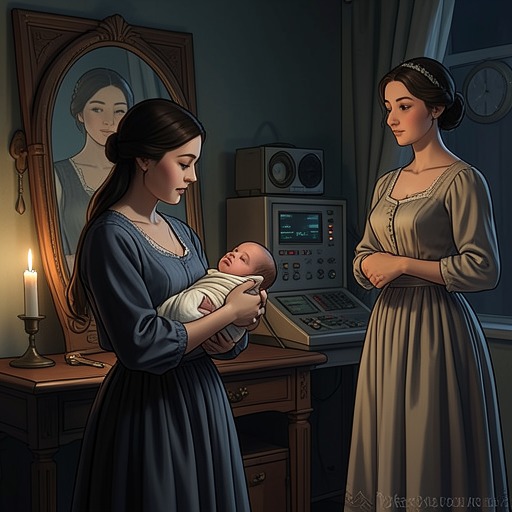
Nieuwe burenReproductive deception and coercion become central when the desire for a child is treated as grounds to override another person’s choice about conception. The novel connects this conflict to Peter and Eva’s infertility and to Rebecca’s earlier account of how Sem was conceived: what one character calls a loving intervention, another experiences as the theft of his reproductive autonomy. The disagreement is not only about who will raise a child. It concerns whether a person may be made a genetic parent without informed consent, and who gets to define the consequences afterward.
Infertility and the pressure to conceive
Peter and Eva’s story gives the later scheme its emotional and practical context. After a year of trying, their doctor initially dismisses the need for concern and recommends tracking Eva’s basal temperature. The thermometer and temperature chart turn sex into a scheduled task: a rise of 0.2 degrees Celsius signals a likely ovulation, and intimacy is reduced to timing ejaculation before they leave for work. Eva is awake before the half-past-six alarm, while Peter misses the affection and spontaneity of their earlier relationship.
The pressure is not shared in the same way. Peter objects to entering the medical process because he wants a child conceived through love rather than in a laboratory; Eva, whose longing for a child feels overwhelming, fears giving up without discovering whether a treatable problem is preventing pregnancy. After an argument, they seek a referral. Eva’s examination finds no apparent abnormality, and her monthly ovulation is confirmed, but two semen tests show that Peter has too few sperm and that those present move poorly. The diagnosis leaves them with medical assistance as the only identified route to having a child. The novel establishes both the strain of infertility and the unequal meanings the couple attach to treatment before Rebecca proposes a different route.
Rebecca’s account of conception and consent
Rebecca has already framed reproductive deception as a form of benevolent pressure. When Peter asks how she became pregnant with Steef’s child, she answers by suggesting that people sometimes forget the pill, then describes having given Steef a push in the right direction. She presents the outcome as vindication: Steef is delighted with Sem, and fatherhood, in her view, has made him a better person. She also acknowledges that he was angry for several weeks and left before returning, kneeling to kiss her pregnant belly and saying he would take responsibility. In her account, his eventual attachment to the child softens the original breach; it does not erase the fact that he had not chosen the pregnancy.
Her proposed solution for Eva repeats that logic on a larger scale. Rebecca says Steef did not want a child with her and would be even less willing to have one with Eva, but recasts the plan as a way for the two couples to help each other. She proposes not consulting either man because discussion would make matters complicated. Instead, Eva is to calculate her next ovulation, and the women will arrange a sexual encounter with Steef; if conception does not happen the first time, they can try again. When Eva raises the condom, Rebecca suggests that it could leak. She rejects the description of the plan as trapping the men, appealing instead to fate and the possibility that Peter might still father a child despite his test results.
The language of love is crucial to Rebecca’s justification. She tells Eva that the child would be conceived and welcomed with love, contrasting that with conception in a laboratory. Eva is moved enough to embrace her and imagine a future with a buggy and a child. But the hopeful domestic image rests on a concealed decision: Steef is not to know that conception is the purpose of the encounter, and Peter is not to be asked before the plan proceeds. Their exclusions are not incidental details; they are what make the proposed help coercive.
The condom incident and competing claims
A later encounter brings the question of risk into the open, although not the full plan. Steef visits Eva carrying a white box of medication he has obtained from a night pharmacy after what he calls a condom accident. He apologizes for his reaction and says he wants her to take no risk of pregnancy. He describes their intimacy as more than sex with a stranger, while carefully distinguishing it from being in love. Eva tells him she is not pregnant and does not look at the box. The scene places practical contraception beside an intimate bond: emotional closeness may explain why the encounter feels different, but it does not settle what either person has agreed to regarding pregnancy.
Steef’s explanation also complicates Rebecca’s story about fatherhood. He says he does not want another child, that Sem came into the world against his will, and that he is trying hard to be a good father despite feeling too unstable and too attached to his freedom. Rebecca had described him as transformed by fatherhood and ultimately willing to take responsibility; Steef describes responsibility as something he is attempting to perform despite an unwanted conception. The contrast exposes the weakness in treating a child’s eventual care as proof that the original choice was acceptable.
Exposure and the meaning of parenthood
When the scheme is disclosed, Steef names the violation directly. He accuses Rebecca and Eva of taking his sperm, stresses that Rebecca acted with her wife’s agreement, and calls what they did criminal. His anger is directed at being treated as though the women could decide what his body and reproductive capacity were for. He argues that children need fathers and invokes his own experience with Sem, while condemning the women for presuming they could make that decision on his behalf.
The confrontation does not make the ethical conflict simple: Peter and Eva’s longing is real, and Rebecca understands her proposal as a way to give Eva the child she wants. Yet the novel distinguishes that longing from consent. Peter’s fertility diagnosis does not give the others authority over Steef’s sperm, just as a loving intention cannot make concealment equivalent to agreement. Rebecca’s earlier account turns the successful outcome of Sem’s birth into an argument for her method; Steef’s later accusation reveals what that reasoning leaves out. The concept’s significance lies in this clash between desired parenthood and the right to choose whether to conceive: care after a birth may be meaningful, but it cannot retroactively supply informed consent.