Bax Denziger
Night TrainBax Denziger is Jennifer Rockwell’s department head and a prominent astronomer at CSU. In Mike Hoolihan’s inquiry into Jennifer’s death, he presents both a public portrait of scientific expertise and a personal account of her intellectual ambition, her thoughts about death, and a serious mistake she made at work shortly before she died. His testimony adds essential context to Jennifer’s final period, but it does not settle the meaning of her death or the full circumstances behind the workplace failure.
Identity and Position
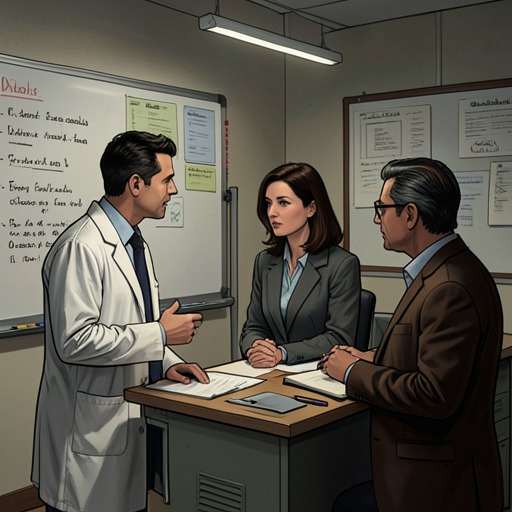
Denziger is introduced to Mike in the corridor of Jennifer’s academic department and brings her friend and investigating detective into his office. The office appears to Mike to contain an immense quantity of readily accessible information; Denziger offers coffee and agrees to an informal, off-the-record interview with a tape recorder. The conversation is prompted by Colonel Tom and Miriam Rockwell, who have asked Mike to inquire into their daughter’s death. Denziger’s role as department head gives him access to Jennifer’s professional life, while the interview places him among the people whose memories Mike must compare rather than simply accept as a complete account.
He is also a public figure in his field. Denziger owns a twin-prop airplane and a second home in Aspen, and he is described as a skier, mountaineer, and former weightlifter for the state. He fronted the Channel 13 series “The Evolution of the Universe” and appears on news-magazine programs when developments in his discipline attract attention. Mike regards him as a practiced communicator who speaks in polished, camera-ready paragraphs. That fluency shapes the interview: Denziger can explain scientific work for a general audience, but the orderly confidence of his explanations does not make Jennifer’s private distress easy to interpret.
His Assessment of Jennifer
When Mike asks what Jennifer did at work, Denziger describes her as an inspiration to her colleagues. He remembers her as persistent, tough, and fair, emphasizing the toughness of her intellect. He does not claim that she was already at the level of a Nobel laureate; instead, he places her in cosmology, a field in which women had made lasting contributions, and says she had a reasonable chance of adding to them. His praise is therefore specific to her promise as a researcher, not merely a general expression of affection after her death.
Denziger also distinguishes Jennifer’s outlook from a narrowly technical attitude toward science. He acknowledges that scientists may find something spiritually resonant in the grandeur and complexity of the universe, while insisting that the universe under study is real rather than a substitute for reality. Jennifer, as he recalls her, was more romantic than those who reduced every question to a physics problem. To her, the universe’s strangeness, beauty, and terror belonged to the world being investigated; scientific attention did not diminish its scale. This recollection presents her ambition as intellectual and imaginative at once.
Jennifer’s Reflections on Death
Denziger tells Mike about a recent conversation in which Jennifer spoke of death. He remembers her invoking Isaac Newton’s prolonged attempts to look at the sun and an aphorism about the danger of staring at the sun or death without protection. The recollection connects the work of observation with the limits and risks of confronting what cannot readily be endured or comprehended. Denziger says he has been replaying the conversation in his mind, suggesting that it acquired new weight for him after Jennifer died.
Jennifer also asked why Stephen Hawking had made advances in understanding black holes when many physicists were working on them. Denziger initially offered the conventional explanation that Hawking was exceptionally intelligent. Jennifer, as he recalls it, proposed a more romantic one: Hawking could understand black holes because he could stare at them. In her account, black holes signified oblivion and death, and Hawking’s sustained confrontation with that subject enabled him to see what others could not. Denziger’s testimony makes the conversation more than an abstract scientific anecdote: it shows Jennifer turning a question about discovery into a reflection on how a person might face death.
The Workplace Failure
Denziger’s account changes when he discloses that, during the week before her death, Jennifer made a major mistake at work. He had assigned her to defend distances in M101 while Princeton’s competing work was outperforming theirs. He begins to explain the technical process: a plate-density scan produced millions of numbers that were compared and calibrated against algorithms. The available account does not establish the complete nature or consequences of Jennifer’s error, so the details should not be treated as a finished explanation of her conduct or state of mind.
The mistake nevertheless becomes an important part of Mike’s reconstruction. Later, Mike tells Colonel Tom that Denziger had said Jennifer was beginning to lose ground at work and had been talking about death. Mike connects those reports with other pressures and clues, but his account to Colonel Tom is an explanation assembled during an inquiry, not proof that any single factor caused Jennifer’s death. Denziger’s testimony establishes that a serious professional failure occurred close to the end of her life; it does not establish why it occurred or what Jennifer herself believed it meant.
Evidence and Narrative Significance
After Jennifer’s death, Mike identifies Denziger’s damaged algorithm as one of the misleading clues she left behind. He calls it a blind, alongside other apparent leads, and interprets it as part of a pattern Jennifer may have expected the people close to her to follow. This later interpretation complicates the workplace revelation: the algorithm is at once associated with an actual professional failure and with the possibility of deliberate misdirection. The evidence does not fully resolve how those meanings fit together, and Denziger’s account cannot by itself distinguish a clue from a decoy.
Denziger’s importance lies in the difference between what he can report and what Mike needs to know. He can testify to Jennifer’s scientific ability, describe her approach to cosmology, remember a conversation about death, and disclose a consequential error at work. These facts sharpen the picture of Jennifer without yielding a definitive motive or verdict. His polished public manner and professional standing make him a credible source on her work, while the limits of his knowledge preserve the novel’s larger uncertainty about how much anyone can know about another person’s final thoughts.