CID
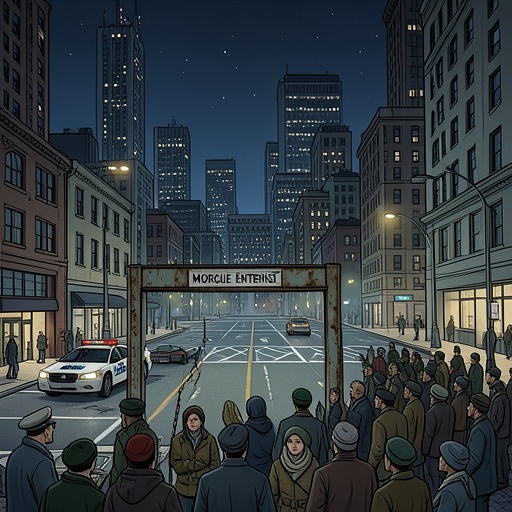
Night TrainCID is the downtown investigative organization that frames Detective Mike Hoolihan’s police work and the investigation of Jennifer Rockwell’s death. With three thousand sworn personnel and a shifting array of departments, subdepartments, sections, and units, it is presented as a sprawling institution whose formal divisions impose order on a city understood as a continuing source of offenses.
Structure and Mandate
CID contains units devoted to Organized Crime, Major Crimes, Crimes Against Persons, Sex Offenses, Auto Theft, Check and Fraud, Special Investigations, Asset Forfeiture, Intelligence, Narcotics, Kidnapping, Burglary, Robbery, and Homicide. Their names and arrangements are described as subject to continual change. The contrast between a glass door marked Vice and the absence of any door marked Sin captures the institution’s practical outlook: police work classifies offenses and responds to them, rather than claiming to embody a universal moral scheme. Its general purpose is cast as defense against the city’s offenses.
The divisions also carry unequal cultural prestige. Hoolihan describes Homicide as the department that commands the greatest attention, the unit other police regard as the central show. That standing reflects the intensity attached to murder investigations, but also the way the institution’s work is organized around distinct specialties, each with its own routines and reputation.
Mike Hoolihan’s Career in CID
Hoolihan’s path through the department gives the organizational structure a working history. After leaving a master’s program in Criminal Justice to attend the Academy, she began as a beat officer in the Southern and served in the Neighborhood Stabilization Unit in the Forty-Four, walking foot patrol and answering radio calls. Five years in the Senior Citizens Robbery Unit followed. Her proactive decoy and entrapment work helped bring her into plainclothes, and a later examination took her downtown with her shield.
By the time of the main investigation, Hoolihan is assigned to Asset Forfeiture, but she has spent eight years in Homicide working murder cases. Her movement across patrol, robbery, and investigative assignments shows CID not only as a set of offices but as a career system: tests, specialized experience, and changing placements shape an officer’s authority and daily work.
Procedure and Investigative Discretion
CID’s rules constrain what its detectives can do, especially when the evidence is not yet sufficient for arrest. When Hoolihan decides to speak with Trader Faulkner, she considers having officers take him from a seminar and bring him downtown, but recognizes that the available information does not establish probable cause. Rather than force an arrest, she calls his campus room at six in the morning and asks him to come in. The choice makes the boundary between suspicion and lawful action concrete: urgency does not itself supply the grounds required for an arrest.
Once Faulkner arrives, Hoolihan conducts the interview without a staged good-cop/bad-cop partnership. She says that the Escobedo ruling has deprived the bad-cop routine of its old tactics and that she needs to work alone, in her own way. The account presents procedure not as a detachable legal formality but as a condition that changes the investigator’s options and makes personal judgment more consequential.
That judgment is also described as an internal process. Hoolihan says she must transform suspicion into conviction within herself and temporarily adopt Colonel Tom’s belief that Faulkner committed the crime. She then asks Faulkner to recount March 4 so she can compare his account with the evidence already assembled. The procedure depends on disciplined alignment with a theory of the case, while the comparison with evidence leaves that theory open to testing.
Workplace Culture and Gender
The novel depicts CID’s police culture as masculine in both its self-image and its account of violence. Hoolihan questions whether women can endure Homicide work and reflects that murder is generally committed, investigated, and prosecuted by men, while women are more often positioned as victims, bereaved relatives, or witnesses. Her perspective makes the division’s prestige inseparable from the gendered expectations surrounding violence and police work.
She also identifies breaking news of a death as an aspect of homicide work in which women may be better equipped than men. In her account, male officers can mishandle the emotional burden of notifying the bereaved, while women feel its weight immediately. This is Hoolihan’s professional assessment rather than an impartial departmental policy, but it reveals that CID’s work includes emotional labor as well as investigation, and that officers’ conduct toward families is part of the job’s demands.
Small encounters with forms of address expose the same gendered friction in ordinary departmental life. During a call concerning Phyllida Trounce, Hoolihan objects when the person assisting her calls her sir; he apologizes and switches to ma’am. The correction is brief, but it places recognition of a woman officer’s identity inside the routine communications through which the institution operates.