Chief Medical Examiner's office
Night TrainThe Chief Medical Examiner's office is where the investigation of Jennifer Rockwell’s death becomes both a medical procedure and a problem of interpretation. In its freezer and examination room, officials document her body and investigate the circumstances of her death; later, Mike Hoolihan watches the recorded examination and reads its report. The office can establish physical findings, but neither those findings nor the official classification provide a final answer to the question of why Jennifer died.
Setting and Function
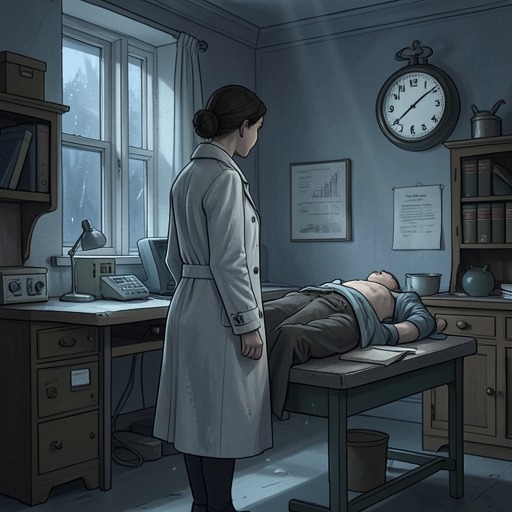
The office is located in the Battery district, near Jefferson. It serves as the destination for deaths considered suspicious, violent, unusual, or unattended: the deceased are brought there, held in a walk-in freezer, and examined. The account describes a system that has changed its tools over time. Photographs once taken with a Polaroid camera and a microphone have given way to a camera that records the examination. Clothing is examined, removed, bagged, and sent to Evidence Control. These details place the office within a wider municipal process, in which documenting a death is also a matter of evidence handling and official procedure.
The office’s wall carries a Latin inscription whose sense is that talking should cease and laughter flee, because death assists the living in this place. The motto gives institutional purpose a stark expression: the examination of the dead is undertaken for the sake of the living. Yet the scene also exposes a tension in that promise. Procedures can describe and test a body, but they do not automatically disclose the life or state of mind behind it. The office is therefore at once a practical workplace and a boundary between observable evidence and unanswered questions.
Jennifer Rockwell’s Examination
The sequence begins with the investigation’s formal timings: Mike Hoolihan is summoned by Detective Sergeant John Macatitch at 20:15, and Jennifer is pronounced at 20:55. Twelve hours later, she is examined. On March 5, Colonel Tom identifies his daughter at the office, leaning against a freezer door; Miriam Rockwell waits in the car with John Macatitch. The identification makes the institution’s impersonal process immediate and familial: the body being handled as evidence is also the daughter whom her father has just lost.
The examination is directed by Tony Silvera, with Paulie No performing the work. Jennifer is recorded as a well-developed, well-nourished woman, five feet ten inches tall and approximately 140 pounds. The process includes an external examination and chemical tests intended to establish whether she fired the .22 revolver. The weapon has a personal connection: Colonel Tom bought it for her years earlier and taught her to use it. That history gives a routine forensic test an added significance without making the test itself a complete explanation of her death.
The examination continues through internal investigation and tissue sampling. Its recorded form allows Mike to return to the scene as a viewer rather than as a participant standing in the room. He watches from a couch, takes notes, and uses pause controls. His work in homicide had made autopsy rooms familiar, and his current work in Asset Forfeiture still brings him into contact with bodies; he distinguishes that professional familiarity from the personal force of watching Jennifer’s examination. The camera preserves procedure, but for him the recording is also a way of bearing witness to someone he knew.
A significant finding emerges during the examination: Jennifer appears to have shot herself in the head three times. The discovery draws a reaction from Silvera and Paulie No, who lean toward the evidence and then move back in surprise. Mike registers Colonel Tom’s interpretation but remains uncertain about how much the finding can establish. The office reveals a physical fact that sharpens the investigation while leaving its larger human question unresolved.
Evidence, Reports, and Classification
The examination’s findings continue to shape the case after the procedure. Eight days later, on March 13, Jennifer is still in the walk-in freezer at the office. When Mike speaks with Trader Faulkner, he learns that Jennifer tested positive for ejaculate in oral and vaginal samples. The information complicates the assumptions surrounding the investigation, but it does not by itself establish what occurred or explain her death. The office’s work supplies evidence for interpretation; the evidence still has to be weighed against what remains unknown.
On March 14, Colonel Tom sends Mike a sealed binder containing the autopsy report, along with a dozen red roses and a note of thanks, apology, and love. Mike has already seen the recorded examination; reading the report is a second encounter with the office’s account of Jennifer, now mediated by a document that Colonel Tom has expedited and that may have been edited. The report thus reaches him not as a neutral object detached from the family’s grief, but through a father trying to manage the consequences of his daughter’s death and an investigator deciding what the evidence can support.
The office also belongs to a legal history. The narration recalls that a coroner was once a tax collector and that people who died by suicide could lose their property as felons. In the present, the coroner works from the Chief Medical Examiner's office, and the coroner, Jeff Bright, is a friend of Tom Rockwell. Bright returns an undetermined finding. Colonel Tom had pressed for an accidental classification, but accepts the undetermined result, as do the others involved. The official decision records the limits of what the investigation can declare rather than converting uncertainty into certainty.
From Physical to Psychological Examination
The office’s procedures become a formal and thematic counterpart to Mike’s later attempt to understand Jennifer’s life. In the second part, he calls his inquiry a psychological autopsy. He compares his ballpoint, tape recorder, and computer to the instruments Paulie No used in the examination room: both inquiries gather and arrange material, though one examines a body and the other reconstructs a mind from records, memories, and behavior. The comparison makes the office more than a location in the investigation; it provides the model for the book’s change in method.
Mike’s retrospective work includes a list headed Stressors and Precipitants, an attempt to organize possible pressures after Jennifer’s funeral. The evidence he assembles includes her concealed mental-health crisis. In a recorded message to Trader, Jennifer says that about a year earlier she began to feel that she was losing control of her thoughts. She explains that she avoided going through Hi Tulkinghorn because she feared he would tell her father, and describes seeking help and taking changing doses of medication. She also says that the treatment had stopped helping and that she was frightened of doing something unprecedented and inhuman. This account adds information unavailable from the physical examination, while remaining Jennifer’s own retrospective explanation rather than a diagnosis made by the office.
The contrast between the two forms of examination defines the office’s importance and its limits. Its instruments can document the body, test for traces, and contribute to an official ruling; they cannot make Jennifer’s private experience fully recoverable. Mike’s later inquiry takes the office’s investigative discipline into another register, but it does not claim to solve the unknowable by collecting more evidence. The Chief Medical Examiner's office stands at the point where the case’s observable facts are established and where the effort to understand Jennifer must continue beyond the medical record.