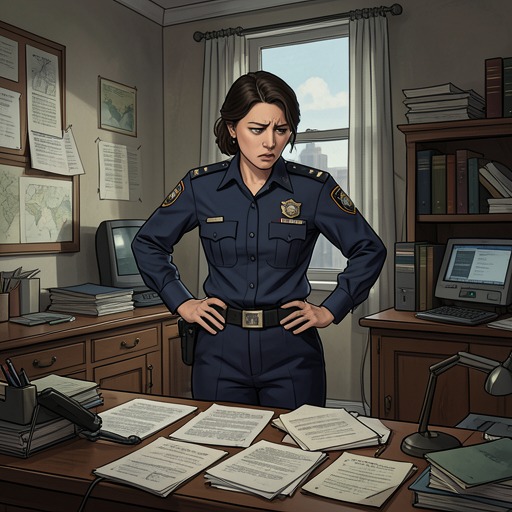
I am a police
Night Train“I am a police” is the expression through which Detective Mike Hoolihan introduces herself and establishes the perspective from which she tells the story of her worst case. Its unusual grammar is deliberate: it is the profession’s own shorthand, and its repetition turns a job description into a claim of belonging. The phrase also carries a tension between collective identity and individual difference, since Hoolihan names herself as a police and immediately adds that she is a woman.
Professional Identity and Insider Speech
Hoolihan explains that police officers do not ordinarily call themselves “a policeman,” “a policewoman,” or “a police officer.” Among themselves, they say “I am a police.” The expression therefore marks an insider’s way of speaking rather than a formal title. Its compactness places the speaker within the profession’s shared vocabulary, even as the unconventional construction makes that vocabulary conspicuous to readers outside it.
The declaration is repeated before Hoolihan gives her name: “I am a police. I am a police and my name is Detective Mike Hoolihan.” The cadence makes professional identity the first fact she offers about herself. Her subsequent addition, “And I am a woman, also,” does not displace that identity; it places gender beside it as another fact that the expression alone might leave unspoken.
Gender and Collective Belonging
The phrase gathers people of different backgrounds into a single occupational category. Hoolihan says that Jews, Black people, Asians, and women can all become police, and that once they do, they belong to “a race called police.” Her formulation recasts the profession as a collective identity that crosses other social categories. At the same time, it does not present belonging as uncomplicated inclusion: membership in this occupational “race” is described as requiring hostility toward everyone outside it.
That deliberately abrasive account complicates the phrase’s pride of belonging. “I am a police” asserts an identity Hoolihan shares with her colleagues, while her broader description of police culture exposes the hostility she associates with that shared identity. The expression is thus both a credential and an entry point into her criticism of the institution’s habits.
Narrative Function and Irony
Hoolihan identifies herself through the phrase while introducing an account she calls the worst case she has ever handled. She qualifies that judgment by noting that, for police, “worst” is elastic and its boundaries are continually pushed outward; this case is worst specifically for her. The contrast makes the expression more than a neutral introduction: it establishes the professional world’s shared scale of experience, then distinguishes the personal weight of this particular case within it.
The phrase’s repetition also gives the opening a declarative force. Hoolihan is not merely classified by her occupation; she speaks that identity for herself, names herself as a woman, and claims the authority of an insider to tell what follows. Yet the collective voice she invokes is not idealized. Her account of police belonging remains entangled with the institution’s prejudices, making the simple declaration carry both solidarity and unease.