Investigation into Jennifer Rockwell's death
Night TrainInvestigation into Jennifer Rockwell's death is both a police inquiry and Mike Hoolihan's attempt to understand what the official procedures cannot settle. Beginning with a homicide file and a reconstruction of the final evening, it moves through an autopsy and the interrogation of Trader Faulkner before becoming a psychological autopsy of Jennifer's concealed crisis. Its decisive tension is between the facts that can be established and the unknowable cause of a death that the medical examiner ultimately classifies as Undetermined.
Reconstructing the Last Evening
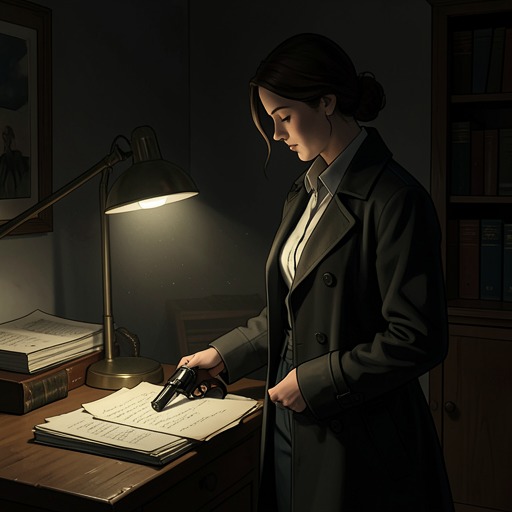
After Jennifer's death, Tom Rockwell gives Mike a folder marked with her name and case number H97143. Tom's request makes the investigation personal as well as procedural: he wants an account he can bear. Mike returns to the file and its minute details, including the odometer reading for the unmarked car he and John Macatitch drove that night. Reconstructing the sequence is a way to test what is known rather than let grief or speculation supply the missing parts.
The timeline places Trader Faulkner as the last person known to have seen Jennifer. At 7:30 p.m. on March 4, he left her, as he regularly did on Sunday nights; the file describes her mood as cheerful and normal. Ten minutes later, an elderly neighbor in an attic apartment was awakened by a shot and called 911. Jennifer was pronounced dead at 8:55 p.m. The sequence gives the inquiry a clear exterior chronology, but the apparent normality recorded before her death does not explain what was happening privately.
The investigation also passes through the routine obligations of suspicious-death procedure. In the city, deaths that are violent, unusual, unattended, or outside a medical-care setting are brought to the Chief Medical Examiner's office on Battery and Jefferson for examination. Jennifer's autopsy began twelve hours after her death. Mike is accustomed to the autopsy room through his police work, yet this case is different: Jennifer matters to him. He watches the recording from a couch, smoking, taking notes, and pausing the image. The procedural record becomes an act of witness, not simply another professional task.
Trader Faulkner and the Homicide Inquiry
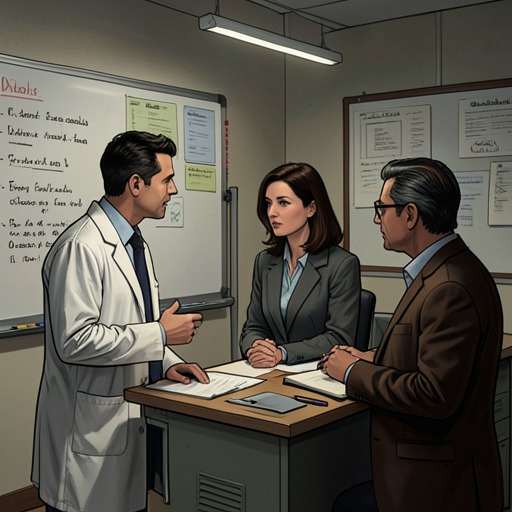
Mike confronts Trader in an interrogation room and presses him about the sexual evidence found in Jennifer's examination. He considers applying the methods that have secured confessions from other suspects, and threatens further steps including a neutron-activation test, a polygraph, and a grand-jury appearance. The encounter demonstrates how investigation can turn pressure into a substitute for knowledge: the longer the interrogation continues, the less confidence a confession would carry, even as Mike prepares to keep questioning him for hours.
Then Trader looks up, and Mike reads his expression as clear despite its complexity. Mike reaches two conclusions: Trader is innocent, and, if he chooses, can prove it. Trader answers the grand-jury threat with a precise account of what a grand jury does, exposing Mike's mistaken assumption that he does not understand the process. He also tells her that he had been devoted to Jennifer and secure in their relationship on the night she died. His wish that he had killed her expresses the intolerable contrast between a crime with an answer and the reality he faces: Jennifer's death has no explanation that can make it comprehensible.
The interrogation ends not in a confession but in shared grief. Mike and Trader join hands across the table and both cry. For Mike, the tears are also connected to what the interrogation room has done to her and to the people she has questioned there. The scene marks a change in the inquiry: Trader is no longer simply a suspect to be made to speak, and Mike's task cannot be fulfilled by finding someone to punish.
From Case Review to Psychological Autopsy
The investigation's second phase is explicitly called the psychological autopsy. Mike sets out to reconstruct Jennifer's state of mind from records, behavior, and the accounts left by people around her. She describes the work as an analogue to the medical examiner's examination, using a ballpoint pen, tape recorder, and computer rather than instruments used in a physical autopsy. The method is investigative, but its limits matter: it can assemble evidence and test explanations without giving Mike direct access to Jennifer's private experience.
After the funeral, Mike had drawn up a list titled Stressors and Precipitants. Its early entries are tentative, including Trader and the question of what he might not have seen, followed by money. The list's brisk heading promises order; its sparse questions reveal how little the initial inquiry can establish about motive. Mike also considers statistical patterns without treating them as a diagnosis. Jennifer was twenty-eight, an age within a comparatively level period in the broad age-related pattern she reviews. Her notes say she had no known previous attempt and, as far as Mike knows, had given no warning. The contrast between population patterns and Jennifer's apparent history leaves the individual case unresolved rather than explained by a statistic.
Gendered suicide statistics further complicate the inquiry. Mike notes that women are more than twice as likely as men to attempt suicide, while men are more than twice as likely to die by suicide; Mother’s Day is identified as an exception to the usual gender pattern for completed suicides. The figures expose the inadequacy of a simplistic claim that suicide is primarily a woman's act, but they do not establish Jennifer's motive. The investigation repeatedly confronts this distinction: a general pattern may direct attention, yet it cannot substitute for evidence about one person's life.
The Concealed Crisis and the Clues
A major change in the case comes when Mike learns that she had not seen Jennifer's toxicology report because Tom had made it disappear. Jennifer had been taking lithium, a mood stabilizer used in the treatment of manic depression. That disclosure changes the meaning of the earlier picture of an apparently cheerful woman and makes a previously hidden medical history relevant to the death inquiry. It does not, by itself, provide a complete explanation.
Jennifer's account of the preceding year supplies more detail. Almost a year earlier, she had begun to feel that she was losing control of her thoughts, which seemed to proceed independently while she felt like an observer. She avoided speaking with Hi Tulkinghorn because she feared he would tell her father, and tried to manage the problem herself. When Trader thought she was having lunch at the Brogan on Mondays, she was instead at Rainbow Plaza with GCG employees. Since the previous May, she had taken varying doses of Serzone, depecote, and tegretol, but the medications had stopped helping. She was frightened that she might do something unprecedented and inhuman. She also told her beloved that he could not have acted differently. These disclosures turn the investigation toward a crisis Jennifer had concealed even from people close to her, while leaving the precise relationship between that crisis and her death beyond simple proof.
A marked passage in Jennifer's copy of Making Sense of Suicide gives Mike another lead. The book's general statement that suicidal people often leave warnings and clues is marked with a double query. Mike takes the mark seriously: Jennifer had left clues, and, as the daughter of a police officer, knew how clues might be read. Yet the book itself does not resolve the case. Its advice and generalizations often strike Mike as banal; Jennifer's marginal marks, rather than the author's explanations, become the evidence that redirects her attention. The inquiry's pattern-making therefore depends on reading the traces critically, not assuming that a printed rule can explain an individual death.
Official Finding and Unfinished Explanation
The investigation establishes that Jennifer committed a crime on the night of March 4 because suicide was treated as a crime in the city. The narrative sets that fact against the history of the coroner's office: in an earlier legal order, suicides could lose their property as felons, while the modern coroner's function has shifted into the Chief Medical Examiner's office. Jeff Bright, the medical examiner and Tom's friend, returns a finding of Undetermined. Tom had pressed for Accidental, but settled for the classification accepted by the others. The finding does not convert uncertainty into a verdict about Jennifer's private reasons.
The official classification carries consequences beyond terminology. Under the city's law, Jennifer has committed a crime, yet she escapes punishment; the coroner's decision also absolves her of public disgrace. Mike refuses to turn this result into a moral judgment of Jennifer. She connects that refusal to her own earlier experience of being cared for by Jennifer, who had also faced troubles and fear in adolescence. The recollection makes their friendship part of the inquiry's emotional evidence, without pretending that affection can answer the question of why Jennifer died.
The investigation does not end with a solved motive. Mike passes information about Phyllida Trounce to Tony Silvera, arranges to meet Paulie No at the Decoy Room in the Mallard Hotel, and tells Tom she is ready to talk that night. These next steps keep the inquiry active, but its central outcome remains a boundary: the timeline, medical evidence, concealed treatment, and marked clues can revise what the living understand about Jennifer, while the official ruling remains Undetermined. The case's lasting significance lies in that divide between assembling a more truthful account and claiming certainty about a death that resists it.