Jennifer Rockwell
Night TrainJennifer Rockwell is an astrophysicist at Mount Lee whose brilliance and apparent success make her death by suicide difficult for Mike Hoolihan, her friend since childhood, to comprehend. Afterward, a concealed mental-health crisis and a trail of misleading clues complicate the investigation: Jennifer’s apparent explanations do not reveal a single, knowable reason for her death, even as they show how carefully she anticipated the search that would follow.
Identity and Background
Jennifer is introduced through Mike’s long familiarity with her and his sense that she seemed almost impossibly accomplished. He remembers her as brilliant and beautiful, while emphasizing that she was also accessible rather than simply distant or intimidating. Her father, Tom Rockwell, was a police commander, and her two considerably older brothers served with Chicago PD in Area Six. Jennifer chose a different profession: she became an astrophysicist at Mount Lee, a distinction that made her an exceptional figure in the police family without making her a police officer.
Mike recalls that Jennifer dated at CSU, then spent roughly seven or eight years with fellow intellectual and academic Trader Faulkner. Their long relationship is part of the background against which her death is understood. The contrast between Jennifer’s outwardly remarkable life and the private crisis she later describes is central to the character: the qualities that made her seem so assured to others did not disclose what was happening in her mind.
Death and the Investigation
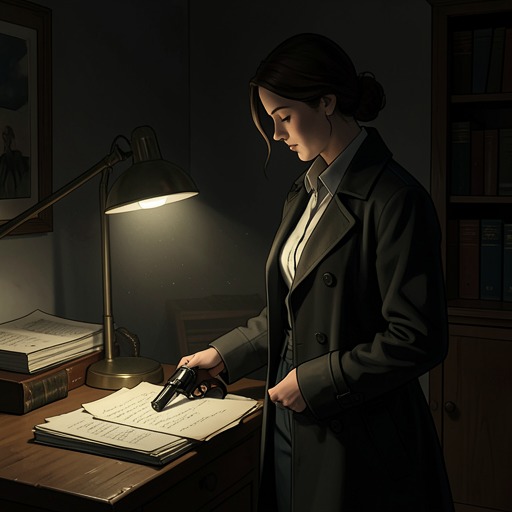
Mike arrives at Jennifer’s residence as a homicide detective, carrying his notebook, flashlight, gloves, and service weapon. He has known her since she was eight and regards her as a favorite, but that closeness does not make the scene intelligible to him. In his experience, some suicides appear immediately consistent with what the scene suggests; Jennifer’s death does not. He describes it instead as a case that seems to fit too well, a judgment that captures his unease rather than settling the cause.
The room is orderly, and Mike follows the procedural discipline of examining its surroundings before concentrating on Jennifer’s body. He records his observations and draws a sketch without touching her. A .22 revolver lies beside the chair. The scene is subsequently documented by the crime-lab technicians, who are to collect prints, measure distances, and take photographs before the medical examiner examines the body. The professional sequence gives the death an investigative structure, but it cannot remove the shock of seeing someone Mike has known for decades transformed into the subject of a case.
Later, the physical findings supply a direct basis for identifying the death as suicide. Microscopic blood and tissue particles on Jennifer’s right hand and forearm are described as blowback; the grip of the weapon has also left impressions in her hand associated with cadaveric spasm. Mike takes these findings as confirmation that Jennifer killed herself. The evidence answers the question of how the weapon was held, but not the question Mike most wants answered: why she died.
A Concealed Mental-Health Crisis
Jennifer’s recorded message to Trader reveals that she had been struggling for nearly a year before her death. She describes a growing feeling that she was losing control of her thoughts, as if they continued independently while she watched from the sidelines. She had not told Hi Tulkinghorn because she feared he would inform Tom Rockwell. Instead, she tried to manage the problem herself, a decision she recognizes may have been part of her own self-deception.
She says she read about her condition and, while Trader believed she was spending Mondays at the Brogan, went to Rainbow Plaza, where GCG members took their lunch breaks. Since the previous May she had been taking varying doses of stabilizing medication. She reports that the medication had stopped helping. Her account therefore gives the earlier outward appearance of a life proceeding normally a sharper, more troubling underside: she was seeking help in private, concealing it from her family and partner, and becoming less confident that she could control what was happening.
The message also conveys fear of doing something unprecedented and inhuman. Jennifer tells Trader that he had been right for her and that he could not have acted differently. She asks him to help her parents and repeats her apology. These statements show her trying to address the people she will leave behind, but they cannot establish that she fully understood her own state or that her words provide a complete explanation. The message makes her crisis visible while preserving the limits of what anyone, including those closest to her, could know.
Relationships and Final Encounters
Jennifer’s ties to her family and to Trader shape both her secrecy and the aftermath. Her fear that Hi Tulkinghorn might tell Tom Rockwell helps explain why she avoided confiding in him; her recorded appeal to Trader, meanwhile, places him in the position of receiving the explanation she had withheld during their life together. Afterward, he gives special weight to her dying words, a response that contributes to the group’s acceptance of a misleading account involving lithium. Mike and Tom are also left to follow a trail that Jennifer appears to have expected them to pursue.
Jennifer visited Phyllida Trounce on the Thursday before her death. Phyllida remembers that the visit lasted ten minutes. Mike’s questioning brings the encounter into the investigation, but the available account does not reveal what Jennifer and Phyllida discussed. The brief visit thus adds a specific final contact without supplying a key that unlocks Jennifer’s reasons. Its significance lies partly in the gap between the fact of the meeting and the uncertainty that remains around it.
Misleading Clues and Narrative Significance
Mike comes to believe that Jennifer knew her father would search for answers and expected him, too, to take part. In his reconstruction, she left clues meant to offer the living a pattern: things that looked like explanations but were actually blinds. He identifies Bax Denziger’s mangled algorithm, paintings she had bought, lithium, and Arn Debs as misleading leads. His account is a detective’s retrospective interpretation, not an unmediated statement of Jennifer’s intention; it clarifies how the clues function in the investigation without proving that Mike can fully recover her plan.
The lithium explanation is especially revealing. At a gathering in the Decoy Room, Mike says that the drug was involved, and the people around him accept the claim. Tom Rockwell, Hi Tulkinghorn, and Trader each have reasons to believe it, while Mike also accepts it because the alternative is harder to face. The scene shows how an apparent explanation can become shared belief through grief and need, even when it is part of a false trail. Jennifer’s actual disclosure of medication use does not make that later lithium account reliable: the investigation treats the claim as another blind.
Mike’s final reflections resist turning Jennifer into either a perfect victim or a solved puzzle. He remembers her body as a lasting image of what she left behind, and he is angry that her clues made him suspect Arn Debs. At the same time, he recognizes that Jennifer may have drawn on what she knew of his history and judgment when anticipating his response. Her character therefore occupies two positions at once: she is the brilliant, beloved friend Mike thought he knew, and a person whose concealed suffering and deliberate misdirection exceed his ability to read her. The investigation can establish the manner of death and expose parts of the crisis, but it cannot make the final why certain.