Jennifer Rockwell's .22 revolver
Night TrainJennifer Rockwell's .22 revolver is the material center of the investigation into Jennifer Rockwell's death. It is found at the scene, examined for evidence that Jennifer fired it, and linked to the reported finding of three shots. Its significance changes as the inquiry proceeds: the revolver helps establish what happened, while its availability as a means of suicide leaves the harder question of why unanswered.
Identity and Provenance
Tony Silvera identifies the firearm as a .22 revolver. Its history reaches back years before the investigation: Colonel Tom bought it for Jennifer Rockwell and taught her how to use it. The revolver is therefore not simply an object newly introduced by the crime scene. It belongs to a history of practical instruction between father and daughter, and the evidence that later bears on Jennifer's death is connected to a gift from her father.
The account does not establish when or under what circumstances Jennifer acquired the revolver from Colonel Tom, nor does it describe its later use. What it does establish is the direct connection between its purchase, Colonel Tom's instruction, and its eventual presence in the investigation. That limited provenance matters: the firearm is familiar within Jennifer's life, but the fact of familiarity does not itself explain her decision or state of mind.
At the Scene
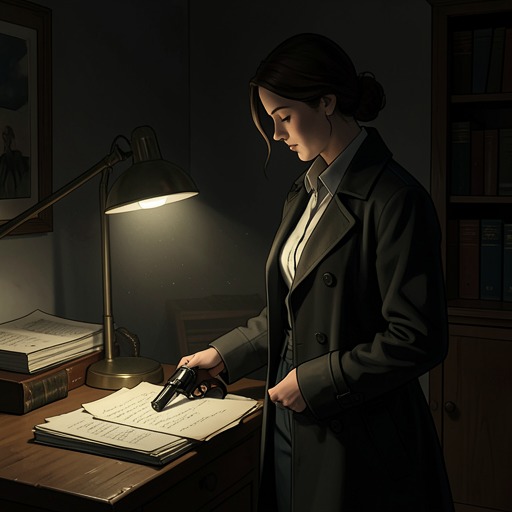
Mike Hoolihan records the scene and makes a stick-figure sketch, describing the work as professionally careful. The revolver lies upside down, almost on its side, propped against a chair leg. Its particular position becomes one part of the scene's arrangement, noted rather than treated as an explanation in itself.
Mike's attention to the scene is shaped by the possibility that apparent details may conceal a discrepancy. She compares examining a crime scene to solving a cartoon puzzle and registers that something about the scene does not fit. The revolver is consequently both a concrete object to document and one piece in a larger pattern whose meaning remains uncertain. The evidence supplied here does not say that its position proves who handled it last or establishes a particular sequence of events.
Forensic Examination
Under Tony Silvera's direction, Paulie No performs a preliminary examination. He examines the firearm-related evidence and takes nail clippings, then conducts chemical tests for barium, antimony, and lead deposits to establish whether Jennifer fired the revolver. These procedures show how the object moves from the scene into a forensic inquiry: the question is no longer only where it was found, but what physical evidence can connect Jennifer to its use.
The reported autopsy finding is that Jennifer shot herself three times. That finding becomes crucial not only as a conclusion but as a source of uncertainty during the investigation. In an exchange with Trader Faulkner, Mike presents the three shots as if they ruled out suicide and uses that assertion to turn suspicion toward several possible people, including Trader. The tactic makes the finding sound conclusive in the opposite direction from the account's eventual understanding. The revolver's evidentiary role is thus complicated by the difference between what the investigation finds and how Mike deploys that finding in conversation.
Means, Uncertainty, and Significance
Mike's later notes on suicide distinguish access to a method from an explanation for a death. They describe suicide as strongly dependent on available means and note that Jennifer owned a gun, while also recording that she had not, so far as Mike knew, attempted suicide before or given warning. The revolver supplies a concrete means within that analysis; none of those facts alone identifies the pressures or precipitating circumstances behind her death.
The question of a note remains similarly unresolved in Mike's account. Jennifer apparently left no suicide note, but Mike believes she wrote one. After the funeral, Mike had compiled a list headed “Stressors and Precipitants”; when she later revisits it, the list seems vague, and she crosses out its remaining entries until nothing is left. These details frame the revolver's limits as evidence. It can be associated with the reported manner of death and examined for traces of use, but it cannot fill the gaps in the record or turn uncertainty about motive into certainty.
The object consequently carries two kinds of weight. As a firearm, it is subject to scene documentation and forensic testing; as the means available to Jennifer, it figures in Mike's effort to understand how suicide can occur without a clear warning or an explanatory note. Its connection to Colonel Tom adds a personal history, but not a final answer. In the investigation, the revolver helps establish the circumstances of Jennifer's death while marking the boundary between evidence about method and knowledge of why.