Jennifer Rockwell's apartment
Night TrainJennifer Rockwell's apartment is the central physical setting of the investigation into her death: a familiar home transformed into a police scene and, later, a difficult space for Mike Hoolihan to revisit. Its significance lies in the contrast between the orderly, recognizable rooms and the unanswered questions they hold. For Mike, this is not an anonymous location to process and leave; it is a place she had visited many times, and where her memories of Jennifer continually meet the material evidence of her death.
Setting and First Arrival
The apartment is on Whitman Avenue, among detached and semidetached residences on a wide, tree-lined street described as an academic dormitory on the edge of the Twenty-Seven. Mike arrives in an unmarked car with a colleague on the night of March 4. Police, crime-scene personnel, medical examiners, and neighbors are already present; uniforms cluster around the entrance beneath the dome lights of the radio cars. The scene’s scale is public and procedural, but the apartment itself is the private home of someone Mike has known since childhood.
Mike gets through the crowd at the front door and identifies the landlady as a key witness. She had been awakened by a gunshot and called 911. The full moon overhead becomes part of Mike’s account of the night, though her attention is already divided between the broader demands of police work and the fact that the person inside is Jennifer. The apartment is not simply another address on a call sheet: Mike understands that special rules apply when a death touches someone close to the murder police.
A Familiar Interior Becomes a Crime Scene
Mike knows the route through the apartment. She has visited roughly a dozen times over the previous several years, sometimes bringing something for Colonel Tom, sometimes giving Jennifer a ride to a ballgame, beach party, or work-related function. Their friendship was practical as well as personal: the rides offered time for conversation, and Mike remembers being welcomed rather than treated as a passing acquaintance. That familiarity gives her entry into the bedroom a different weight from an ordinary scene examination.
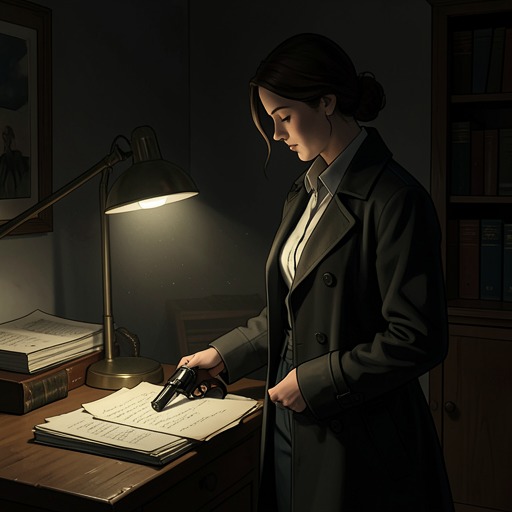
The bedroom leads off the living room. Mike follows professional procedure, turning slowly into the scene and taking in its margins before concentrating on Jennifer. The room contains half-drawn curtains, a dressing table, and disturbed bedding; Jennifer is seated in a chair rather than lying on the bed. An old pillowcase and a can of 303 are on the floor nearby. Mike records what she sees and makes a sketch without touching Jennifer. The .22 revolver is positioned beside the chair, later to be collected by Tony Silvera, while the crime-lab team is expected to take prints, measurements, and photographs before the medical examiner examines the body.
The apartment initially offers the investigative appearance of a legible scene: objects can be recorded, distances measured, and evidence collected. Yet Mike’s attention is not satisfied by that apparent order. She recognizes that something about the scene does not fit, although her first observations do not resolve what has happened. The distinction matters: the apartment can provide physical evidence without explaining Jennifer’s state of mind or making her death comprehensible.
Access, Memory, and the Household
The apartment’s connection to its neighbors is part of its domestic history. Jennifer and Trader Faulkner were neighborly with the older woman who lived upstairs: Jennifer ran errands for her, and Trader helped move heavy things. They exchanged spare keys, and the neighbor’s key was used to gain access on the night of March 4. Mike takes the key and says she will log it with Evidence Control. She also leaves her card, imagining that she might continue checking on the neighbor as she does for other elderly people in the Southern. The practical business of evidence custody briefly opens onto a possible continuing obligation between people living in the same building.
The apartment’s ordinary details remain visible after the initial investigation. On a later visit, Mike sees orange crime-scene tape across Jennifer’s door and finds the bedroom scene preserved. Blood evidence on the wall and the pattern of the sheets are still as she remembers them, while a section of the wall has been removed for scientific examination. The apartment is both a home and a partially dismantled record: investigators have taken material from it, but the rooms continue to hold the arrangements that Mike associates with Jennifer.
Elsewhere in the apartment, Jennifer’s belongings suggest a life organized around everyday habits and private papers. Post-it notes remain on the mirror above the telephone; magnetic Scrabble pieces on the refrigerator spell out reminders for milk and filters. Cosmetics, shampoos, and medicines occupy the bathroom cabinet, and sweaters are stored in plastic covers in the bedroom closet. Her personal papers are kept in a locked blue trunk in the living area, to which Mike also has a key. These details do not disclose a single explanation for the death. Instead, they set mundane routines beside the unresolved event, showing how much of a person’s life remains in place when that person is gone.
Return and Narrative Significance
When Mike returns, the apartment has acquired a different temporal quality. Death scenes ordinarily deteriorate, but this one seems to her to retain an unnerving youth: the warning tape is still on the door, and the evidence remains recognizable. The passage of time has altered the wall’s appearance, while the removed section marks the investigators’ intervention. The scene is therefore neither untouched nor restored. It is held between preservation and disturbance, like an investigation that has gathered facts without closing the question.
Mike also returns with a changed relationship to Trader Faulkner. At first she recalls trying to secure a case against him; later, after speaking with him at the wake at the Rockwells’ home, she finds herself regarding him as a friend. She holds his key and relies on what he has told her about where to look. The apartment thus becomes a point of contact between their grief and their uneasy cooperation, rather than merely the setting of an earlier confrontation.
For Mike, the clearest impulse on this later visit is unexpectedly domestic: she imagines cleaning the room herself and wonders whether Trader will be able to sleep there, or how much repainting he will want. This thought does not undo the investigation or explain the death. It shows instead how the apartment resists remaining only an evidentiary diagram. It is a place someone may have to inhabit again, and a place Mike cannot reduce to measurements, photographs, and the locked papers awaiting examination. Its rooms keep the practical and personal meanings of Jennifer’s absence in the same frame.