Jennifer Rockwell's autopsy report
Night TrainJennifer Rockwell's autopsy report turns a disputed death into a set of physical findings that support suicide, but it cannot explain why Jennifer died. Delivered to the narrator in a sealed binder by Colonel Tom, it becomes both a forensic account and the starting point for a second inquiry: the psychological autopsy, which searches for context the body cannot supply.
Delivery and Reading
On March 14, Colonel Tom sent the narrator a dozen red roses accompanied by thanks, apologies, and love, as well as an expedited, sealed binder containing the autopsy report. The narrator suspected Colonel Tom had edited it before sending it. Having already seen the autopsy film, the narrator now faced the written account, which brought the investigation’s physical evidence into focus.
The report arrived while the narrator was recovering from a night of drinking. After coffee, cigarettes, and a shower, the narrator sat on the couch in a terrycloth bathrobe and began reading. That ordinary domestic setting contrasts with the report’s institutional authority: Jennifer’s death reaches the narrator not as an abstract case file but as a document delivered by her father, alongside a personal expression of grief and affection.
What the Examination Established
The report records Jennifer’s height as five feet ten inches and her weight as 141 pounds. It describes scrambled eggs, lox, and bagels as a fully digested meal in her stomach, with a partly digested meal of lasagne also present. These details locate the forensic account in the body’s measurable particulars, rather than in speculation about intention.
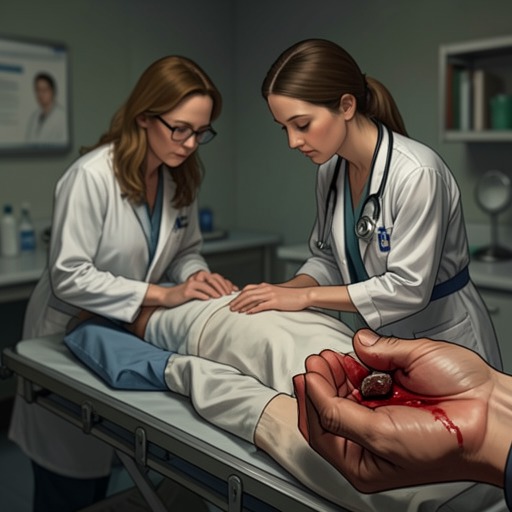
Other findings address whether the scene or body had been altered. Lividity appeared in the expected locations, and the report concluded that no one had moved or arranged Jennifer’s body. Microscopic particles of blood and tissue were found on her right hand and forearm, a finding the report identifies as blowback. Her right hand also showed cadaveric spasm, a temporary stiffening associated with the tightly held weapon; the shape of the trigger and grip had left corresponding impressions. Taken together, these observations supported the report’s direct conclusion that Jennifer had killed herself.
That conclusion gives the document a decisive evidentiary force: it answers how Jennifer died more firmly than the surrounding investigation had done. It does not, however, establish what brought her to that act. The distinction between a physical finding and an explanation of motive shapes everything the narrator does next.
From Autopsy to Psychological Inquiry
The report becomes a point of departure for the book’s second form of investigation. At the beginning of Part Two, the narrator calls the work a psychological autopsy and compares it to the medical examiner’s physical procedure. The pathologist works with instruments and tissue; the narrator works with a ballpoint pen, a tape recorder, and a computer. The analogy presents both inquiries as examinations, but their evidence and limits differ: the medical report interprets bodily traces, while the psychological inquiry assembles records, recollections, and possible stressors.
The narrator’s list, headed Stressors and Precipitants, initially offers only uncertain leads, including Trader Faulkner and the question of what he might not have seen, followed by money. The investigation also weighs general findings against Jennifer’s known history. She had not previously attempted suicide, and, as far as the narrator knew, had given no warning; the narrator describes her as someone who had seen things through. Jennifer owned a gun, and the narrator believed she had written a suicide note despite its apparent absence. These notes and impressions provide context, not proof of a single cause.
A later letter from Jennifer adds information that the autopsy report itself could not contain. She described feeling, about a year earlier, that she was losing control of her thoughts; she had researched her condition and taken varying doses of stabilizing medication since the previous May. She had concealed this from the narrator and avoided going through Tulkinghorn because she feared that he would tell her father. Her account changes what the narrator knows about the period before her death, while also underscoring why the physical report alone could not disclose Jennifer’s private experience.
Official Finding and Limits
On March 16, the narrator reflects on the legal meaning of Jennifer’s death in the city, where suicide was treated as a crime. The account recalls that, historically, suicides could lose their property like other felons, and that the coroner had once been associated with collecting taxes from the dead. In the present, the coroner’s work belongs to the Chief Medical Examiner’s office. The old punitive history and modern administrative process are not identical, but both show how an official classification can carry consequences beyond the forensic description.
Jeff Bright, a friend of Tom Rockwell’s, returned an official finding of undetermined. Colonel Tom had pushed for an accidental ruling but ultimately accepted the undetermined finding, as did the narrator. This does not erase the autopsy report’s conclusion: it distinguishes that conclusion about the physical evidence from the formal determination recorded by the coroner. The report supplies a strong account of how Jennifer died, while the official finding stops short of settling the case as accidental or intentional.
The narrator refuses to turn that gap into a judgment of Jennifer. The report is therefore both clarifying and limited: it establishes a physical account of her death, yet cannot settle its unknowable causes or make the official record say more than it does. The psychological autopsy grows from that boundary, gathering what the body, the formal finding, and the surviving records can each reveal without treating any one of them as a complete explanation.