Mandatory autopsy for suspicious deaths
Night TrainMandatory autopsy for suspicious deaths governs what happens to bodies in the novel’s city: deaths deemed suspicious, violent, unusual, or unattended are examined rather than left outside official inquiry. Jennifer Rockwell’s case makes the rule both a practical procedure and a point of tension between forensic evidence, legal classification, and the living person who refuses to treat her death as routine.
Scope and Procedure
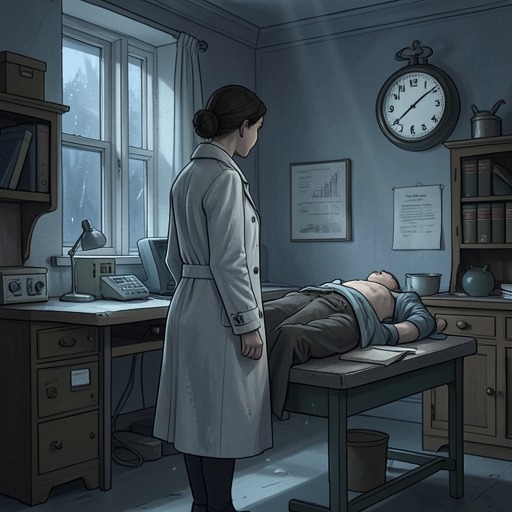
The rule covers deaths occurring outside an intensive-care unit or hospice, as well as deaths in which the person was unattended. Paramedics bring such bodies to the Chief Medical Examiner’s office on Battery and Jefferson. When the examination begins, the body is taken from a walk-in freezer, weighed, and placed on a zinc gurney beneath an overhead camera. Clothing is examined, removed, bagged, and sent to Evidence Control. The account notes that the room’s recording equipment has changed over time: a microphone and Polaroid photographs have given way to a camera and television recording.
The procedure is presented as routine, almost industrial in its sequence, but not indifferent in its consequences. Jennifer is pronounced at 20:55 and cut twelve hours later. Unlike the ordinary process of examining a clothed arrival, she is wearing nothing but a toe-tag. The wall’s Latin inscription describes the place as one where talking and laughter cease and death helps the living; its ceremonial language hangs over a procedure that is also administrative and physical.
Jennifer’s Examination and the Witness
Mike Hoolihan is familiar with the autopsy room from her former work in Homicide and her continuing visits on Asset Forfeiture business. Bodies, including murder victims found in airport rental-car trunks, are part of that work. The examination process itself therefore holds little novelty for her. Jennifer does. Mike watches the recording from a couch, smoking, taking notes, and pausing the tape. She understands this act as bearing witness, not as simply observing a standard forensic procedure.
That distinction connects physical autopsy to the book’s later idea of psychological autopsy. Mike describes her notes, tape recorder, and computer as counterparts to the Medical Examiner’s clamp, electric saw, and knives: different instruments applied to the task of examining a death. The parallel does not make the two inquiries equivalent. The physical examination acts on the body; Mike’s investigation tries to organize records, recollections, and clues without claiming certainty about Jennifer’s inner life.
Legal Classification and Its Limits
The autopsy takes place within a history in which suicide was treated as a crime. The narrative recalls that suicides once lost their property like other felons, and that the coroner’s older role was associated with taxing the dead. In the present-day city, the coroner works from the Chief Medical Examiner’s office. Jeff Bright, a friend of Tom Rockwell’s, returns an Undetermined finding in Jennifer’s case. Tom presses for Accidental but accepts Undetermined, as do the others.
That finding does not erase the difference between what the authorities suspect and what they can formally establish. By March 16, people at CID know that Jennifer committed a crime on the night of March 4 because the city treats suicide as criminal. Yet the coroner’s Undetermined ruling leaves the official cause unresolved. The account presents that classification as an absolution from public disgrace and punishment, while also showing how the city’s law gives the death a criminal meaning before the evidence yields a settled official answer.
Forensic Inquiry and Uncertainty
The autopsy rule ensures that suspicious deaths enter an evidentiary process, but examination does not provide a complete explanation of motive. Mike’s effort to reconstruct Jennifer’s state of mind turns toward warning signs, prior attempts, access to a gun, and possible stressors. Her notes acknowledge that many suicides involve earlier attempts or warnings, while stating that Jennifer had not tried before and, so far as Mike knows, gave no warning. The missing suicide note is another uncertainty: Mike initially believes Jennifer left none, though she suspects that one was written.
The rule’s significance therefore lies in both what it makes visible and what it cannot settle. It supplies a body, a procedure, and a record for investigation; it does not by itself resolve whether Jennifer’s death was accidental, criminal, or fully knowable to those left behind. Mike’s decision not to judge her underscores the limit: forensic scrutiny can establish circumstances and preserve evidence, but the official examination cannot turn grief into a definitive account of why she died.