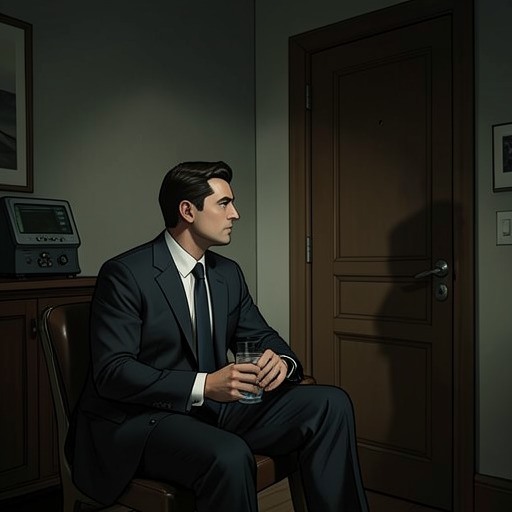
McLellan Street infant murder case
Night TrainThe McLellan Street infant murder case is a rapidly solved investigation whose apparent explanations collapse when Mike Hoolihan attends to the children in the room as closely as he listens to the adults. The case moves from a public spectacle and a disputed account of an accidental death to a concealed family structure and a specific motive. Its decisive clue is not a confession but a brief, involuntary response to a baby’s cry.
Discovery and public pressure
The case begins when the body of a fifteen-month-old boy is found in a picnic cooler at a public recreation facility in the Ninety-Nine, near Oxville. A precinct canvass brings investigators to a rowhouse on the 1200 block of McLellan Street. By the time Mike arrives, a crowd of roughly a thousand people lines the street, media trucks have caused gridlock, and network helicopters hover overhead. The scale of the attention makes the investigation not only a search for what happened to the child but also a problem of managing a volatile public scene.
Inside the house are five detectives, two squad supervisors, and the deputy commissioner, all considering how to bring the case downtown without provoking a prime-time riot. They are questioning LaDonna, a twenty-eight-year-old woman, and her boyfriend, DeLeon. LaDonna says the dead boy was her baby and the cooler was hers. Two silent girls, Sophie and Nancy, sit nearby on kitchen chairs, swinging their white-socked feet. The scene’s adult account appears to offer a coherent explanation, but the quiet presence of the girls gives Mike another source of evidence to watch.
Mike also revises the language he says he would once have used to describe LaDonna and DeLeon, identifying them instead as people of color. That correction sits within an investigation already framed by public attention and the risk of racial interpretation. The case will later be presented nationally as neither a racial killing nor a drug-related one, but the route to that conclusion depends on uncovering the family relationships the questioning has not yet exposed.
Competing explanations and the clue
LaDonna describes an accidental sequence: during a family picnic in January, the toddler wandered away in only a diaper; the family searched an open field without finding him, then went home, leaving the cooler behind. In her account, the child later returned, climbed into the cooler, pulled down its lid, and engaged the external catch, leaving himself unable to get out. The medical examiner’s initial finding, which the autopsy is soon to confirm, is that the boy died by strangulation, not through the accident LaDonna describes.
DeLeon gives investigators a different complication. As he tells it, while the family was leaving after abandoning the search, they saw a group of white skinheads, described as known Nazis and drug dealers, get out of a truck and head toward the part of the field where the child was last seen. The accounts therefore place the death amid competing explanations: an accident, a possible killing by outsiders, or something concealed within the household. At this stage, the visible clues do not yet resolve who the dead boy was to the people being questioned.
While LaDonna continues speaking, Mike watches Sophie and Nancy. A baby cries in an adjoining bedroom, sounding like a waking child who may be dirty, hungry, or lonely. LaDonna does not break the flow of her account. Sophie, however, rises slightly from her chair for an instant, while Nancy’s face changes with sudden hatred. Mike treats that contrast between the adult’s uninterrupted explanation and the girls’ physical reactions as the moment the account becomes legible. The response to the crying baby leads him to infer that the relationships in the room are not what LaDonna has claimed.
The concealed relationships and motive
Mike’s reconstruction reverses the family roles presented during questioning. LaDonna is the murdered boy’s grandmother, not his mother. Sophie and Nancy are her daughters, not her younger sisters. Sophie is the mother of the baby crying in the bedroom, while Nancy is the mother of the child found in the cooler. The case’s central concealed fact is that Sophie murdered her own baby.
The investigation also establishes a motive: earlier that same day, Nancy had taken Sophie’s last diaper. The ordinary object supplies the immediate cause that the family’s initial explanations concealed. The revelation is both specific and devastatingly small in scale beside the case’s public dimensions: the crowd, the helicopters, the gridlocked street, and the officials’ concern about a televised riot. Mike’s reading of the girls’ reactions connects the domestic dispute to the death and resolves the case quickly through concentration and instinct.
Public resolution and narrative significance
That evening, Mike appears on the six o’clock news in a broadcast watched nationwide. Addressing an audience of 150 million, she reassures viewers that the murder was not about race and not about drugs, but about a diaper. The formulation reduces a sensational, politically urgent case to the immediate conflict that the investigation has uncovered. It also makes the resolution publicly communicable: the dramatic assumptions around the case give way to a motive rooted in a family relationship and a single disputed possession.
The case’s swift answer contrasts with the uncertain work Mike is doing elsewhere in the same stretch of the narrative. She has been compiling a list of possible stressors and precipitants in Jennifer Rockwell’s life, but finds the list vague; she describes that separate inquiry as a psychological autopsy, an attempt to reconstruct a dead person’s inner life from records and traces. The McLellan Street investigation, by contrast, produces a sharply defined chain of relationships and motive. Yet its resolution does not make Mike’s other inquiry simple: immediately after her national appearance, she reflects on what she has not told Trader Faulkner about Jennifer’s letter. The juxtaposition distinguishes a case that can be closed through observed reactions and established facts from a suicide whose meaning remains under question.