Mike Hoolihan
Night TrainMike Hoolihan is a woman detective whose account of Jennifer Rockwell’s death joins the procedures of a homicide investigation to the uncertain work of interpreting a life. She calls the case the worst she has handled, considers it solved on April 2, and still finds that its supposed solution opens onto further complexity. Her authority comes from years in police work; her unease comes from recognizing that professional certainty can be as vulnerable as anyone’s judgment to what it wants to see.
Identity and Background
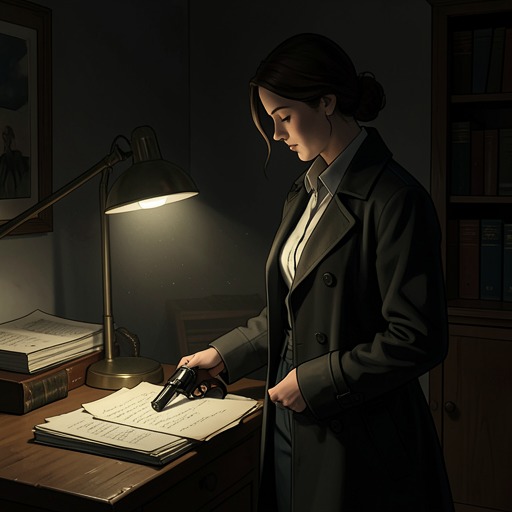
Hoolihan introduces herself through the language of the job: within the department, she explains, a person says they are a police, not a policeman, policewoman, or police officer. She names herself as Detective Mike Hoolihan and also as a woman, making gender and occupational identity inseparable parts of her account. She insists that this self-description matters because she is part of the story she is about to tell, and wants the reader to know where she is coming from.
Born and raised in the city, Hoolihan grew up in Moon Park. Her childhood changed when she was ten and she was thereafter raised by the state; she says she does not know where her parents are. She describes her tall, substantial build as inherited from her mother, her features as inherited from her father, and her hair as dyed blonde. These details sit beside, rather than explain, her professional identity: the narrator presents herself as someone shaped by family origins and institutional upbringing, without turning either into a complete account of who she is.
Police Career and Professional Identity
At eighteen, Hoolihan enrolled in a criminal justice master’s program at Pete Brown, but says that what she really wanted was street work. She passed examinations for state trooper, border patrol, corrections, and city police work, then left Pete Brown for the Academy. Her career began as a beat cop in the Southern and continued with foot patrol and radio calls in the Neighborhood Stabilization Unit in the Forty-Four.
She later spent five years in the Senior Citizens Robbery Unit. Decoy and entrapment work helped her move into plainclothes, and another examination took her downtown with her shield. By the time she tells the story, she is assigned to Asset Forfeiture, but had worked in Homicide for eight years. That experience gives her command of murder investigations without making her immune to their effects: of the bodies she has seen, Jennifer Rockwell’s is the one that remains with her most deeply.
Hoolihan describes the police as a professional group whose shared identity can absorb people of different backgrounds while also sustaining prejudice against outsiders. Her account does not present the badge as a simple moral distinction between good and bad. Instead, it shows belonging to the force as both a source of authority and a system with its own habits of suspicion. Her blunt assessment of that culture helps establish the standpoint from which she narrates the case, while also warning that the narrator’s perspective is not detached from the institution she represents.
The Investigation and the Psychological Autopsy
On April 2, Hoolihan calls Jennifer Rockwell’s case solved, closed, and finished. Yet she immediately qualifies that confidence: the solution, she says, has reduced a firm knot to loose ends. She is due to meet Paulie No that evening, expects to ask two questions and receive two answers, and imagines that the exchange will finish the matter. The repeated language of closure therefore carries a contradiction from the outset. The case may be administratively complete, but its meaning remains unsettled for the detective telling it.
Hoolihan describes her work with a ballpoint, tape recorder, and computer as the counterpart of Paulie No’s work in the medical examiner’s office with instruments used to examine a body. She calls her own method a psychological autopsy. The comparison identifies both the ambition and the limit of her inquiry: like a physical examination, it seeks an account of how a death came about, but its materials are recollections, records, and interpretation. She says she is trained to do this, even as the case forces her to slow down and reconsider what she thinks she knows.
The form of the account reinforces that uncertainty. Hoolihan says that the papers and transcripts were assembled piecemeal over four weeks and cautions that the tense may be inconsistent when writing about the recently dead. Her narrative is thus presented not as a seamless record made at one remove from events, but as a reconstruction assembled after the fact. The shifts and qualifications matter: the reader encounters a detective trying to organize evidence while remaining aware that arrangement itself can shape what appears to be true.
Judgment, Relationships, and Conflict
Hoolihan’s reflections on perception make the problem of solving the case explicit. She recounts Trader Faulkner’s comparison between calling a play in a ballgame and judging evidence: a person may call a good ball out because they wish it out, and desire can distort sight. The analogy turns the investigation into a test of the investigator as well as of the evidence. Hoolihan’s question is not only whether the case is solved, but whether what seems clear is reality or her own reading of it.
Her exchange with Paulie No displays a similar tension between warmth and control. She tells him that she has always liked and trusted him, and earnestly denies his suggestion that she has a prejudice against him. She explains that he had seemed absorbed in his work. In the same conversation, however, she tells him to keep quiet about Jennifer Rockwell and warns that Colonel Tom could remove him from his work. The appeal to trust and the warning stand together: Hoolihan can express affection and respect while also using the force of professional power to secure silence.
She later speaks with Colonel Tom by phone. He asks whether she is sure she wants to proceed in this way; Hoolihan says she will not be there, assures him that she is fine, then admits that she is upset. She tells him that the matter is made and that he has to let it be, ending with an apology. The conversation does not spell out every implication of her decision, so its importance lies partly in its restraint: Hoolihan announces a boundary and an outcome, but cannot make the distress behind them disappear.
Change and Narrative Role
Hoolihan’s ending does not replace uncertainty with a clean explanation. She continues to call the case finished, yet her own account returns to questions about reality, perception, and the limits of her judgment. Her changing movement is less a discovery of perfect certainty than a recognition that closure and understanding are not the same. The case can be declared down while still leaving her with loose ends and difficult feelings.
As narrator, Hoolihan is both the investigator and one of the subjects of the investigation. She examines the evidence surrounding Jennifer Rockwell’s death while exposing the pressures that shape her own conclusions: professional experience, personal attachment, the desire to finish a case, and the possibility of misreading what she sees. The psychological-autopsy framework makes this double role central. Her account asks how a life and a death can be interpreted from what remains, but its self-questioning prevents that interpretation from becoming an uncomplicated verdict.