Mike Hoolihan–Colonel Tom
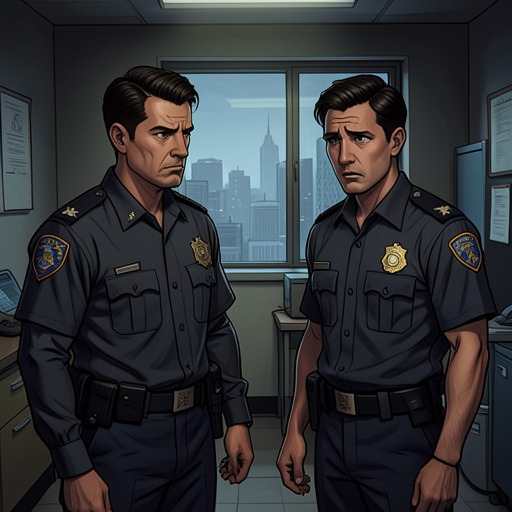
Night TrainMike Hoolihan–Colonel Tom is a relationship in which the habits of police work and the vulnerability of family feeling are difficult to separate. Colonel Tom is Mike’s colleague and a trusted authority whose knowledge of Mike makes deception especially hard; Mike, in turn, is close enough to Colonel Tom to take responsibility for telling him what happened to Jennifer Rockwell, yet cannot bring himself to deliver the account face to face. Their final phone exchange turns that contradiction into the relationship’s defining test: Mike lies to protect Colonel Tom, while Colonel Tom hears the strain beneath the lie and offers to come to him.
Professional Trust and Personal Knowledge
Mike’s expectation that Colonel Tom will recognize a lie shows how deeply their professional acquaintance has become personal. Mike anticipates the familiar demand to meet his eye, a gesture he compares to a parent correcting a child. The point is not merely that Colonel Tom is a perceptive police officer: Mike knows that, in his presence, the truth would be harder to disguise because Colonel Tom knows him well enough to detect evasion. That intimacy makes the phone an instrument of distance, not convenience. Mike chooses a voice-only conversation because he cannot withstand the scrutiny of a face-to-face meeting.
The trust also runs through their shared connection to Jennifer’s death. Mike believes that Jennifer knew her father would pursue the trail she left, and that she expected Mike to take part in the search. He imagines himself as the person she would count on, asking who else would do it if not him. His reference to Colonel Tom’s command of three thousand sworn officers places the investigation within the father’s professional world, but Mike’s assumed role in it is personal: he is not simply one more detective available to follow evidence. In his account, Jennifer anticipated the particular involvement of both her father and his colleague.
The Lie and Its Preparation
Mike arranges the conversation as a phone date with Colonel Tom because he cannot tell the story in person. At nine, he is alone at the kitchen table with a notebook, tape recorder, and computer; Tobe is away at a video-game tournament, and Mike expects to speak with Colonel Tom at ten. The practical details give the call the quality of a planned testimony. Mike intends to record it and transcribe it, preparing both a statement and a record of what he has said. Yet the equipment cannot make the account emotionally straightforward: he knows in advance that Colonel Tom would recognize the truth if he had to meet his eye.
The account Mike gives recasts Jennifer’s apparent crisis as a familiar pattern of drug use. He tells Colonel Tom that Jennifer was on a break, that no doctor was providing the substance she had been taking, and that she was obtaining it on the street. He insists that the pattern fits. The explanation is presented not as a discovery shared between colleagues but as a story Mike has decided to make stick. Its neatness is part of its purpose: it gives Colonel Tom a comprehensible account while concealing what Mike believes about the misleading clues Jennifer left and the uncertainty surrounding her death. The lie therefore draws on their professional language of patterns even as it turns that language away from the harder truth.
A Call That Cannot Be Slowed
Colonel Tom’s responses expose the emotional cost of Mike’s performance. He asks whether Mike is sure he wants to do it this way, then asks him to slow down. When Mike speaks of people presenting one life to the world while another reality gathers behind it, he describes a clear sky suddenly ringed by thunderheads. The image conveys the gulf between an outward account and what lies beyond it, even as Mike uses it to introduce his own constructed explanation. Colonel Tom does not simply accept the rapid conclusion: his requests to slow down register concern about Mike as much as uncertainty about the report.
When Colonel Tom asks what is happening with him, Mike retreats again into the claim that the pattern is obvious. Colonel Tom’s answer is to offer to come over. Mike refuses, says he will not be there, and insists that he is fine before admitting that he is upset. He then says the matter has been made and must be left that way, and apologizes. The exchange shifts from investigation to care: Colonel Tom proposes physical presence, while Mike maintains the distance that lets him finish the deception. His apology acknowledges the personal breach without undoing it.
The Relationship’s Defining Tension
The call brings together the two roles Colonel Tom occupies for Mike. As a police colleague, he is the person to whom an explanation of Jennifer’s death must be given; as a fatherlike figure, he is the person before whom Mike cannot comfortably lie. Mike’s choice to telephone rather than meet him preserves the account but also displays the intimacy it is meant to evade. His fear that Colonel Tom will read him accurately is evidence of their closeness, while the false explanation is evidence of the limit that closeness reaches under pressure.
The relationship is not resolved by the conversation. Colonel Tom offers to come, but Mike declines; he apologizes, but does not withdraw the account. The call instead leaves their bond suspended between trust and concealment. Mike tries to protect Colonel Tom by controlling what he hears, yet Colonel Tom’s attention remains fixed on Mike’s distress. In this final exchange, professional confidence cannot guarantee emotional honesty, and a father’s concern cannot force disclosure. The care survives the lie, but the lie prevents that care from becoming a face-to-face reckoning.