Mike invents an explanation for Jennifer's death to Colonel Tom
Night TrainMike Hoolihan’s false account to Colonel Tom is the moment her psychological autopsy turns into deliberate concealment. After hearing Jennifer Rockwell’s recorded farewell, Mike tells her father a fabricated explanation built from apparent clues about street drugs, trouble at work, and a flirtation; the narrative he offers is coherent precisely where the evidence remains uncertain. The call ends not with clarification but with Mike declaring the account finished and preparing to leave.
Preparation and the evidence behind the call
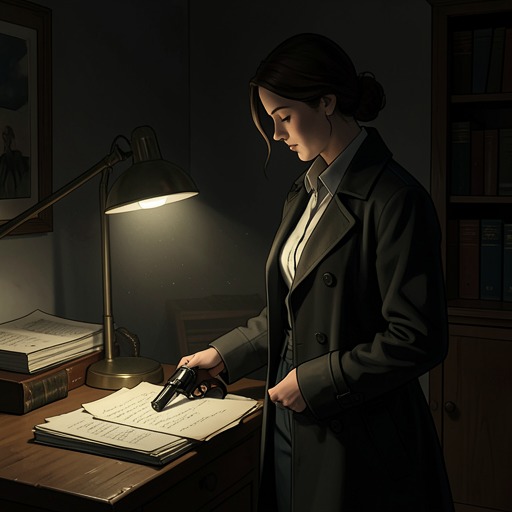
The scene belongs to Mike’s attempt to reconstruct Jennifer’s state of mind after her death. She calls that work a psychological autopsy, comparing her ballpoint, tape recorder, and computer with Paulie No’s clamp, electric saw, and knives in the medical examiner’s office. The comparison gives her method a forensic shape, but its object is not a body: it is the life and inner experience that the physical examination cannot recover. Mike insists to herself that she is trained to do the work, even as Jennifer’s imagined presence feels like an intruder trying to illuminate what she would rather not see.
After the funeral, Mike had begun a list headed Stressors and Precipitants. Its first entries ask whether Trader Faulkner, Jennifer’s significant other, had missed something, and whether money was a problem. The brisk heading promises an orderly assessment, but Mike admits that the material beneath it feels vague. That gap matters when she later speaks to Colonel Tom: the list records questions, not conclusions, while the phone call turns questions into a settled explanation.
Jennifer’s tape supplies information that complicates any simple account. She tells Trader that, about a year earlier, she began to feel that she was losing control of her thoughts and experiencing them as separate from herself. She had avoided going through Hi Tulkinghorn because she feared that he would tell her father, and had tried to manage the problem alone. While Trader believed she was at the Brogan on Mondays, she was instead visiting Rainbow Plaza, where GCG people took lunch on the lawn. She says she had been taking varying doses of Serzone, depecote, and tegretol since the previous May, but that the drugs had stopped helping. Her fear that she might do something unprecedented and inhuman, together with her repeated pleas to help her parents, gives Mike a record of private distress that does not resolve the cause of her death.
The call and its invented pattern
At ten o’clock, Mike sets out to record and transcribe what she will say. The brief exchange begins with Colonel Tom identifying the caller as Mike and asking whether she is sure she wants to do it this way. Mike answers by describing how people present one kind of life to the world while another reality gathers behind it: a clear sky can give way, on a second look, to surrounding thunderheads. Colonel Tom asks her to slow down. Her image of a sudden change in the weather prefigures the account she is about to construct, but it does not itself establish a cause.
Mike then presents Jennifer’s supposed drug supply as the explanation’s central fact. She tells Colonel Tom that Jennifer was on a break and that no doctor was giving her the substances she had been taking; she asserts that Jennifer was obtaining them on the street. When Colonel Tom interrupts, Mike raises her voice and presses on. She says that, for a year, Jennifer had been second-guessing her own mind, and attributes to Bax Denziger the report that Jennifer had begun to lose control at work and talk about death and staring at death. The call thus combines a detail Mike has heard from another person with claims about where Jennifer obtained medication and what her behavior meant. It presents them as parts of one explanation, although the evidence available to the reader does not establish that every part is true.
The story then adds a romantic explanation. Mike tells Colonel Tom that things were coming apart between Jennifer and Trader because she was sizing up another man. When he asks who, she reduces the supposed rival to an unnamed man met in a bar, perhaps no more than a flirtation. She tells Colonel Tom not to tell Trader and not to tell Miriam Rockwell, leaving the claim deliberately vague while still inviting him to treat it as meaningful. The answer supplies no verifiable identity or circumstance; its force comes from the suggestion that a hidden relationship helps complete the pattern.
Refusal, aftermath, and narrative significance
Mike labels the assembled account a classic pattern and insists that it adds up. Colonel Tom does not accept her momentum without alarm: he asks what is happening to her and says he is coming over. Mike refuses the visit, saying that she will not be there. After a pause in which she tells him she is fine and apologizes, she says the account is finished. Her apology registers the pressure of the exchange, but neither it nor Colonel Tom’s concern brings the two of them to a shared understanding of what happened to Jennifer.
The immediate aftermath makes the refusal concrete. Mike says she is heading for Battery and its long string of dives, and thinks of calling Trader to say goodbye. The phone rings again; the approaching night train becomes part of the scene’s imagery as Mike anticipates an angry man on the stairs and imagines what she will do if he blocks her way or speaks. The call to Colonel Tom has therefore not calmed the night or settled Mike’s own distress. She leaves behind a finished recording and a father who has not been given the truth as she knows it.
The action’s central reversal is that the investigator who has described her work as an autopsy of a life knowingly turns interpretation into fabrication. Mike has Jennifer’s recorded account of concealed symptoms, medication, and fear, but tells Colonel Tom a cleaner story that assigns causes and connections the record does not prove. Her instruction not to tell Miriam or Trader, paired with Jennifer’s recorded pleas to help her parents and her insistence that Trader could not have acted differently, makes the gap between the private tape and the public explanation especially stark. The scene does not disclose a definitive cause of Jennifer’s death; instead, it shows Mike choosing an account that sounds conclusive while the underlying evidence remains incomplete.