Mount Lee
Night TrainMount Lee is both a landmark in the landscape around CSU and the setting of the Institute of Physical Problems, where astrophysicist Jennifer Rockwell worked. Its approach—marked by campus roads, a long traffic delay, and low scientific buildings beneath an old observatory—makes the place a concrete part of Mike Hoolihan’s inquiry into Jennifer’s death. The mountain also frames a contrast between the image of astronomy as looking at the sky and the increasingly computer-mediated work described at the institute.
Setting and Approach
The Institute of Physical Problems lies well north of campus, in the foothills of Mount Lee, with an old observatory looming above it. The journey from CSU follows the MIE around the campus, skirting Lawnwood, before reaching the Sutton Bay tailback, where the narrator says a driver can be stuck for twenty minutes. The trip ends not at a monumental observatory but at a low array of wood-clad buildings reached on foot after parking.
That modest approach gives the scientific site an understated, somewhat unexpected character. Mike Hoolihan describes arriving with the expectation of encountering a forest ranger, a Boy Scout, or even a chipmunk; instead, the buildings lead into a working research department. The contrast sets the institute apart from the conventional image of a remote, imposing observatory without making it separate from the everyday geography of campus travel and traffic.
Jennifer Rockwell’s Workplace
Jennifer Rockwell worked in the Department of Terrestrial Magnetism, part of the Institute of Physical Problems at Mount Lee. Her position places her within a demanding scientific institution rather than in the police world of her father and brothers. Mike identifies her as an astrophysicist and, during the inquiry prompted by Colonel Tom and Miriam Rockwell, visits her department to ask about her working life.
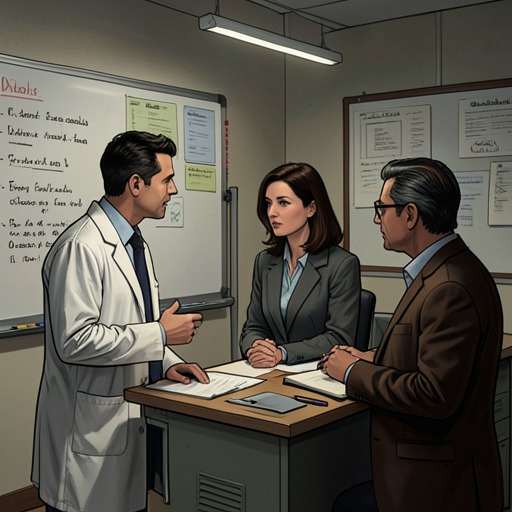
The department head, Bax Denziger, receives Mike in his office. The room makes a strong impression as a place where enormous quantities of information are available and readily summoned; Denziger offers coffee and agrees to Mike’s informal, off-the-record inquiry and request to use a tape recorder. Asked whether Jennifer had been happy in her work, he praises her as an inspiration to the department, emphasizing her esprit, persistence, fairness, and toughness. He says she had a reasonable chance of making a lasting contribution to cosmology.
The Meaning of Seeing
The entrance corridor displays a Latin inscription, which a passing student translates for Mike as the biblical phrase about becoming like gods and knowing good and evil. In the setting of a scientific institute, the words join knowledge to an older language of temptation and power. The passage does not establish that the institute endorses a particular interpretation; it records the inscription and the associations it prompts for Mike.
At Mount Lee, astronomy also appears as a discipline whose methods have changed. When Mike asks about “The seeing,” Denziger explains that the term refers to image quality and the clarity of the sky, but says astronomers no longer do much seeing in that older sense. Their work, he says, is now conducted through pixels, fiber optics, CCDs, and computers. The mountain’s observatory and its research department thus hold two modes of looking in view: direct attention to the sky and the technological systems through which its images are now handled.