Night Train image
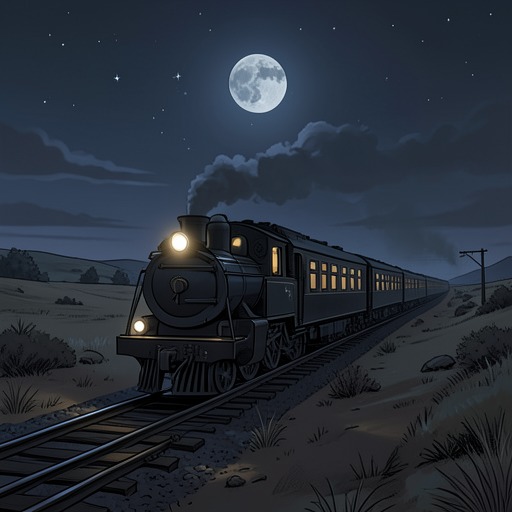
Night TrainThe Night Train image turns a recurring sound in Mike Hoolihan’s domestic life into a figure for suicide, lost time, and the limits of understanding. The passing night train is first a physical presence: it shakes the floor, interrupts sleep, and helps keep Mike’s rent low. As it recurs, that familiar disturbance becomes harder to separate from memory and uncertainty. By the time Mike is trying to understand Jennifer Rockwell’s death, the train has become both a metaphor for a one-way passage into darkness and a measure of time that has already passed.
A sound in the Sunday routine
On March 4, the image enters through an exact, ordinary circumstance. At 20:15, Mike is alone in the apartment, with a biography open beside the ashtray and no dinner started. Tobe is out of town at a computer convention. Mike has just been startled from a doze by the passing night train, which comes through early, as it always does on Sundays. The train’s significance is practical as well as sensory: it shakes the floor Mike walks on, but the inexpensive rent makes that disturbance worth enduring. From the start, the image holds material routine and bodily disruption together.
That opening establishes a recurring clock outside the home. Sunday is marked not by a calendar alone but by the train’s approach, its passage through the building, and the tremor it leaves behind. The sound is familiar enough to belong to the household’s ordinary rhythms, yet forceful enough to wake Mike. This double character allows later appearances to draw on a concrete sensation rather than introduce the train as an abstract symbol.
Presence, absence, and the building
The train returns alongside uncertainty about who is in Mike’s home. After explaining that Deniss had in fact been driving away with his belongings, Mike corrects the idea that she lived with him: she did live alone, not with Deniss. Then the approaching sound unsettles that account. Mike wonders whether Tobe is starting up the stairs or whether what the building hears is the first rumor of the night train. The building seems to recognize the train in the distance and brace itself for its desperate cry. Immediately afterward, Mike insists on the opposite of the earlier correction: she does not live alone; she lives with Tobe.
The sequence does not make the train a literal explanation for Mike’s uncertainty. Instead, the competing possibilities—Tobe returning or the train drawing near—place domestic presence and mechanical sound in the same field of expectation. The building’s imagined response extends that uncertainty beyond Mike: it too seems to listen and prepare. The image thus marks a point where a familiar sound can make the home feel both inhabited and solitary, without resolving the difference.
The train as a figure for suicide
On March 14, the image is repeated in a more deliberate form. After receiving a dozen red roses and a sealed, likely edited autopsy report from Colonel Tom, Mike sits down to read it. Before doing so, she tries to clear the previous night’s drinking haze with coffee, cigarettes, and a shower. Tobe’s tape plays softly: eight versions of the jazz standard Night train, including performances by Oscar Peterson, Georgie Fame, Mose Allison, and James Brown. Mike and Tobe think of the tape as a kind of hymn to the low rent. The practical joke of the image remains—the rent is scarcely noticed, while the train is unmistakable—but now the repeated musical versions accompany an attempt to make sense of a death.
The psychological autopsy gives the image its starkest meaning. Suicide is figured as boarding a train bound for darkness: the ticket costs everything, the journey is one-way, and the passenger is left in the night. This metaphor makes the train’s movement irreversible. It also connects the familiar passage through Mike’s neighborhood to a death that cannot be treated as an ordinary departure or recovered from by retracing the route. Mike describes Jennifer as present within her, searching with a flashlight for what Mike does not want to see. The train image therefore belongs not only to Jennifer’s death but to the painful work of looking at it.
The account also refuses to make the metaphor a complete explanation. Suicide is described as a mind-and-body problem that ends violently without a winner. The train gives the passage a forceful shape—a ticket, a journey, darkness—but does not disclose a single reason that would settle why it happened. Its symbolic clarity sits beside the acknowledged difficulty of understanding.
A clock that cannot restore what has passed
The train continues to punctuate Mike’s work after the report arrives. Woken around quarter to four, she cannot fall asleep again, so she gets up, makes coffee, and smokes over her notes. The familiar sound is now bound to wakefulness and the effort to assemble an account from what remains. Its recurrence does not bring an answer; it brings Mike back to the notes and to the questions the investigation has opened.
Later, at 3:25, Mike realizes that the previous day was Sunday and that the train must have passed hours earlier. The recognition arrives after the event it identifies: the train has already come and gone. The evening Jennifer died had clear skies and excellent visibility, yet Mike concludes that the seeing was no good. That contrast gives the recurring image its final interpretive weight. Physical visibility and the passage of time can be stated precisely, but neither guarantees understanding. The train makes time audible and measurable; its absence at the moment Mike notices the missed passage makes that measure belated. The Night Train image thus joins the book’s domestic routine to its investigation of death, while insisting that observation, even under a clear sky, may not be enough to see what matters.