Paulie No
Night TrainPaulie No, known in the investigation as the state cutter, examines Jennifer Rockwell’s body and reports findings that unsettle the apparent explanation of her death. His work first establishes the physical evidence and later helps expose a weakness in the accepted account of Jennifer’s medication. The narrative sets his procedure beside Mike Hoolihan’s attempt to reconstruct Jennifer’s state of mind: one investigates the body directly; the other must work from records, recollections, and uncertain clues.
Identity and Work
Paulie No is a state medical examiner who determines how people died by examining their bodies. Mike describes his role in plain terms: he cuts for the state. The work is routine for him, and his manner during Jennifer’s examination is brisk and professional. The procedural composure matters because the investigation’s emotional weight falls heavily on Mike, while No’s function is to inspect, test, and report.
No is not introduced as someone who can resolve every uncertainty in the case. His examination provides evidence, but evidence still has to be interpreted. The distinction becomes important as Mike tries to understand what Jennifer’s death means and whether the physical findings support the assumptions made by those around her.
The Examination of Jennifer Rockwell
Tony Silvera briefs No during Jennifer’s autopsy. No examines the gunshot wound, checks the body for marks and signs of struggle, and takes nail clippings for chemical testing intended to determine whether Jennifer fired the .22 revolver. The examination also includes tests and samples that can inform the account of how she died. Mike watches a recording of the procedure, taking notes and pausing the tape; he describes his purpose as bearing witness, even though the process itself is familiar to him from his earlier work in homicide investigations.
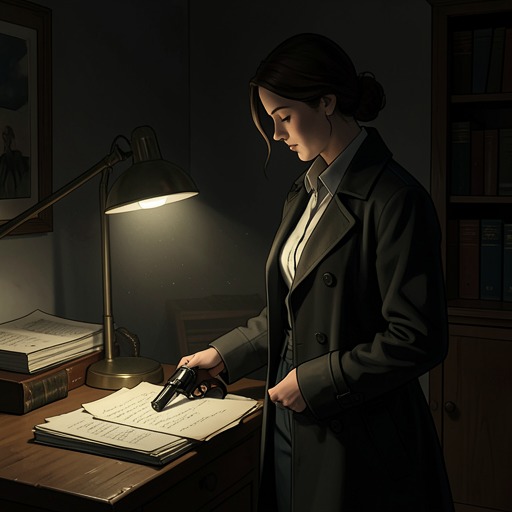
The autopsy’s physical procedures are presented through Mike’s unsettled perspective rather than as neutral technical inventory. As No proceeds, Mike is reminded of Colonel Tom, who bought Jennifer the gun and taught her to use it. The association makes the weapon evidence carry a personal history: the examination concerns not only a death, but also an object that came from her father. Mike’s thoughts turn to whether the case can be made to fit suspicions about Trader Faulkner, but he is unsure how much the details actually establish.
A striking finding emerges when No and Silvera react with surprise to what they see during the examination. The account concludes that Jennifer appears to have shot herself in the head three times. That finding complicates the case rather than closing it. Mike has begun by calling the case solved, yet he recognizes that the apparent solution opens further questions; No’s work supplies a consequential fact without making the surrounding uncertainties disappear.
A Physical Autopsy and a Psychological One
The novel later makes No’s examination a point of comparison for Mike’s effort to investigate Jennifer’s life. Mike calls that effort a psychological autopsy. His instruments are a ballpoint pen, a tape recorder, and a computer, rather than No’s surgical tools. Both procedures seek to reconstruct what happened from traces, but the difference is decisive: No examines a body, while Mike must assemble an account from documents, memories, and statements that can be incomplete or misleading.
Mike’s list of possible stressors, headed “Stressors and Precipitants,” begins with questions about Trader and money. The list shows the gap between a methodical intention and an uncertain result: its categories look definite, but the entries do not yet explain Jennifer’s death. Her recorded account adds important context. She says that for about a year she had felt she was losing control of her thoughts, had concealed her visits to a support group from her family, and had taken varying doses of stabilizing medication. She also says that the medications had stopped helping. These disclosures make the question of her treatment relevant to the physical evidence, without allowing Mike to claim certainty about her inner state.
The Toxicology Disclosure
At the Decoy Room in The Mallard Hotel, Mike arranges to meet No at six in the evening. Although Mike had said on the phone that he would buy the drinks, when No asks what he wants at the bar, Mike chooses seltzer. Their conversation turns to Jennifer’s autopsy and to a toxicology report that No had not seen. Mike tells him that Colonel Tom had the report suppressed. No’s response indicates that he had not known it existed.
Mike raises lithium as the central test of the report’s significance. No explains that sustained use would be expected to produce signs of renal damage and changes to the thyroid, potentially within a relatively short period. Asked whether Jennifer showed those signs, he rejects the assumption: her organs did not present the expected picture of prolonged lithium use. His conclusion undercuts the shared belief that she had been taking lithium. It does not, by itself, explain why the report was withheld or determine Jennifer’s full medication history, but it makes the suppression newly consequential.
Significance in the Investigation
No’s importance lies in the precision and limits of his contribution. His autopsy provides evidence about Jennifer’s death, and his later recollection challenges a belief that had shaped how several people understood her condition. Yet he does not supply a complete account of her motives, relationships, or final decisions. Those questions remain the work of Mike’s psychological autopsy, which is inherently less direct and more vulnerable to misreading.
The meeting also shows a change in the investigation’s handling of information. Mike asks No to treat their conversation as confidential, and No agrees. Their exchange gives Mike a fact that conflicts with the accepted lithium explanation, but it does not turn uncertainty into a definitive resolution. Paulie No is therefore both a source of forensic authority and a reminder that even a careful examination can narrow the possibilities without making the unknowable fully knowable.