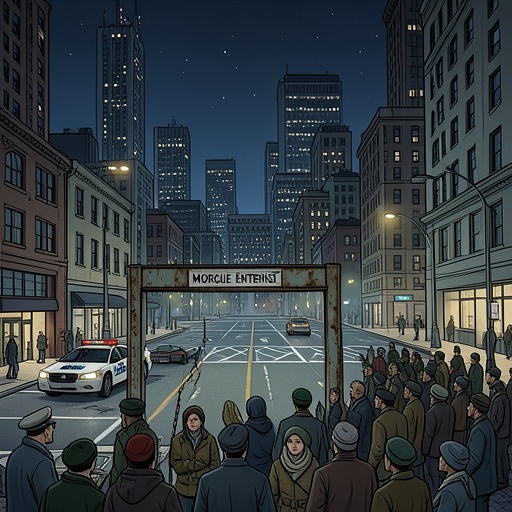
Taceant colloquia, effugiat risus; hic locus est ubi mors gaudet succurrere vitae
Night Train“Taceant colloquia, effugiat risus; hic locus est ubi mors gaudet succurrere vitae” is the inscription on the autopsy-room wall, framing forensic examination as a place where death can assist life. Its movement from commands for silence to a declaration about death gives the room both a solemn atmosphere and a stark professional purpose.
Wording and Meaning
The inscription is presented in two parts: “taceant colloquia, effugiat risus” and “HIC LOCUS EST UBI MORS GAUDET SUCCURRERE VITAE.” The accompanying translation is, “Let talking cease. Let laughter flee. This is the place where death delights to help the living.” The first clauses banish ordinary conversation and laughter; the final clause gives the place its governing paradox, making death—not merely a subject of study, but a means by which the living may be helped.
Placement and Use
The words appear on the wall where Jennifer Rockwell’s autopsy is about to begin. The surrounding account describes the routine for suspicious, violent, unusual, or unattended deaths: the body is brought to the Medical Examiner’s office, taken from the freezer, weighed, and placed on a zinc gurney beneath a camera. Against that concrete procedure, the inscription reads as more than a general meditation on mortality. It names the forensic room’s purpose: examination of the dead may provide information relevant to the living.
Narrative Significance
The motto joins ceremonial gravity to practical work. Its demand that speech and laughter fall away contrasts with the procedural details of weighing, photographing, and examining a body; the room is at once a place of death and an institution devoted to what can be learned from it. In the account of Jennifer’s autopsy, that promise carries personal weight: the process itself is familiar to the narrator, but Jennifer is not merely another body. The inscription therefore stands at the threshold between routine procedure and an individual loss, holding together the professional claim that death can help the living and the emotional fact that this particular death matters.