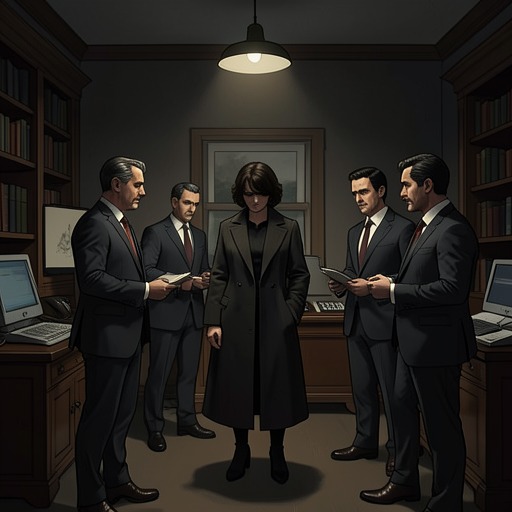
The city treats suicide as a crime
Night TrainThe city treats suicide as a crime, a rule that makes Jennifer Rockwell’s death both a legal offense and an inquiry into what punishment can mean after the person accused is dead. The investigation identifies her act on March 4 as criminal under the city’s jurisdiction, yet the coroner’s finding is Undetermined. In this gap between the city’s prohibition and the official classification, Jennifer escapes punishment and public disgrace; the case exposes how legal judgment persists even when it cannot proceed as an ordinary prosecution.
The Rule and Its Jurisdiction
At CID on March 16, investigators are no longer debating whether Jennifer committed a crime on the night of March 4. The narrator describes that conclusion as settled knowledge within the department. The city’s rule makes suicide an offense, but the narrator’s hypothetical comparison shows that its reach is local: had Jennifer driven a hundred miles south to the state line before dying, she might have died innocent. The contrast makes jurisdiction, rather than any change in the act itself, decisive to its legal meaning.
The case is described as a perfect crime in a particular, bitter sense. Jennifer has not escaped detection; the investigators know what she did. But death puts her beyond punishment. The narrator also distinguishes punishment from disgrace: the city’s criminal designation does not ultimately result in public condemnation of Jennifer. The crime is established within the investigation, while its usual consequences cannot be imposed on the person who committed it.
From Forfeiture to the Coroner
The narrator places the modern rule against a harsher legal past. Historically, the coroner’s office is described as an institution that taxed the dead, and suicides could lose everything they owned, like other felons. The account connects the classification of suicide to material consequences: the legal designation once carried the possibility of forfeiture, not merely a finding about how someone died.
In the present, the coroner works from the Chief Medical Examiner’s office. The change in institutional setting does not erase the legal force attached to the category. The contemporary finding can determine whether a death is treated as criminal, while the older history shows how that judgment once extended into the dead person’s property. The distinction between historical forfeiture and modern investigation marks a change in practice, but not a complete separation of death classification from law.
Jennifer’s Official Finding
Jeff Bright, the coroner and a friend of Tom Rockwell, returns a finding of Undetermined in Jennifer’s case. Colonel Tom initially presses for Accidental, but accepts Undetermined instead. The result is neither a ruling of accident nor a formal finding that fully resolves the circumstances; it leaves the official cause unsettled even as investigators consider the act itself known.
That division matters. The police can say Jennifer committed a crime under the city’s rule, yet the coroner’s finding does not affirm the accidental conclusion sought by her father. At the same time, Undetermined avoids a definitive official classification that would expose her to the public disgrace the narrator associates with the city’s treatment of suicide. The ruling therefore stands between competing pressures: the investigative certainty that the act occurred, the family’s wish for a different designation, and the limits of what the official record finally decides.
Statistics and the Limits of Explanation
The rule operates within a wider discussion of suicide that repeatedly tests general patterns against an individual death. Jennifer was twenty-eight, an age the narrator places on a relatively level stretch of a broad statistical curve before the increased risk associated with midlife. The figures do not explain her case; they instead underline how little an age-based pattern can say about one person’s death.
The narrator also notes that many people who die by suicide have attempted it before or given warning, while Jennifer had not attempted it before and, as far as the narrator knew, had given no warning. A further observation is that suicide is strongly affected by access to means: Jennifer owned a gun. The notes stress that the available statistics about suicide notes vary widely and that notes may be removed by loved ones. Although Jennifer apparently left none, the narrator suspects that she wrote one. These uncertainties complicate any effort to turn the criminal category into a complete account of her actions or state of mind.
Gender and occupation provide other statistical contrasts, not a verdict on an individual. Against Tony Silvera’s claim that suicide is more characteristic of women, the narrator distinguishes women’s higher rate of attempts from men’s higher rate of completed suicides, and identifies Mother’s Day as a striking exception in the pattern for men. Speaking with Hi Tulkinghorn, the narrator also considers elevated suicide rates among mental-health professionals and other occupations, and wonders whether exposure to suffering, access to means, or the loss of professional power might be relevant. Such questions widen the social context without establishing Jennifer’s motive.
Investigation Without a Final Moral Verdict
After the funeral, the narrator organizes possible causes under the heading Stressors and Precipitants. The list includes Trader Faulkner and the possibility that he had missed something, along with questions about money and mental health. Later, the narrator crosses out the proposed mental-health explanations, including psychological, organic, and metaphysical possibilities. The exercise does not reveal a hidden cause; it makes visible how the search for an explanation can end with its categories emptied out.
The narrator refuses to treat the legal word crime as a sufficient moral judgment. Remembering Jennifer’s earlier kindness while the narrator was recovering at the Rockwells’ home, the account presents her as someone who had also endured fear and distress, not as a person reducible to the offense investigated by CID. The city’s rule supplies a legal category, and the coroner supplies an official finding, but neither resolves why Jennifer died. The rule’s significance lies partly in that mismatch: the act can be named a crime, while its motive, its full circumstances, and the appropriate judgment remain beyond the reach of the case.