This is the body
Night Train“This is the body” is the phrase through which Jennifer Rockwell’s forensic examination becomes more than procedure: it is a record of evidence, an act of witness, and a point of departure for thinking about the people bound to her. Repeated around the autopsy and revisited in Mike Hoolihan’s later reflections, it shifts from a formal description of a body to an acknowledgement of its history and effects.
Forensic Description and Repetition
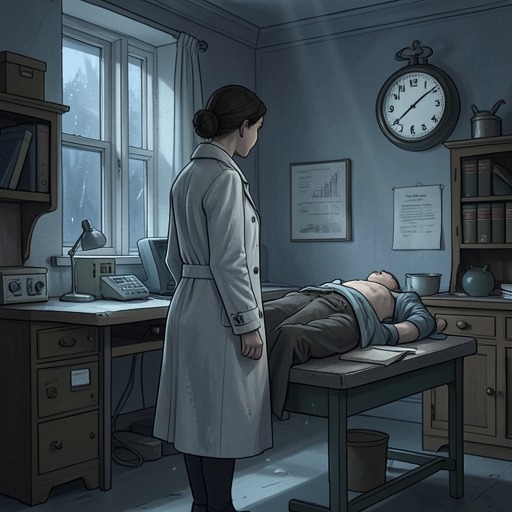
During the autopsy, Mike watches a recording rather than treating the examination as an unfamiliar professional ritual. The work is ordinarily close to her experience: she explains that she had encountered autopsies routinely while working in homicide and still dealt with bodies in her later assignment. This one matters for a different reason. Jennifer matters to her, and watching the tape becomes a deliberate act of bearing witness.
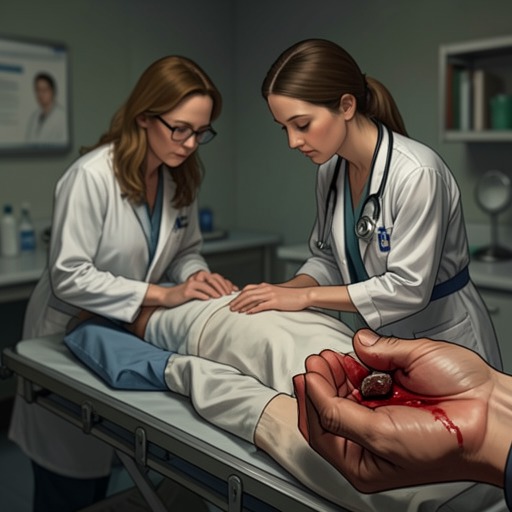
The examination’s language is impersonal and measured. Tony Silvera briefs the pathologist, Paulie No, whose formal description identifies Jennifer as a well-nourished adult woman, five feet ten inches tall and approximately 140 pounds. The repeated phrase introduces a body made legible through clinical particulars. Later, Mike gives Jennifer’s weight as 141 pounds while again recording her height. The small discrepancy remains in the account; the phrase gathers the measurements without making them stand for the whole person.
The examination also proceeds through specific tests and observations. Paulie No checks for signs relevant to the investigation, including whether Jennifer fired the .22. This question carries a personal history: Colonel Tom had bought her the gun years earlier and taught her to use it. The autopsy therefore joins a forensic question to a fact about their father-daughter relationship, without making that relationship an explanation for her death.
From Procedure to Witness
Mike’s attention to the recording is active rather than detached. She sits on the couch, smokes, takes notes, and pauses the tape. The description of the autopsy room as a kitchen before service contrasts routine procedure with the attention she gives this particular examination. She does not claim that the process itself has great meaning for her; her reason for staying with it is Jennifer.
When the phrase returns in the later account of the findings, it organizes observations that bear on whether Jennifer’s body was moved or arranged and on the conclusion that she died by suicide. The language is still grounded in examination, but its function has changed: it is now Mike’s way of addressing Jennifer directly through the record. That return gives the finding a human context while keeping the basis of the conclusion in the evidence rather than in speculation about motive.
The repetition also holds two registers together. One is the examiner’s controlled inventory; the other is Mike’s recognition that the person being described was her friend. The phrase does not erase the clinical account or replace it with an emotional explanation. Instead, it makes the account’s boundary perceptible: observations can establish facts about the body and support a conclusion, while not resolving the larger question of why Jennifer died.
A Body in Relationships
In a later reflection, Mike understands the body through the lives and actions connected to Jennifer. She recalls that it was the body Miriam Rockwell bore, Colonel Tom protected, Trader Faulkner loved, Hi Tulkinghorn cared for, and Paulie No examined. Each relation supplies a different kind of history. The body is not merely the object of the investigation; it is the point at which family, intimacy, care, and forensic work meet.
This widening of meaning also changes the force of the phrase. At the autopsy it introduces a description of Jennifer as a subject of examination. In Mike’s reflection it insists that the examined body is the same body that lived among people and was shaped by their ties to her. The list does not claim that these relationships disclose a single cause for the suicide. It instead resists reducing Jennifer to the final event or to the measurements entered in the record.
The Body’s Return
Mike’s insight comes amid an ordinary search through kitchen cupboards for Sweet ’N’ Low, when she notices the liquor bottles Tobe drinks. The sight prompts her to think of her own liver and of the body as something with an inside as well as an outside. That thought extends the phrase beyond the autopsy: the body is not only what can be inspected but also a material presence that responds to what is done to it.
The expression thus links the investigation of Jennifer’s death to Mike’s bodily awareness, including her recognition of alcohol’s place in her own life. Its recurrence does not solve the unknowable parts of the case. Rather, it gives the book a firm point from which to hold together physical evidence, personal attachment, and the continuing consequences bodies bear. The phrase’s significance lies in that movement—from the formal statement of what is before the examiner to the recognition of a life that cannot be contained by the examination.